
How AI Improves Client Retention in Home Care
Healthcare Technology
Updated Apr 10, 2026
AI improves home care retention with predictive analytics, caregiver matching, automated intake, chatbots, and smarter scheduling.
AI is transforming how home care agencies retain clients by addressing common challenges like caregiver turnover, inconsistent service quality, and poor communication. Here's how AI makes a difference:
Predictive Analytics: Identifies clients at risk of leaving by analyzing feedback, engagement patterns, and service data, helping agencies act before issues escalate.
Caregiver Matching: Matches clients with caregivers based on skills, personality, and preferences, improving compatibility and reducing turnover.
Automated Intake: Speeds up onboarding by reducing documentation time, ensuring faster responses to inquiries, and creating a smoother first impression.
Improved Communication: AI chatbots and sentiment analysis tools enhance client interaction by offering 24/7 support and detecting dissatisfaction early.
Scheduling Automation: Reduces scheduling conflicts and administrative workloads, ensuring consistent, reliable care delivery.
These tools not only streamline operations but also strengthen trust and relationships with clients, helping agencies improve retention while maintaining high-quality care.
How To Leverage AI with ChatGPT In Home Care
Client Retention Challenges in Home Care
Home care agencies face a variety of hurdles when it comes to keeping their clients satisfied and loyal. One of the biggest issues is inconsistent care quality. If caregivers lack the skills or compassion needed to meet client expectations, even a single mistake can shatter the trust families place in the agency’s ability to provide dependable care [1].
Another pressing problem is caregiver instability. High turnover rates mean clients are often greeted by new and unfamiliar faces, which disrupts the continuity of care. This constant change makes it hard to form stable, trusting relationships. On top of that, clients are left repeating their preferences and needs over and over, which can lead to frustration and a loss of confidence in the agency.
Communication breakdowns also play a big role in client dissatisfaction. When agencies fail to provide timely updates, offer clear information, or coordinate effectively between caregivers and families, misunderstandings are almost inevitable. Families may feel left in the dark about their loved one’s care. Operational missteps, like scheduling errors or billing mistakes, only add to the frustration. These kinds of errors can create financial uncertainty and push families to look for a more reliable provider.
The financial impact of losing clients is significant. Retaining current clients is far less expensive than bringing in new ones. But it’s not just about the money - reputation is on the line too. Word-of-mouth is critical in this industry, and agencies that struggle with care continuity often find it harder to attract new clients, no matter how much they spend on marketing. When families feel their loved ones are treated impersonally or that their specific needs are overlooked, they’re much more likely to leave [1].
These challenges create a tough cycle: poor retention leads to lost revenue and a damaged reputation, which makes it even harder for agencies to grow. However, this is where AI tools can make a real difference. Predictive analytics and automated communication systems offer promising solutions to improve care quality, enhance communication, and strengthen client relationships. By addressing these pain points, agencies can start turning the tide on retention challenges.
Using Predictive Analytics to Identify At-Risk Clients
Predictive analytics helps agencies spot potential problems before they escalate by analyzing client data for early warning signs. This approach gives agencies the chance to step in, address issues, and strengthen client relationships. Let’s break down how this technology works and how you can incorporate it into your processes.
How Predictive Analytics Works
AI-powered algorithms analyze a variety of data sources to identify clients who might be at risk of leaving. They look at client feedback, shifts in service requests, and changes in engagement patterns. Tools like Natural Language Processing (NLP) even scan communications for subtle signs of dissatisfaction before they develop into larger issues [1].
"Predictive analytics identify early warning signs of dissatisfaction by analyzing client feedback, health data, and engagement trends." - CareVoyant [1]
The system also monitors behavioral changes that may indicate dissatisfaction. For example, if a client who normally responds quickly to check-in calls suddenly becomes unresponsive, or if medication adherence drops, those changes are flagged as potential concerns [3]. By studying historical data from past client departures, the AI learns to recognize patterns, improving its predictions over time [1].
Adding Predictive Analytics to Your Workflows
Integrating predictive analytics into your daily operations can take client engagement to the next level. To make the most of this tool, it’s crucial to focus on data quality and timely notifications.
Start by centralizing all client-related information - demographics, care history, service notes, and customer service records - into a single system. Establish clear data governance practices to maintain accuracy. This includes standardizing how staff record notes, ensuring dates are formatted consistently, and eliminating duplicate entries [4]. Clean, well-organized data leads to more reliable predictions, while messy data can create unnecessary false alarms.
Once your data is in order, connect predictive analytics tools to your existing CRM or Agency Management System. This ensures care coordinators receive real-time alerts when a client shows signs of dissatisfaction [4][2]. The aim isn’t to replace human expertise but to complement it - AI identifies which clients need attention, and your team can step in to address their concerns directly [1]. By combining technology with personal interaction, you create a stronger approach to client retention.
Automating Client Intake for Better First Impressions
Automating the client intake process can transform the way agencies make their first impression. While predictive analytics help identify at-risk clients, automation ensures that the very start of a client’s journey is smooth and frustration-free. A clunky or slow intake process can turn potential clients away before care even begins. By leveraging AI-driven automation, agencies can eliminate tedious administrative tasks and create a better experience from the start.
Simplifying the Onboarding Process
AI receptionists and virtual agents can handle much of the heavy lifting during onboarding. They automatically collect demographic details and intake information, updating systems like CRM and EHR without requiring manual input. Real-time insurance verification is another game-changer, confirming coverage instantly and avoiding the need for lengthy callbacks.
These systems maintain consistent data collection by asking every client the same tailored questions. This ensures accuracy and creates a reliable data set that can later be used to match clients with the right care. By syncing data across platforms like Salesforce, automation prevents duplicate entries and maintains a single source of truth. Tools like Lead Receipt even provide 24/7 AI receptionists, so no inquiry goes unanswered - no matter the time of day. These streamlined processes make it easier to convert inquiries into actual clients.
Improving Inquiry-to-Client Conversion Rates
First impressions are critical, and speed plays a huge role in capturing potential clients. If a prospect has to wait two days for a callback, chances are they’ll move on to another agency. AI-powered intake systems respond instantly, gathering information when interest is at its peak. This immediate engagement keeps momentum alive throughout the sales pipeline.
The benefits go beyond just speed. Automation can reduce administrative workloads by up to 30% [1]. This saved time allows staff to focus on more meaningful tasks, like building relationships with clients and caregivers. To maximize these benefits, agencies should ensure their systems have API compatibility for seamless integration with existing tools [1].
Improving Client Communication with AI Solutions
Keeping communication consistent is essential for maintaining client engagement and trust, especially in care settings. Good communication helps address retention challenges, and AI has become a crucial tool for strengthening client relationships. When families feel informed and valued, they’re more likely to stay with an agency for the long haul. AI-powered tools make it possible to deliver personalized, instant support tailored to each client’s needs, all while reducing the workload on staff. Combined with efficient intake processes, these tools ensure ongoing engagement and quick resolution of issues.
Using AI-Powered Chatbots and Assistants
AI chatbots and virtual assistants provide immediate answers to routine questions, offering support 24/7. Whether it’s inquiries about medication schedules, caregiver arrival times, or billing, these tools improve accessibility and build confidence in the service provided [1].
What makes these systems stand out is their ability to deliver intelligent, context-aware responses. When paired with Customer Relationship Management (CRM) systems and Electronic Health Records (EHR), they can pull up past conversations and medical histories automatically, saving clients from having to repeat themselves. Additionally, many modern AI tools support over 32 languages, allowing seamless communication in a client’s preferred language. This multilingual capability ensures inclusivity and strengthens client relationships.
For example, Lead Receipt offers AI receptionists that manage calls and web chats 24/7, ensuring no inquiry is missed. Their Professional plan supports up to 100 AI calls per day in 5 languages, while the Enterprise plan offers unlimited calls with fully customizable language options. Such automation has reduced staff-handled calls by 52% in some healthcare settings, freeing teams to focus on providing direct care.
Using Sentiment Analysis for Proactive Engagement
While chatbots handle straightforward tasks, sentiment analysis takes client communication to another level by addressing emotional needs. AI doesn’t just interpret what clients say - it evaluates how they say it. By analyzing tone and speech patterns, these systems can detect signs of frustration or anxiety. When negative emotions are identified, the system can escalate the issue to a senior specialist, ensuring concerns are resolved quickly and preventing small issues from becoming larger problems.
This approach has shown impressive results. For instance, AI-driven call routing based on sentiment data has increased customer satisfaction by 30% in some organizations. By connecting clients with the right support based on emotional cues, agencies can address concerns more effectively and build stronger bonds. The goal is to strike a balance - using AI to enhance communication while preserving the human connection that’s so central to quality care.
Improving Caregiver-Client Matching with AI
Finding the right caregiver isn’t just about availability or qualifications - it’s about creating meaningful, supportive, and lasting connections. AI is changing the game by analyzing dozens of compatibility factors that go beyond what manual scheduling can handle. Instead of relying on gut feelings or basic spreadsheets, agencies now have access to data-driven insights that make better pairings possible. These insights integrate seamlessly with the automated processes we’ve already discussed.
Matching Clients and Caregivers for Long-Term Success
AI matching systems use a weighted scoring formula to evaluate potential pairings, considering much more than just qualifications. Here's how the algorithm typically breaks down: 25% skills match, 20% availability, 20% distance, 15% past performance, 10% client preferences, and 10% personality fit [5].
This approach allows the system to handle complex requests with ease. For example, if a scheduler needs "someone for Mrs. Chen on Tuesday who speaks Mandarin", the AI can identify the best match within seconds - saving up to 15–20 minutes per match [5]. The system also learns from historical data, continuously improving its recommendations.
What sets this apart is the depth of data analyzed. Modern AI systems consider "soft" factors like communication styles, energy levels, hobbies, and even preferences for work environments, such as comfort with pets or smokers [7]. This shifts the process from a basic availability check to a comprehensive analysis of long-term compatibility. Scott Zielski, CEO of Aaniie, captures this well:
Matching the right caregiver with the right client is essential for delivering exceptional, person-centered home care. By focusing on high compatibility, agencies can create deeply meaningful connections [7].
Reducing Turnover Through Better Compatibility
When caregivers’ skills and personalities align with clients’ needs, it leads to better retention and less burnout [7]. This kind of matching not only improves daily operations but also strengthens client trust, a key factor in retention. Clients benefit from consistent care, which fosters emotional connections and reduces feelings of isolation. On the flip side, frequent caregiver turnover can leave clients feeling unsettled or undervalued, often prompting them to switch agencies [1].
The financial benefits are clear, too. For instance, improving caregiver retention by just 5% can save an agency with 50 caregivers around $3,840 annually in turnover costs [5]. Beyond the savings, AI-powered matching can build schedules 90% faster than manual methods, giving coordinators more time to focus on building relationships instead of juggling administrative tasks [5]. As AlayaCare highlights:
AI isn't meant to replace schedulers - it's designed to complement their existing skills and remove friction from workflows [5].
To make the most of this technology, agencies should start by streamlining their data - updating caregiver certifications, calendars, and client profiles. From there, AI-assisted recommendations can refine scheduling and reduce turnover [5]. Starting with recommendations rather than full automation allows schedulers to provide feedback, building trust in the system. Tracking baseline metrics like time to fill a callout and current turnover rates can help measure the system’s impact as it evolves [5].
Simplifying Operations with AI-Powered Scheduling and Workflow Automation
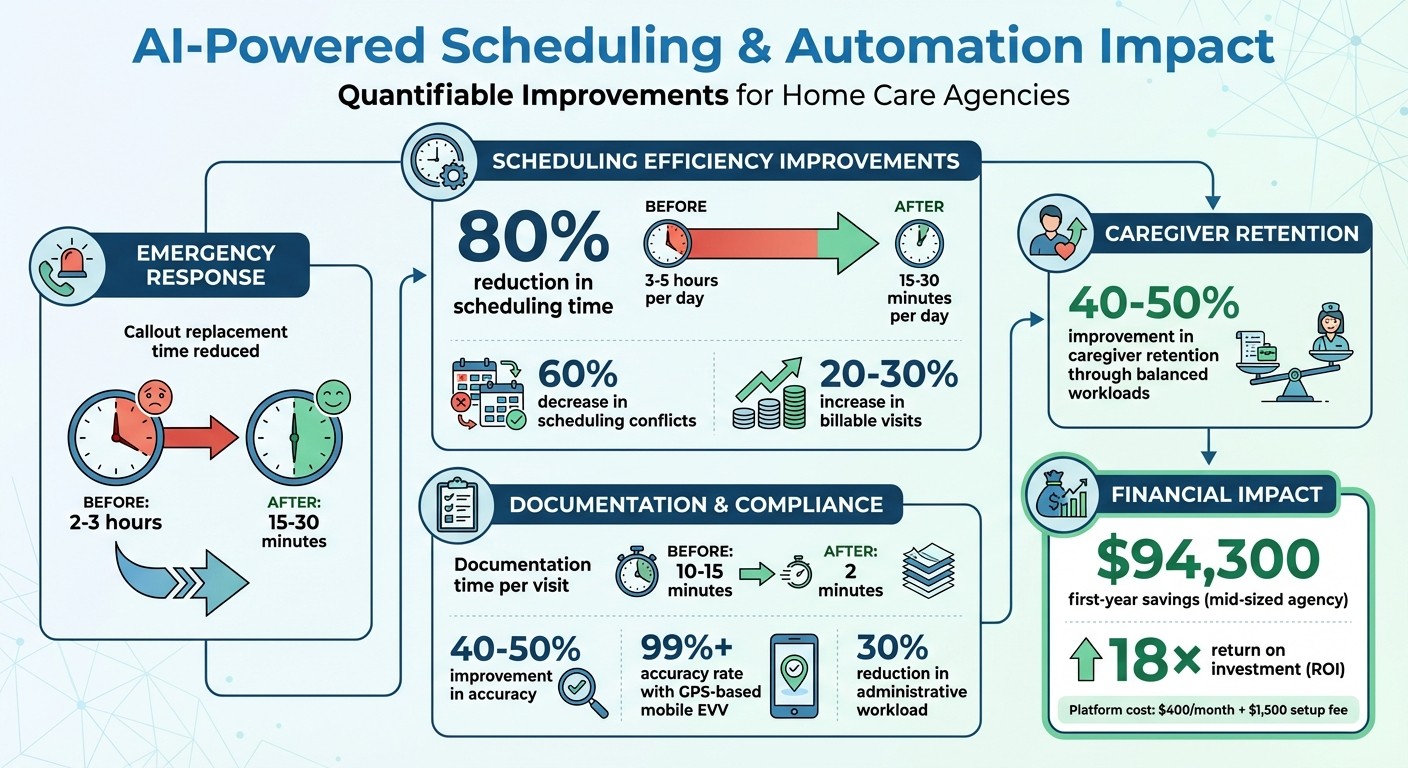
AI Impact on Home Care Operations: Key Performance Metrics
Scheduling conflicts and administrative overload don’t just create headaches for staff - they can directly impact the care clients receive. When coordinators spend hours manually managing caregiver assignments, the result is often inconsistent service for clients and burnout for caregivers. AI-powered scheduling and workflow automation tackle these issues by handling repetitive tasks, improving efficiency, and ensuring smoother operations. Let’s dive into how AI is reshaping scheduling processes.
Improving Scheduling Efficiency
AI-driven scheduling systems can slash scheduling time by up to 80%, cutting the process from 3–5 hours to just 15–30 minutes per day [8]. These systems instantly match caregivers to clients based on factors like skills, certifications, location, and availability. By clustering appointments, they also reduce travel time, which helps lower mileage costs and lessens the physical toll on caregivers [8].
When unexpected absences occur, such as a caregiver calling out sick, AI steps in to identify replacements and send notifications automatically - reducing response times from 2–3 hours to just 15–30 minutes [8]. This quick turnaround is vital because delays can lead to missed visits, which erode client trust. Agencies using AI have reported a 60% drop in scheduling conflicts and a 20–30% increase in billable visits due to better resource utilization [8]. Additionally, by balancing workloads to avoid caregiver burnout, these systems have improved caregiver retention by 40–50% [8]. When caregivers aren’t overwhelmed by chaotic schedules or excessive travel, they’re better equipped to deliver consistent care - key to maintaining client satisfaction and loyalty [1][6].
But AI doesn’t stop at scheduling - it also simplifies essential administrative tasks.
Automating Documentation and Compliance Tracking
Manual documentation typically takes 10–15 minutes per visit, but AI tools can reduce this to just 2 minutes while improving accuracy by 40–50% [8]. This increased precision means fewer billing errors and ensures compliance, which is critical for earning the trust of families.
GPS-based mobile EVV (Electronic Visit Verification) further streamlines clock-in and clock-out processes. Instead of spending 15 minutes per visit on paperwork, caregivers now spend about 2 minutes, achieving accuracy rates of over 99% [8]. This automation lightens administrative workloads by up to 30%, allowing staff to focus more on direct patient care rather than time-consuming documentation [1]. Accurate records not only reduce costs but also foster trust by eliminating billing uncertainties for families [1].
The financial benefits speak for themselves. A mid-sized agency can expect to see around $94,300 in first-year savings - an 18× return on investment - after factoring in platform costs of $400 per month and a one-time setup fee of about $1,500 [8]. These efficiencies create a strong foundation for reliable service delivery, improving caregiver retention while keeping clients satisfied.
For home care agencies ready to embrace these advantages, Lead Receipt offers AI-powered scheduling and workflow automation tools that integrate seamlessly with current systems, ensuring smoother operations and consistently high-quality care.
Conclusion
AI offers a practical way to tackle the client retention challenges faced by home care agencies today. With predictive analytics, agencies can spot early warning signs of dissatisfaction by analyzing feedback trends and service usage patterns [1]. This not only helps monitor client sentiment but also streamlines care processes for better operational efficiency.
Through AI-powered caregiver matching, agencies can pair caregivers and clients based on skills, personality traits, and preferences, fostering stronger connections and reducing turnover [1]. On top of that, workflow automation can cut administrative workloads by up to 30%, freeing up staff to focus on providing compassionate and personalized care [1]. Embracing these AI tools ensures agencies stay competitive while maintaining the essential human touch.
For a tailored solution, consider Lead Receipt's AI-powered receptionist and automation tools designed for healthcare providers. With 24/7 call management, workflow automation, and seamless CRM integration, these tools help agencies scale efficiently while preserving the personal care that keeps clients coming back. By adopting these AI-driven strategies, home care agencies can boost retention and deliver even better care.
FAQs
What data is needed for AI to predict at-risk clients?
AI relies on data gathered during intake conversations to pinpoint clients who may be at risk. This data typically includes details such as care requirements, preferred schedules, family contact information, health history, and location-specific needs. By summarizing and organizing this information automatically, AI tools help home care agencies stay on top of client needs and respond more efficiently.
How do we integrate AI tools with our current CRM and scheduling system?
Integrating AI tools with your CRM and scheduling system means incorporating AI solutions that work effortlessly with the platforms you already use. For example, Lead Receipt provides custom AI receptionists and automation tools that can handle tasks like logging client details, managing calls, and automatically updating schedules.
Additionally, their consulting services are designed to align AI workflows with your specific systems. This ensures a seamless setup, streamlining client intake, communication, and scheduling processes for maximum efficiency.
How do we use AI without losing the human touch in home care?
AI has the potential to transform home care by taking over time-consuming tasks such as intake processes, scheduling, and creating call summaries. This means caregivers can spend more time focusing on meaningful, one-on-one interactions with clients. Beyond that, AI can process and analyze data to help create care plans that are more tailored to each individual’s needs, while also enhancing communication between caregivers and clients.
However, to preserve the essential human connection, agencies should approach AI as a tool that supports caregivers rather than replaces them. By using AI to complement caregiver efforts, agencies can build stronger relationships, foster trust, and ensure clients feel genuinely cared for.