Ultimate Guide to HIPAA-Compliant AI for ABA Therapy
Healthcare Technology
Updated Apr 12, 2026
Steps to select, secure, and implement HIPAA-compliant AI in ABA therapy—encryption, BAAs, access controls, and staff training.
In ABA therapy, AI can simplify complex tasks like documentation, scheduling, and compliance monitoring. But when sensitive patient data is involved, HIPAA compliance is non-negotiable. Here's what you need to know:
HIPAA Compliance Requirements: AI tools must safeguard Protected Health Information (PHI) with administrative, physical, and technical safeguards, including encryption, access controls, and audit logging.
Key AI Features: Look for role-based permissions, end-to-end encryption (AES-256), and secure data storage on U.S.-based servers.
Business Associate Agreements (BAAs): Ensure every AI vendor signs a BAA prohibiting the use of your data for training global models.
Staff Training: Educate your team on HIPAA rules and AI usage, and establish clear policies to prevent the use of unapproved tools.
Challenges: Address risks like data privacy concerns, high costs, and vendor reliance with isolated environments, scalable automation, and regular audits.
HIPAA-compliant AI tools can save time, improve efficiency, and enhance patient care - if implemented correctly. Follow these steps to integrate AI safely into your practice.
From Amazon to Autism Care: AI Powered Tools for ABA and Diagnostics: Frontera Series on AI with...
HIPAA Requirements for ABA Therapy Providers
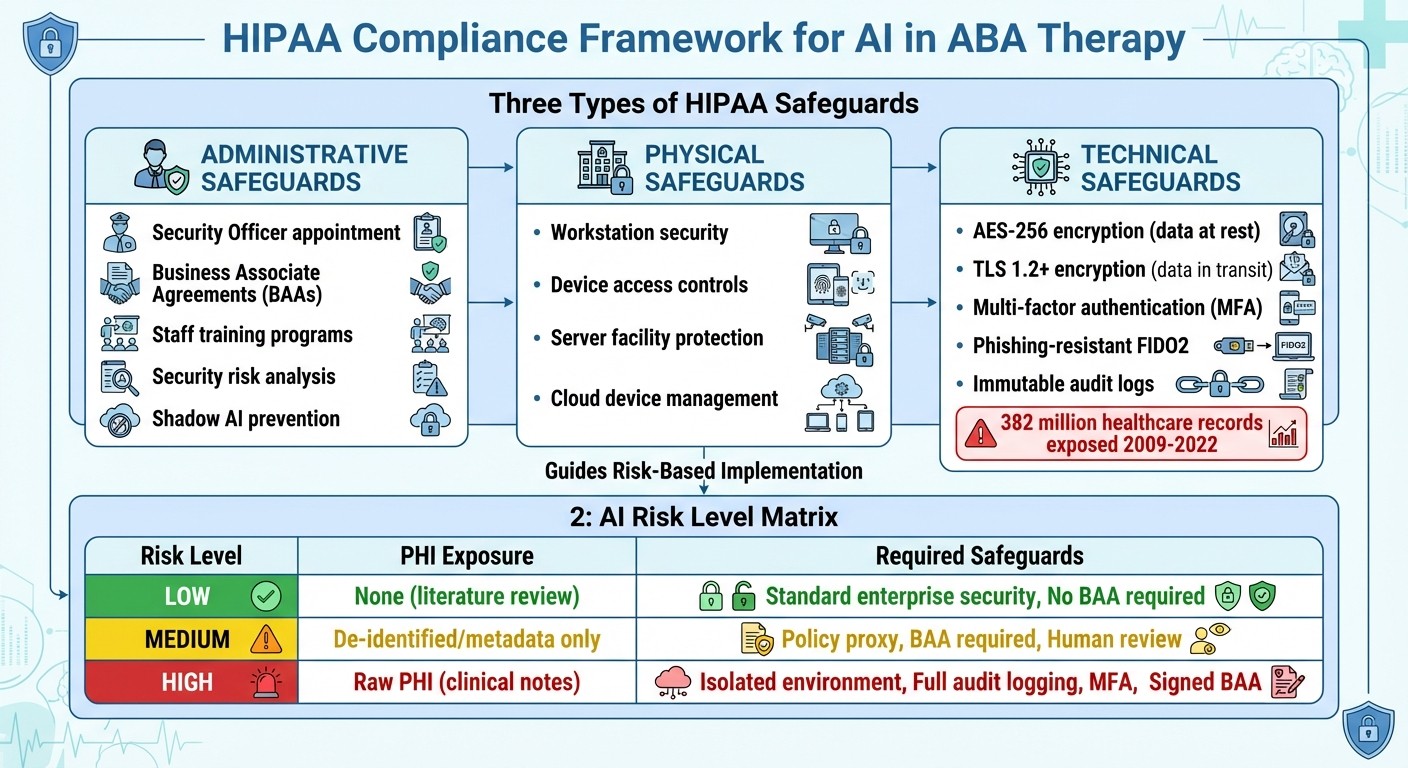
HIPAA Safeguards and Risk Levels for AI in ABA Therapy
HIPAA regulations are non-negotiable when it comes to safeguarding client data, whether it’s stored in physical files or processed using AI tools. These rules apply to every piece of client information your practice handles. When AI tools are part of the equation, HIPAA compliance becomes even more essential to protect all forms of Protected Health Information (PHI). Let’s break down what qualifies as PHI in ABA therapy and how to safeguard it.
What Counts as PHI in ABA Therapy
In ABA therapy, PHI goes far beyond just a client’s name or diagnosis. A session note, for instance, can include a wide variety of PHI elements, such as:
Client Identifiers: Name, date of birth, address, and contact details.
Clinical Data: ICD-10 codes, behavior targets, and skill programs.
Session Metadata: Details like session date, time, location, duration, and supervising BCBA credentials.
Caregiver Information: Names and contact details of parents or guardians, along with their relationship to the client.
Behavior Descriptions: Notes that might reference third parties like siblings or teachers.
Billing Information: Payer names, policy numbers, authorization numbers, and CPT codes.
When working with AI tools, adhering to the Minimum Necessary standard is crucial. This means sharing only the data required to complete a specific task. Understanding the scope of PHI is the first step toward implementing the three core HIPAA safeguards.
3 Types of HIPAA Safeguards: Administrative, Physical, and Technical
HIPAA’s safeguards are divided into three categories, all of which must be followed when using AI in your practice. Here’s how each applies:
Administrative Safeguards: These involve creating and enforcing policies and procedures. Examples include appointing a Security Officer, signing Business Associate Agreements (BAAs) with AI vendors, and training staff to avoid risks like "Shadow AI" (when employees use unauthorized tools for work). AI systems should also be part of your organization’s formal security risk analysis to identify vulnerabilities like prompt injection or data leakage through model memorization.
Physical Safeguards: These focus on protecting the physical devices and facilities where data is processed. This includes securing workstations used for AI applications and implementing access controls for any servers handling electronic PHI (ePHI). Even if your AI vendor operates in the cloud, you’re still responsible for controlling physical access to devices that connect to those systems.
Technical Safeguards: This is where things get more intricate with AI. You’ll need AES-256 encryption for data at rest and TLS 1.2 or higher for data in transit. Multi-factor authentication (MFA) is a must for systems accessing PHI, with phishing-resistant options like FIDO2 being the gold standard. Additionally, audit logs need to be immutable and should capture user identity, access details, timestamps, source IPs, the purpose of access, and the outcome of each attempt. With over 382 million healthcare records exposed in data breaches between 2009 and 2022, these technical measures are absolutely essential [1].
Required Features in HIPAA-Compliant AI Tools for ABA Therapy
HIPAA-compliant AI tools need to have specific features that safeguard client data throughout its lifecycle - from the moment it’s entered into the system to when it’s archived or deleted. Here’s what to prioritize.
Access Controls and Role-Based Permissions
Role-Based Access Control (RBAC) is a must-have for securing AI systems. It ensures that data access is strictly limited based on job roles. For instance, a Registered Behavior Technician (RBT) might only access session notes and behavior targets for their assigned clients. In contrast, a Board Certified Behavior Analyst (BCBA) could view broader treatment plans. Meanwhile, administrative staff handling billing would only access insurance details and authorization numbers.
"Access is strictly role-based, ensuring only authorized personnel can interact with sensitive information." - Ernesto Prieto, Co-founder, ABA Matrix [5]
To strengthen access controls, use phishing-resistant Multi-Factor Authentication (MFA) protocols like FIDO2 or WebAuthn instead of SMS-based codes. For high-risk actions, implement step-up MFA. Also, enforce session timeouts - 5 minutes on shared workstations and 15 minutes on secure devices - to reduce unauthorized access risks.
Adopt workflows for joiner-mover-leaver scenarios. This automates access adjustments when an employee changes roles or leaves the organization, preventing outdated permissions from lingering. Integration with your HR system can streamline this process, reducing risks like "permission creep."
Risk Level | PHI Exposure | Required Access Safeguards |
|---|---|---|
Low | None (e.g., literature review) | Standard enterprise security; no BAA required |
Medium | De-identified or metadata only | Policy proxy; BAA required; human review |
High | Raw PHI (e.g., clinical notes) | Isolated environment; full audit logging; MFA; signed BAA |
While access controls are critical, they’re just one layer of protection. Encryption and secure storage are equally important.
End-to-End Encryption and Secure Data Storage
HIPAA technical safeguards emphasize the importance of data encryption. For stored data, Advanced Encryption Standard (AES) 256-bit encryption is the gold standard. For data in transit, use TLS 1.2 or higher, with TLS 1.3 preferred for added security. Following these standards means encrypted data may not be considered a breach under HIPAA [4].
Ensure your AI vendor stores data exclusively on servers located in the U.S. Using servers in foreign jurisdictions can create legal and compliance challenges [2]. Although not explicitly required by HIPAA, a SOC 2 Type II certification can provide independent assurance that the vendor’s encryption and storage practices are effective [2].
Audit Trails and Business Associate Agreements (BAAs)
Effective security frameworks also rely on detailed audit trails and well-defined BAAs. Every interaction with Protected Health Information (PHI) should be logged in a tamper-proof system. These logs must capture the "6 W's": who accessed the data, what action was taken, when it happened, where it occurred (including IP address and device), why access was needed, and the outcome. Storing these logs in Write-Once-Read-Many (WORM) systems ensures they cannot be altered or deleted, even by administrators.
Before sharing PHI with any AI vendor, secure a signed Business Associate Agreement (BAA). This legal document should explicitly prohibit the vendor from using your patient data to train or improve their global AI models. It should also cover any subcontractors or cloud processors they rely on.
Finally, AI workflows should prioritize data minimization. Strip or redact identifiers as early as possible, ensuring that the AI only processes the minimum data necessary to perform its task. This aligns with HIPAA’s "minimum necessary" standard and reinforces compliance across your practice.
How to Implement HIPAA-Compliant AI in Your ABA Therapy Practice
To successfully incorporate AI into your ABA therapy practice while adhering to HIPAA regulations, you'll need to focus on selecting the right tools, integrating them effectively, and maintaining ongoing compliance.
How to Choose Verified HIPAA-Compliant AI Tools
Start by requesting a compliance packet from each vendor. This should include:
A signed Business Associate Agreement (BAA) explicitly prohibiting the use of your patient data for training global AI models.
SOC 2 Type II or HITRUST certification reports.
A complete list of subprocessors.
Summaries of recent penetration tests.
To ensure your vendor's reliability, check the HHS Office for Civil Rights Breach Portal for any reported incidents involving breaches affecting 500 or more individuals. Also, confirm their encryption standards meet HIPAA requirements. For ABA-specific tools, prioritize those supporting healthcare protocols like HL7 FHIR and offering secure APIs to integrate with EHR systems such as CentralReach or Theralytics.
Create a checklist to guide your evaluation process. Include criteria like:
BAA availability.
Encryption standards.
Uptime SLA (aim for over 99.9%).
ABA-specific features (e.g., session note generation, behavior tracking).
Additionally, ask about data residency - vendors should store data on U.S.-based servers to avoid jurisdictional issues. For example, Lead Receipt offers HIPAA-compliant AI receptionists with custom BAAs and secure scheduling integrations, ensuring PHI is protected during call handling and intake processes [6].
Connecting AI Tools with Your Current Systems and Workflows
After verifying a vendor’s compliance, focus on integrating their AI tools into your existing systems. Start by mapping how PHI flows between the AI tools and your current setup. Identify where data is entered, stored, and transferred, and ensure all connections use secure APIs with OAuth 2.0 authentication.
Begin with sandbox testing to ensure data flows correctly and securely. Roll out the tool in a controlled pilot phase, targeting a small group of clients and assigning role-based permissions. Automate repetitive tasks, like appointment reminders, while ensuring PHI-heavy tasks are routed through secure channels. Monitor performance using KPIs such as integration uptime and data accuracy (aim for over 99%). Always maintain a rollback plan in case any issues arise [7].
Implement a Human-in-the-Loop (HITL) process where clinicians review and approve AI-generated outputs - such as treatment plans or behavior suggestions - before they are added to patient records. This step ensures clinical accuracy and compliance with HIPAA’s "minimum necessary" rule.
Training Staff and Monitoring Compliance
Prepare your team with a 2-hour onboarding module covering AI functionality and PHI handling, including how to report incidents. Use interactive simulations to make the training practical, such as scenarios where AI generates behavior plans. Track training completion through your LMS and schedule quarterly refreshers alongside phishing simulations.
Take advantage of resources offered by vendors. For instance, Lead Receipt provides consulting services to tailor training for their AI receptionists, emphasizing HIPAA’s minimum necessary rule [6][8]. Designate Security and Privacy Officers to manage vendor relationships and oversee policy updates. Form an AI Governance Council with representatives from clinical, IT, and compliance teams to evaluate and approve new AI use cases based on risk assessments.
Automate compliance monitoring by setting up dashboards to review audit trails, access logs, and data exports. Look for anomalies such as unusual login patterns and set alerts for potential breaches. Conduct monthly internal audits and annual third-party penetration tests. Ensure systems automatically log out after 5–15 minutes of inactivity to reduce the risk of unauthorized access in clinical settings.
Benefits and Challenges of AI in ABA Therapy
Building on the HIPAA safeguards outlined earlier, AI introduces both opportunities and hurdles in ABA therapy. Let’s explore how it reshapes operations while addressing its challenges.
Benefits of AI in ABA Therapy
AI drastically reduces documentation time. By using natural language processing (NLP), it can process hundreds of session notes in seconds. For mid-sized clinics, this can mean saving up to 75 hours weekly - a significant boost to efficiency [1].
Streamlined operations are another advantage. AI can manage repetitive tasks like scheduling appointments, verifying insurance, and handling patient communication. For instance, services like Lead Receipt offer HIPAA-compliant AI receptionists that handle calls, integrate scheduling, and protect patient health information (PHI), freeing up clinical staff to focus on patient care.
Compliance monitoring also becomes more reliable. Automated systems generate tamper-proof audit logs for every interaction involving PHI. These logs are invaluable during audits, as they document over 40 PHI elements - even in complex notes - ensuring nothing is overlooked [1].
While these benefits are substantial, they come with challenges that require careful navigation.
Challenges and How to Address Them
Data privacy concerns are a significant issue, especially given the detailed behavioral narratives in ABA therapy. Large language models may inadvertently retain PHI or fall victim to prompt injection attacks. To mitigate this, clinics should use isolated, single-tenant environments with strict input/output filtering. Additionally, ensure your Business Associate Agreement (BAA) explicitly prohibits vendors from using PHI to train their global models.
Shadow AI poses compliance risks when staff use unapproved, consumer-grade tools. This can lead to non-compliance with HIPAA. To address this, establish clear processes for requesting new tools and provide staff with approved, HIPAA-compliant options. The Office for Civil Rights (OCR) now uses automated systems to flag providers with inconsistent compliance practices [[9]](https://ebcba.abaimpact.com/blog/hippa future is now).
High implementation costs for enterprise-grade AI systems can be a barrier. To offset this, focus on automating repetitive tasks like redaction and scheduling, which can deliver a quicker return on investment. Vendor reliance is another challenge, as security updates often depend on third-party providers. Regularly conduct third-party audits (e.g., SOC 2, HITRUST) and maintain a Plan of Action and Milestones (POAM) to ensure ongoing compliance.
When large datasets are required, which could conflict with the "minimum necessary" data standard, integrate a Human-in-the-Loop (HITL) review. This ensures that only essential data informs clinical decisions.
Comparison Table: Benefits vs. Challenges
Here’s a snapshot of how AI’s advantages align with its challenges and the solutions to address them:
Benefit of AI in ABA | Challenge of AI in ABA | Practical Solution |
|---|---|---|
Faster Documentation: Automated session notes and reports | Data Privacy Risks: Potential PHI leaks via model memorization or attacks | Use isolated, single-tenant environments and input/output filtering |
Enhanced Compliance Tracking: Automated audit logs and real-time threat detection | Shadow AI: Staff using unapproved tools without BAAs | Create formal request channels and offer HIPAA-compliant alternatives |
Improved Patient Insights: AI analyzes behavioral trends and skill progression | Implementation Costs: High initial investment for secure AI systems | Prioritize scalable automation for tasks like redaction and scheduling to see faster ROI |
Accurate Redaction: AI reliably identifies PHI in narrative text | Vendor Dependence: Reliance on third-party updates for security | Perform regular audits (SOC 2, HITRUST) and maintain a POAM for compliance tracking |
Conclusion and Key Takeaways
Summary of HIPAA Compliance and AI Benefits
This guide highlights the importance of integrating HIPAA-compliant AI into ABA therapy practices. Beyond being a regulatory requirement, it’s a smart move for safeguarding patient privacy and enhancing care. HIPAA compliance involves administrative, physical, and technical safeguards that protect PHI (Protected Health Information) at every stage. To meet these standards, AI tools must include features like end-to-end encryption, role-based access controls, and comprehensive audit logging. However, compliance isn’t just about picking the right tools - it requires organizational commitment. This includes training your staff and setting up Business Associate Agreements (BAAs) with every vendor handling PHI. Remember, vendors can’t "provide" compliance - it’s your responsibility to enforce it.
With these basics in mind, let’s look at actionable steps to strengthen your ABA therapy practice.
Next Steps for ABA Therapy Providers
Assess Your Current AI Risk Level
Evaluate how your practice handles PHI. If you're working with raw PHI, you’ll need robust safeguards like isolated environments, multi-factor authentication (MFA), full audit logs, and signed BAAs. For de-identified data or metadata, medium-level protections combined with human oversight may be enough.
Choose the Right Tools
Use enterprise-grade APIs that come with explicit BAAs and enforce zero data retention policies. Avoid consumer-facing AI tools, as they are typically not designed to meet HIPAA requirements
[4].
Leverage De-Identification Tools
Consider using NLP (Natural Language Processing) tools to remove identifiers from clinical text before processing. This reduces risk while maintaining compliance.
Centralize Compliance Management
Managed AI gateways can simplify compliance by consolidating controls across multiple AI models. This eliminates the complexity of managing numerous individual systems simultaneously
[4].
Automate Patient Communication Safely
For practices looking to streamline communication, services like Lead Receipt offer HIPAA-compliant AI-powered receptionists. Plans start at $300/month for 24/7 web chat, while professional plans at $750/month include voice and chat support in five languages. Larger agencies can explore enterprise solutions with unlimited integrations and dedicated consultants - all with signed BAAs included
[3].
FAQs
When does an AI tool become a HIPAA Business Associate?
When an AI tool handles protected health information (PHI) for a healthcare provider or covered entity, it takes on the role of a HIPAA Business Associate. To meet HIPAA requirements, a Business Associate Agreement (BAA) must be established. This agreement ensures the AI tool follows all necessary privacy and security standards.
How can we use AI without exposing PHI in prompts or outputs?
To integrate AI into healthcare or ABA therapy while avoiding exposure of Protected Health Information (PHI), it's crucial to de-identify or redact sensitive data before feeding it into AI systems. Employ technical measures such as encryption, role-based access controls, and audit logging to reinforce data security. Additionally, operating AI within controlled environments under strict governance frameworks minimizes risks and ensures compliance with HIPAA regulations, keeping PHI secure during AI use.
What’s the safest way to pilot HIPAA-compliant AI before rolling it out clinic-wide?
To navigate HIPAA-compliant AI safely, it’s crucial to follow a structured, step-by-step testing process that prioritizes data security and compliance. Begin with a small-scale pilot in a secure environment. This environment should include encryption, multi-factor authentication, and audit trails to protect sensitive information.
Make sure to verify vendor compliance by securing Business Associate Agreements (BAAs) and conducting thorough risk assessments. Additionally, ensure your staff is well-trained on HIPAA regulations to prevent accidental violations. Only consider expanding the AI system clinic-wide once you’ve confirmed that all safeguards and policies are functioning as intended.