AI Call Handling for Home Care Agencies
Healthcare Technology
Updated Apr 13, 2026
AI call systems give home care agencies 24/7 intake, faster scheduling, HIPAA-secure records, and major staffing cost reductions.
AI call handling systems are transforming how home care agencies manage their operations. Here's why they stand out:
24/7 Availability: Unlike human staff limited to office hours, AI systems ensure no call goes unanswered, even during nights or weekends.
Cost Savings: AI reduces the need for additional staff, saving agencies thousands monthly. For instance, the Professional plan costs $750/month, compared to the $3,000/month salary of a single intake coordinator.
Efficiency: AI tools handle multiple calls simultaneously, reducing delays and capturing leads instantly. They also automate tasks like scheduling, data entry, and follow-ups.
HIPAA Compliance: These systems meet strict healthcare data regulations with features like encryption and audit trails.
While traditional methods rely on personal interaction, they often lead to missed calls, errors, and higher costs. AI systems address these challenges but still require human oversight for nuanced situations. Ultimately, agencies must balance efficiency with a personal touch to improve client experiences and streamline operations.
I Built an AI Receptionist for a Healthcare Practice
How AI Call Handling Changes Home Care Operations
AI-powered call systems bring a new level of accessibility to home care operations by providing 24/7 coverage, far beyond the limits of traditional office hours. While human staff are typically available during a 9-to-5 workweek, AI receptionists ensure no call goes unanswered - day or night. This eliminates the frustration of voicemail for potential clients and ensures agencies capture every lead, creating a more efficient and responsive operation [1][2].
The benefits don't stop at availability. These systems can handle unlimited simultaneous calls, ensuring every family gets immediate attention, even during peak hours like a morning rush or after a hospital discharge [2]. Instead of callers being placed on hold or leaving messages, they receive instant responses. For agencies that previously had to hire extra coordinators - costing upwards of $3,000 per month each [2] - this shift offers both significant savings and improved service.
A great example of this technology is Lead Receipt, a platform tailored for healthcare settings, including home care agencies. It manages tasks like new client intakes, support inquiries, and scheduling with ease [1]. Its Professional plan supports multilingual communication in five languages, ensuring language barriers don’t become missed opportunities [1][2]. Additionally, it meets strict HIPAA compliance standards, combining secure data handling with operational efficiency.
AI systems also deliver measurable cost savings by reducing administrative workloads. For instance, instead of staff spending 15–30 minutes per call taking notes, AI systems automatically sync call summaries, detect intent, and update lead data directly into CRMs like Salesforce [1][3]. This streamlined process frees staff to focus on patient care. Lead Receipt’s Professional plan, priced at $750 per month, includes up to 100 AI-handled calls per day with HIPAA Business Associate Agreement coverage. For larger agencies, the Enterprise plan offers unlimited calls and features like zero-retention modes for added security [1].
The result? A smooth, error-free intake process that not only saves time but also allows staff to prioritize what matters most - caring for patients [2].
1. Traditional Call Management
Lead Intake and Routing
Home care agencies operating under traditional models often face a major challenge: limited availability. With most agencies sticking to standard 9-to-5 hours, they miss out on connecting with families who research care options after their own workday. Missed calls can mean lost clients, as highlighted by DialMind:
Families calling for care don't leave voicemails - they call your competitor.[2]
And by the time the agency opens the next morning:
By 9am, they've already called three other agencies.[2]
Even when calls are answered, the manual intake process can bog things down. Staff often rely on handwritten notes, which can result in incomplete or inaccurate records about a client's needs, location, or urgency[2]. Plus, staff can only handle one call at a time. During busy periods, additional callers are sent to voicemail - a problem particularly pronounced in larger providers, where around 50% of calls transferred to local branches go unanswered. Each missed call isn't just a lost opportunity - it represents a potential $15,000+ annual revenue loss per client[2].
These inefficiencies don’t stop with call routing; they spill over into scheduling, creating further delays.
Scheduling Efficiency
Manual scheduling processes create additional hurdles for home care agencies. For example, pre-admission and scheduling can take as long as 20 minutes per patient, with consultations often delayed by up to three days. During that waiting period, families frequently turn to agencies that respond faster.
The statistics paint a clear picture: the average hold time in U.S. medical call centers is 4.4 minutes, but 60% of callers hang up if they wait longer than one minute. On top of that, manual scheduling systems contribute to no-show rates as high as 25%, wasting valuable clinician time and reducing revenue.
These delays frustrate families and hurt the agency’s bottom line. But the financial strain doesn’t end there.
Cost-Effectiveness
Traditional intake coordination is expensive. A single intake coordinator typically costs over $3,000 per month for a standard 40-hour workweek[2]. This only covers weekday business hours, leaving evenings, weekends, and holidays unattended. Extending coverage means hiring additional staff, which drives up costs. Beyond salaries, agencies must also account for the expenses of hiring, training, benefits, and turnover, all of which add to the financial burden.
In short, the traditional approach to call management and scheduling is not only inefficient but also costly, leaving agencies struggling to keep up with client demand while managing their operational expenses.
2. AI-Powered Call Handling (e.g., Lead Receipt)
Lead Intake and Routing
AI tools are transforming how calls are managed by identifying callers and their needs instantly. When a call comes in, the system determines if it’s a new family looking for care, a caregiver applying for a position, or an existing client with a question. From there, it directs the caller to the right destination - whether that’s scheduling consultations for new leads, connecting caregivers to the scheduler, or linking current clients to their care coordinator [3].
By detecting intent, these systems eliminate manual delays and ensure calls are routed efficiently. They also assign a lead quality score, which helps prioritize inquiries based on urgency and potential value. This means agencies can focus on high-priority leads without wasting time.
Scheduling Efficiency
Once calls are routed, AI systems take it a step further by managing scheduling tasks in real time. They can book consultations during the initial call and send out confirmation texts and appointment reminders automatically. This reduces the likelihood of no-shows and keeps operations running smoothly. Plus, with 24/7 availability, families can schedule consultations at any hour, offering unmatched convenience.
HIPAA Compliance and Data Security
AI platforms are designed with healthcare regulations in mind, ensuring data security and compliance. They maintain tamper-proof audit trails, logging every action for easy access to HIPAA-compliant records. This level of security provides peace of mind for both agencies and clients.
Cost-Effectiveness
The financial benefits of AI-powered call handling are clear. Unlike manual systems that require extensive staffing, AI reduces overhead while improving efficiency. For example, the Starter plan costs $300 per month and includes 24/7 web-chat coverage. The Professional plan, priced at $750 per month, handles up to 100 AI calls daily and supports voice and chat in five languages [1]. For larger needs, the Enterprise plan offers unlimited calls and full automation with custom pricing [1]. These options help agencies cut costs related to hiring, training, and employee benefits while delivering round-the-clock service.
Advantages and Disadvantages
Traditional vs AI-Powered Call Handling for Home Care Agencies Comparison
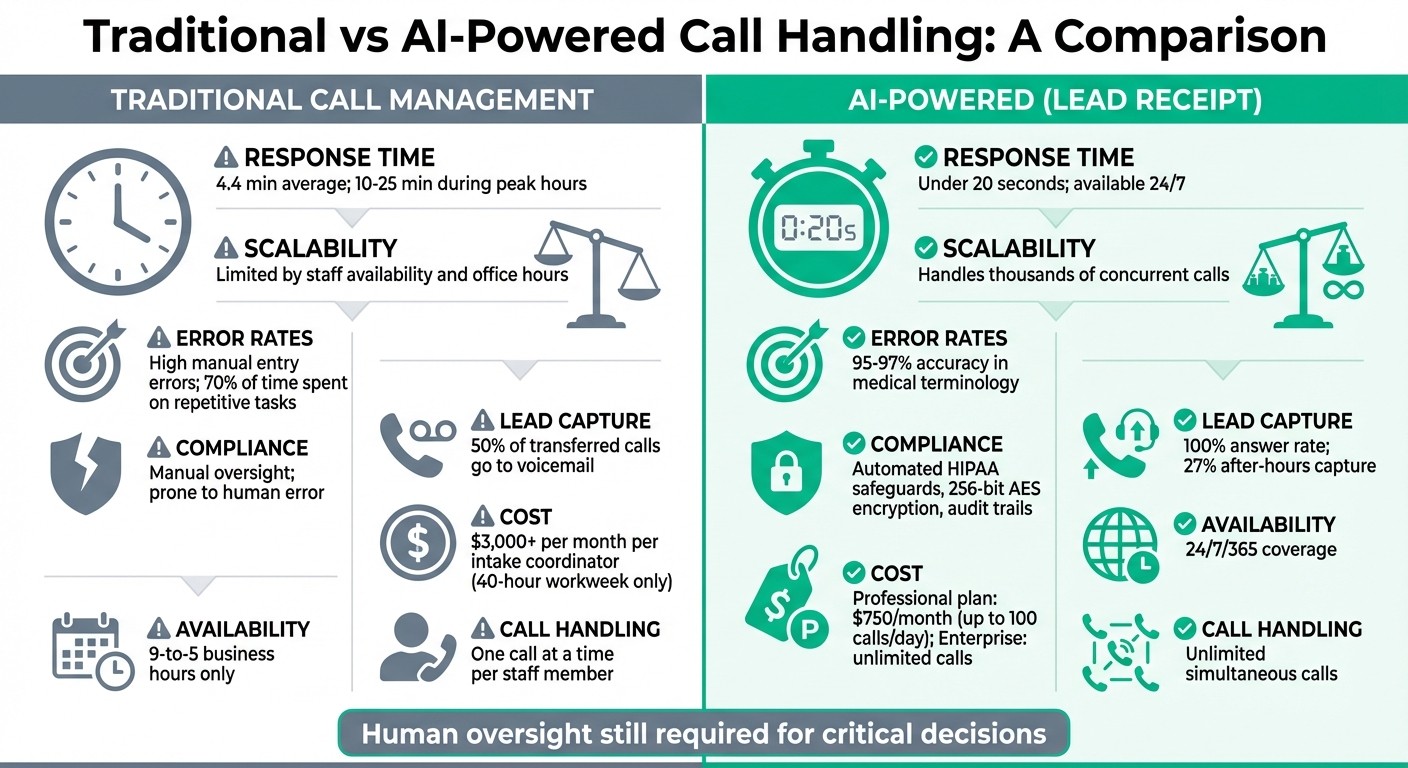
Let’s break down the strengths and weaknesses of traditional and AI-powered call management systems, building on earlier insights into lead intake, scheduling, and compliance. Each approach offers distinct benefits, but neither is without its challenges.
Traditional systems rely on human interaction, which many families appreciate - especially during sensitive discussions about care. This personal touch can make a big difference when empathy and understanding are key. However, traditional methods are constrained by staff availability, office hours, and the potential for human error. Issues like long hold times and missed calls, as mentioned earlier, are common drawbacks.
On the other hand, AI-powered solutions, such as Lead Receipt, tackle these limitations head-on. They deliver responses in under 20 seconds, operate 24/7, and can manage thousands of calls simultaneously. With a medical terminology accuracy rate of 95–97%, these systems significantly reduce manual errors. Additionally, automated compliance features like HIPAA safeguards, 256-bit AES encryption, and detailed audit trails ensure data security and regulatory adherence.
That said, AI systems come with their own hurdles. They require an upfront investment and careful integration into existing workflows. As the Sage Care Editorial Team points out:
AI intake tools are not a replacement for human judgment. AI generates drafts. Coordinators review, edit, and approve everything.
This highlights a key point: while AI excels at streamlining repetitive tasks, human oversight is still necessary for critical decisions and nuanced situations. Balancing these systems can directly influence lead management, scheduling efficiency, and compliance success - key pillars for any home care agency.
Here’s a side-by-side comparison to clarify the differences:
Feature | Traditional Call Management | AI-Powered (Lead Receipt) |
|---|---|---|
Response Time | 4.4 min average; 10–25 min during peak hours | Under 20 seconds; available 24/7 |
Scalability | Limited by staff availability and office hours | Handles thousands of concurrent calls |
Error Rates | High manual entry errors; 70% of time spent on repetitive tasks | 95–97% accuracy in medical terminology |
Compliance | Manual oversight; prone to human error | Automated HIPAA safeguards, 256-bit AES encryption, audit trails |
Lead Capture | 50% of transferred calls go to voicemail | 100% answer rate; 27% after-hours capture |
Each system has its place, but the choice ultimately depends on your agency’s priorities - whether that’s maintaining a personal touch or maximizing efficiency and scalability.
Conclusion
Home care agencies often face a choice: sticking with traditional call handling, which can lead to missed leads, extended hold times, and manual errors, or embracing AI systems that provide round-the-clock availability and streamline operations. It's important to note that AI doesn't replace staff - it takes over repetitive tasks, allowing employees to focus on delivering exceptional patient care.
When considering AI adoption, pricing transparency is a great starting point. For example, Lead Receipt offers a Professional plan at $750 per month, handling up to 100 calls daily with HIPAA-compliant 256-bit AES encryption. For larger agencies, the Enterprise plan provides unlimited call handling with custom pricing options. They even offer a 30-day trial, so you can test real intake calls and see how it fits into your workflow. This pricing structure highlights the focus on efficiency and compliance, aligning with the operational improvements discussed earlier.
Another key factor is system integration. The AI solution should work effortlessly with your current systems, eliminating the need for manual data input. Features like built-in VoIP and automated call logging ensure smooth communication and remove potential bottlenecks. This kind of integration not only simplifies processes but also helps redefine staff roles by reducing administrative burdens.
To tackle issues like burnout from manual scheduling and documentation, it's essential to get your team on board. Position AI as a tool that supports them by handling tedious tasks while still requiring their oversight for critical decisions. This balance maintains the personal touch families value while leveraging AI to improve lead management, streamline scheduling, and ensure compliance.
Over time, adopting AI for call handling can reshape daily operations, enhancing both efficiency and the quality of care provided.
FAQs
How does AI decide where to route each call?
AI call handling systems rely on technologies such as natural language processing (NLP), sentiment analysis, and predictive analytics to manage calls effectively. These systems analyze a caller's words, tone, and intent in real-time, helping to prioritize and direct calls with precision. By identifying key phrases or gauging urgency, AI ensures that calls reach the appropriate person or department. Additionally, these systems integrate with tools like scheduling software and CRM platforms to provide smooth, HIPAA-compliant call management.
Can AI book a consult during the first call?
Yes, AI can set up a consultation during the initial call by taking care of lead intake, scheduling appointments, and generating call summaries. This simplifies the process, allowing for fast and efficient appointment booking while cutting down on manual tasks.
What makes AI call handling HIPAA-compliant?
AI call handling systems meet HIPAA compliance by implementing robust security measures. These include encrypting patient data both during storage and transmission, enforcing strict access controls such as multi-factor authentication and role-based permissions, and maintaining secure, tamper-proof audit trails. Additionally, compliance requires partnering with vendors who follow HIPAA regulations and have signed Business Associate Agreements (BAAs).