How AI Enhances Multi-Channel Scheduling Systems
Healthcare Technology
Updated Mar 13, 2026
AI improves multi-channel appointment scheduling with predictive analytics, automated reminders, real-time EHR sync, and fewer no-shows.
AI is transforming how appointments are scheduled by making the process faster, more accurate, and available 24/7. Here's what you need to know:
88% of healthcare appointments are still booked by phone, but 67% of patients prefer online options. AI bridges this gap with instant, round-the-clock scheduling.
No-shows drop by up to 42% with AI-driven reminders and predictive tools that identify high-risk patients and adjust communication strategies.
AI automates repetitive tasks like booking, rescheduling, and insurance verification, cutting manual work by 75% and reducing call volumes by 20–40%.
Integration with systems like EHRs ensures real-time updates, reducing errors and improving efficiency.
AI-powered scheduling tools save time, reduce no-shows, and improve patient satisfaction by handling tasks that used to overwhelm staff. These systems are becoming essential for businesses aiming to meet customer expectations and recover lost revenue.
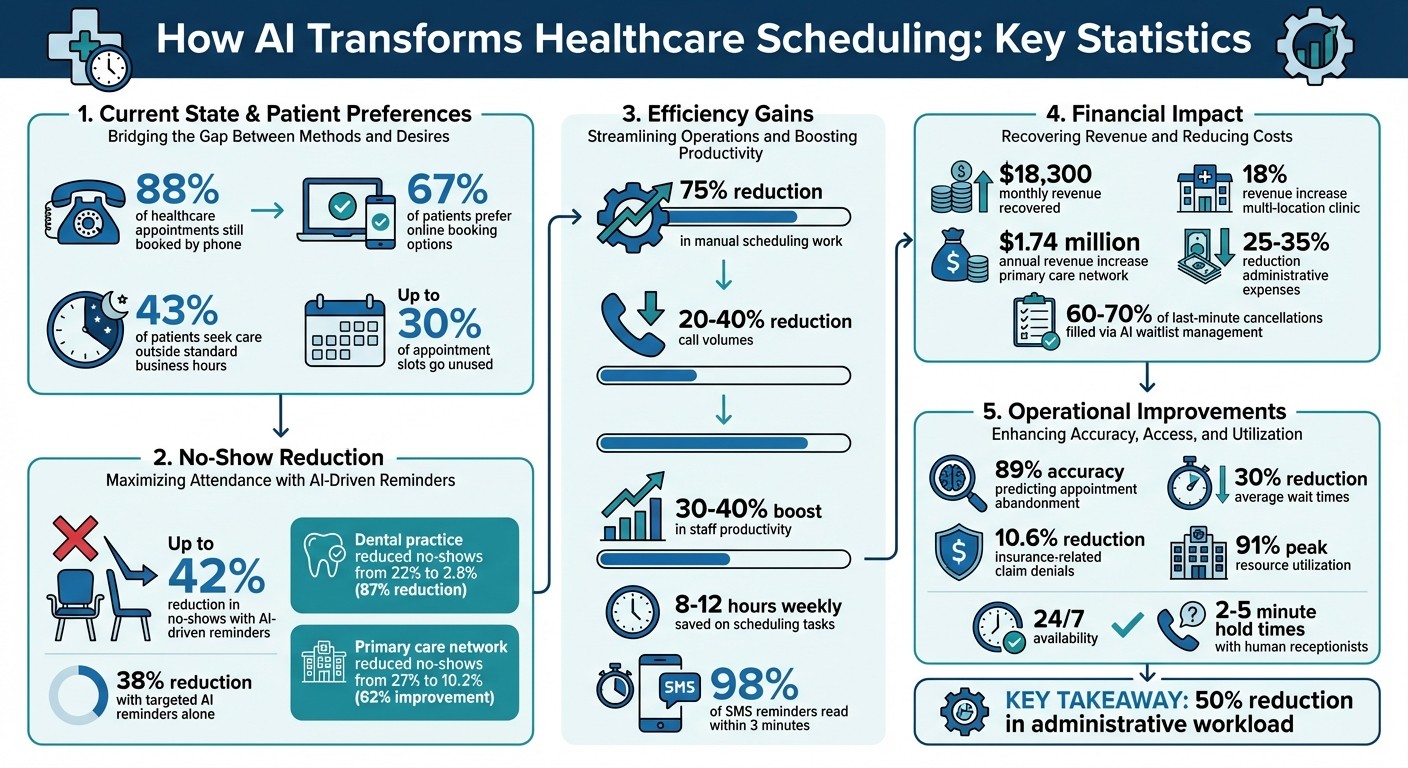
AI Scheduling Impact: Key Statistics on No-Shows, Efficiency, and ROI in Healthcare
Predictive Analytics for Better Scheduling
Forecasting Demand Using Historical Data
Efficient scheduling starts with accurate demand forecasting, and AI is making this process smarter than ever. By analyzing historical data, AI identifies patterns and integrates various signals - such as lead times, day of the week, appointment durations, and even external factors like weather and traffic conditions [8][9]. It also considers behavioral trends, such as a patient’s history of no-shows or how they respond to appointment reminders.
Algorithms like XGBoost and LightGBM are commonly used for no-show predictions. These models excel at handling incomplete data while delivering precise results, especially with tabular healthcare datasets [8]. For instance, they can flag a patient as high-risk for missing an appointment if they are scheduled during rush hour and have a long travel distance [9][10]. With these tools, AI can predict appointment abandonment with an impressive 89% accuracy [5].
AI also enables smarter overbooking strategies. By analyzing historical cancellation patterns - like a consistent 30% cancellation rate on Thursday afternoons - AI can recommend overbooking levels that improve provider utilization without causing chaos [9][10]. Additionally, AI tailors communication strategies by learning patient preferences. For example, if a patient ignores Monday morning texts but responds to evening emails, the system adapts its outreach accordingly [7][9].
These predictive capabilities allow healthcare providers to take proactive steps, reducing no-shows and making schedules more efficient.
Reducing No-Shows and Appointment Gaps
The results of AI-driven scheduling speak for themselves. For example, a suburban dental practice slashed its no-show rate from 22% to just 2.8% in only 90 days [7]. During this time, confirmation rates jumped from 58% to 94%, and 68% of last-minute cancellations were filled - recovering $18,300 in monthly revenue [7].
Similarly, an urban primary care network serving 45,000 patients across eight clinics saw its no-show rate drop from 27% to 10.2% in three months - a 62% improvement. This change added $1.74 million in annual revenue and reduced appointment wait times from 3.2 weeks to 1.8 weeks [11]. Another multi-location clinic network reduced its 28% no-show rate by 42% in three months, increasing revenue by 18% and cutting wasted provider time by 60% [5].
These results were achieved through tiered interventions based on risk scores. Low-risk patients received standard automated reminders, medium-risk patients got enhanced confirmation messages 72 and 24 hours before their appointment, and high-risk patients were contacted personally or offered flexible rescheduling options [11]. Targeted AI reminders alone have been shown to lower no-show rates by up to 38% [10]. Additionally, AI-powered waitlist management systems can fill 60–70% of last-minute cancellations by matching open slots with waitlisted patients based on their availability and location [7].
These strategies not only reduce wasted time and revenue loss but also improve patient satisfaction by creating a more seamless scheduling experience.
Automation and Workflow Improvements
Automated Appointment Matching and Reminders
AI takes on the repetitive tasks that often overwhelm front-desk teams. On average, service businesses spend 8–12 hours weekly handling calls and managing cancellations [2]. By automating booking, rescheduling, and confirmations around the clock, AI can reduce manual work by up to 75% [13].
Using "Calendar Intelligence", modern AI tools group similar appointments, streamline transitions between patients, and evenly distribute workloads among team members [2][12]. When cancellations happen, the system springs into action, identifying and notifying eligible waitlisted patients within 60 seconds - all without staff involvement [1][12].
The results speak for themselves. Clinics using AI see 40% fewer scheduling-related calls and 20% higher patient throughput, thanks to automated appointment matching [1]. Unlike the average 2–5 minute hold times with human receptionists, AI provides instant responses [3].
Automated SMS reminders are another game-changer. With 98% of messages read within 3 minutes [1], a multi-step reminder sequence can significantly reduce no-shows. For example, sending an immediate confirmation, a 48-hour reminder with a one-tap rescheduling link, and a same-day check-in message can cut missed appointments by 29% to 30%. Plus, it eliminates the hassle of endless "phone tag" [1][3][13].
Beyond scheduling, AI also improves backend processes like insurance verification and compliance, which we’ll explore next.
Real-Time Insurance Verification and Compliance
AI ensures that appointment data stays accurate and up-to-date across all channels. By streamlining insurance verification during scheduling, it reduces intake-related claim denials by 10.6% [1]. The process starts with collecting only essential details - name, date of birth, and insurance carrier - before sending secure links to gather complete medical histories. This approach aligns with HIPAA’s "minimum necessary" standard while keeping the booking process quick and efficient.
Security and compliance are baked into these systems. Leading AI platforms use AES-256 encryption for stored data and TLS 1.2+ for data in transit. They maintain detailed audit logs for all Protected Health Information (PHI) access and require Business Associate Agreements (BAAs) before handling sensitive patient data [1][3]. Many platforms also pursue SOC 2 Type II certification to reinforce their data protection measures [13].
AI’s advantages extend beyond compliance. It seamlessly integrates with Electronic Health Records (EHRs), syncing available slots and confirmed appointments in real time to eliminate manual updates [1]. This automation boosts staff productivity by 30% to 40%, freeing front-desk teams to focus on more complex patient needs instead of repetitive data entry [14]. With minimal missed calls during peak hours and precise rule-based scheduling, AI creates a reliable system that works across web chat, SMS, WhatsApp, and phone channels [3][14].
Integration with EHRs and Existing Systems
Data Synchronization Across Platforms
AI scheduling systems seamlessly connect with Electronic Health Records (EHRs), CRMs, and scheduling software, eliminating the need for manual data entry. For example, when a patient books an appointment - whether through a phone call, SMS, or online chat - the system automatically updates the EHR. Direct API integrations provide the quickest and most adaptable syncing, while middleware solutions and manual approaches can help resolve compatibility challenges. However, these alternative methods may introduce delays or require additional oversight.
One challenge with integrating AI into older systems is the risk of creating data silos. For instance, clinical information stored in an EHR might not easily communicate with business data in a CRM. To address this, many organizations rely on HL7 and FHIR protocols, which enable data mapping between incompatible systems while maintaining HIPAA compliance.
This level of integration not only simplifies workflows but also sets the stage for smarter resource management.
Better Resource Allocation
With real-time data synchronization, AI-driven systems take resource management to the next level. A great example is NextGen Healthcare, which introduced AI-powered ambient assistants into their cloud-based EHR system. This innovation allowed providers to save up to 2.5 hours daily on documentation tasks [15]. These time savings free up clinicians to focus more on patient care without needing to expand their staff.
AI integration doesn’t just save time - it improves efficiency. For instance, healthcare operations using AI have seen a 30% reduction in average wait times and a 25% improvement in queue management by analyzing data across systems [17]. With access to comprehensive scheduling information, including staff skills and patient requirements, AI can achieve up to 91% peak resource utilization compared to traditional methods [17]. This optimization directly enhances both operational efficiency and patient satisfaction.
Beyond clinical benefits, administrative teams also see improvements. Sales and administrative staff using AI-integrated CRMs save about 4 hours per week per representative [16]. Moreover, with nearly 40% of healthcare appointments booked outside regular business hours, 24/7 synchronization ensures no opportunities are missed [15]. By aligning resources and schedules intelligently, AI helps healthcare systems operate more effectively while prioritizing patient needs.
Case Studies and Research Data
Performance Metrics from AI Implementation
AI scheduling systems have proven to be game-changers, consistently cutting down no-shows, saving staff hours, and boosting revenue recovery.
Take Indiana University Health, for example. In June 2024, they rolled out Experian Health's Patient Schedule across 52 departments, spearheaded by Justin Baur, Manager of Patient Access. Within just a year, they saw a 114% jump in patient utilization and now handle an impressive 600 referrals every month [18].
"Now we have teams of four managing up to eight service lines because it's so easy to work. The team wouldn't be able to go back to the old way" [18].
Similarly, Jefferson Healthcare experienced remarkable results after adopting Artera's multi-channel communication platform in June 2022. Rachel Barbieto, Business Applications Analyst, highlighted a 25% drop in call volume, a 40% reduction in no-shows at their largest primary care clinic, and a 10–15% increase in bill payments [20].
"Potential no-shows are immediately identified and refilled, optimizing provider schedules. We're able to utilize provider schedules more efficiently now" [20].
Here's a snapshot of the improvements driven by AI systems:
Metric | Before AI | After AI | Improvement |
|---|---|---|---|
No-Show Rate (Dental Practice) | 22% | 2.8% | 87% reduction [7] |
Patient Confirmation Rate | 58% | 94% | 62% increase [7] |
Staff Time on Scheduling | 15 hrs/week | 3 hrs/week | 80% reduction [7] |
Booking Conversion Rate | 10% | 20% | 100% increase [19] |
Call Center Throughput | 6.57 calls/hr | 7.61 calls/hr | 16% increase [4] |
Wasted Provider Time | Baseline | 60% reduction | 60% improvement [5] |
These results underscore how AI-powered tools can streamline operations and deliver measurable benefits across healthcare settings.
Lead Receipt's AI Solutions for Multi-Channel Scheduling
Features for Healthcare and Service Businesses
Lead Receipt streamlines multi-channel scheduling with its AI-powered receptionist, making it easier for healthcare and service businesses to manage appointments across phone, web, and app platforms. This system operates 24/7, handling calls in five languages, booking appointments directly into calendars, and sending automated SMS and email reminders to cut no-show rates by up to 41% [23].
By integrating seamlessly with existing CRMs and scheduling tools, the platform synchronizes patient data in real time and automates follow-ups. For instance, if a patient calls after hours to reschedule, the AI receptionist updates the EHR, confirms the change, and notifies the patient - all without staff intervention. This reduces administrative burdens while improving both efficiency and patient satisfaction [22][23].
The automation features extend beyond scheduling. Lead Receipt also verifies insurance in real time, matches appointments to provider availability and patient needs, and adjusts schedules instantly when cancellations occur. Healthcare facilities using similar AI tools have reported a 34% increase in patient visits and a 30% drop in receptionist workloads [23].
Pricing Plans and Options
Lead Receipt offers flexible pricing to accommodate practices of different sizes, with three distinct tiers:
Plan | Price | Best For | Key Features |
|---|---|---|---|
Starter | $300/month | Small practices needing 24/7 web coverage | 24/7 web-chat receptionist, AI-driven visitor responses, standard analytics, email support, up to 3 domains [21] |
Professional | $750/month | Growing practices with moderate call volume | 24/7 AI voice and chat, multilingual support (5 languages), lead data output, call recordings, priority support, up to 100 calls/day [21] |
Enterprise | Custom | Large healthcare systems with high volume | Fully customizable automation, dedicated AI consultant, enterprise-level compliance, VIP support, unlimited calls and integrations [21] |
The Professional plan, priced at $750/month, stands out for its value. Clinics using comparable AI scheduling systems have saved over three hours daily, leading to substantial reductions in labor costs and improved operational efficiency [22][23].
AI Based Patient Scheduling - The Ultimate Guide!
Conclusion
AI is reshaping multi-channel scheduling, turning what was once a manual and error-prone process into a smart, always-on system that benefits both patients and healthcare staff. By automating tasks like appointment matching, reminders, and insurance verification, administrative workloads can be reduced by 50% [6], while no-show rates drop by 30% [1]. This boost in efficiency not only frees up time for more patient-centered care but also helps recover revenue lost to unfilled appointment slots.
Currently, up to 30% of appointment slots go unused due to scheduling gaps and miscommunications. This is especially challenging for the 43% of patients seeking care outside standard business hours. With AI, patients can book, reschedule, or cancel appointments instantly - whether through phone, SMS, or web chat - any time of day. This 24/7 accessibility removes barriers and ensures smoother access to care.
"Healthcare access should never depend on how busy the front desk is. Patients deserve clarity, speed, and responsiveness." – Harikrishna Patel, Founder, MIA [24]
AI-powered reception systems also bring measurable cost savings. They can cut administrative expenses by 25–35% and reduce call volumes by 20–40% in just a few months [24]. For practices spending 8 to 12 hours a week on manual scheduling tasks [2], these tools translate into lower labor costs and more time to focus on patient care.
These operational and financial benefits pave the way for integrated solutions. Lead Receipt's AI platform delivers these advantages to providers of all sizes. With multilingual support, seamless EHR integration, and flexible pricing starting at $300 per month, it captures after-hours requests, fills cancellations instantly, and provides the personalized service patients now expect.
FAQs
How does AI decide who is likely to no-show?
AI can anticipate potential no-shows by examining historical trends, behavioral patterns, calendar data, and engagement signals. By pinpointing appointments at higher risk of being missed, this technology enables businesses to take proactive steps to improve scheduling efficiency and minimize missed appointments.
What does it take to integrate AI scheduling with an EHR?
Integrating AI scheduling with an Electronic Health Record (EHR) system is all about creating a secure and efficient way to manage healthcare operations. The process starts with choosing AI tools that work seamlessly with the EHR platform. From there, real-time data synchronization needs to be configured to ensure smooth communication between the systems.
Collaboration with vendors is key to setting up secure data pipelines that comply with HIPAA regulations, protecting sensitive patient information. Beyond the technical setup, staff training plays a major role. Teams need to understand how to use the new tools effectively, while thorough system testing ensures everything runs as expected.
Once implemented, ongoing monitoring is essential to maintain accuracy and minimize errors. This integration not only streamlines workflows but also helps improve patient satisfaction by making scheduling more efficient and reliable.
How do you measure ROI from AI scheduling?
AI scheduling systems deliver measurable returns by balancing the financial and operational gains against the initial investment. Clinics using these systems often see no-show rates drop by up to 30% and booking rates increase by as much as 70%, both of which directly impact revenue. Additionally, patient engagement improves, enhancing overall satisfaction.
On average, clinics report a net ROI of 300–500% within 10 to 18 months. This impressive return is largely driven by reduced no-shows, streamlined administrative tasks, and quicker patient processing. For many, the payback period for this investment falls between 3 and 18 months, making it a practical and efficient solution for long-term growth.