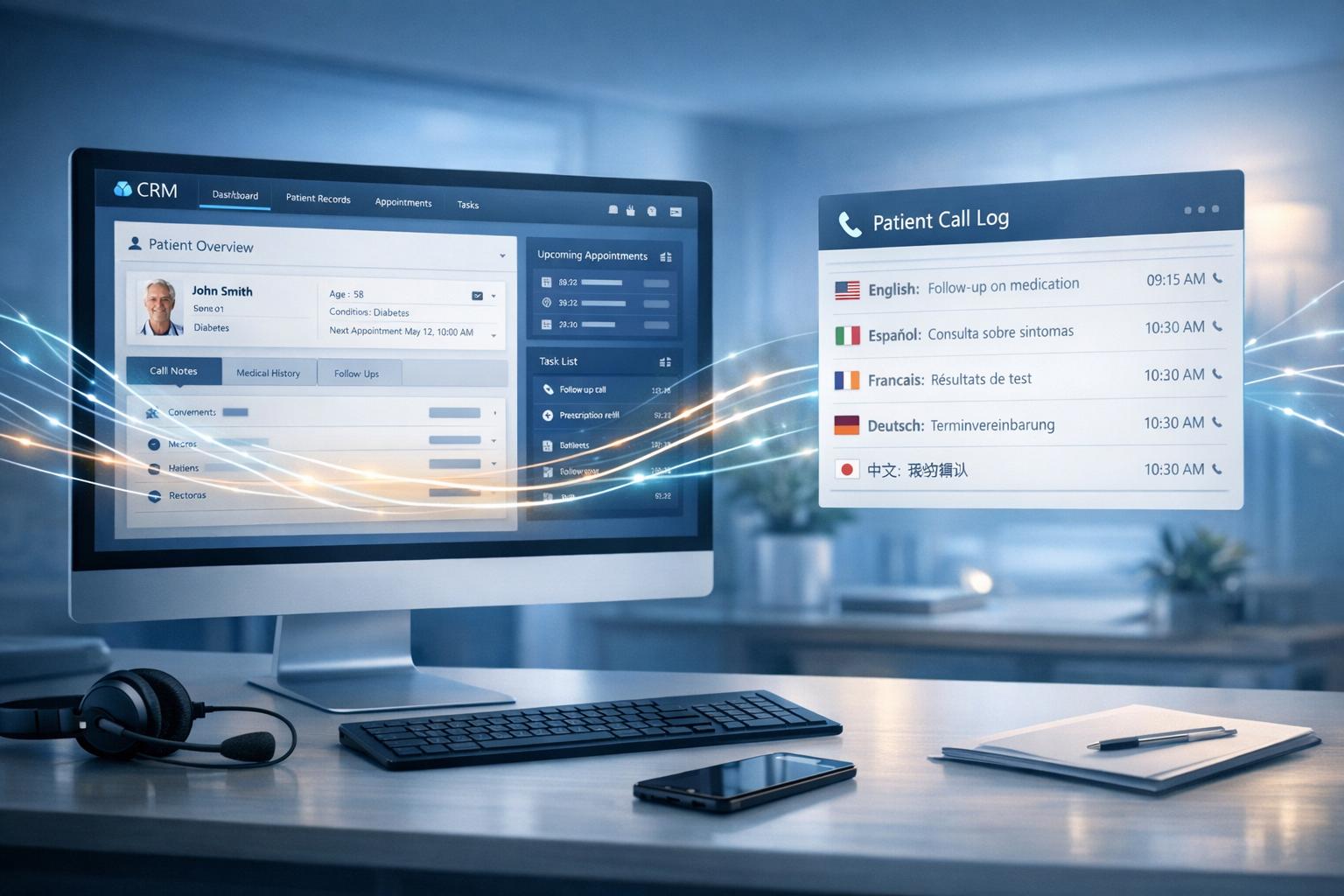
NLP Integration with CRMs for Patient Calls
Healthcare Technology
Updated Jun 17, 2026
NLP agents and CRMs automate patient calls: transcribe, log, schedule, support multilingual callers, and preserve HIPAA compliance.
NLP (Natural Language Processing) is transforming how healthcare providers manage patient calls, especially after hours. By integrating NLP tools with CRM systems like Salesforce, Epic, and Athenahealth, healthcare organizations can:
Automate call handling: AI-powered agents understand patient intent, schedule appointments, and log interactions.
Reduce administrative workload: Automatically update records, transcribe calls, and handle routine tasks.
Improve efficiency: Cut average call times and streamline workflows, reducing errors and delays.
Enhance accessibility: Offer support in over 30 languages for diverse patient populations.
Key tools like Lead Receipt and Eleven Labs provide advanced features such as real-time transcription, sentiment analysis, and seamless CRM integration. These solutions save time, reduce costs, and ensure HIPAA compliance, while enabling 24/7 support and better patient experiences. However, challenges like setup costs, occasional inaccuracies, and technical expertise requirements must be considered.
For healthcare providers, adopting NLP-powered CRM solutions can lead to faster call resolutions, lower no-show rates, and significant operational improvements.
How NLP Improves Patient Call Handling
Natural language processing (NLP) is changing how patient calls are managed by turning conversations into structured data for customer relationship management (CRM) systems. Unlike traditional systems with rigid "press 1 for appointments" menus, NLP understands the intent behind different phrases. For example, whether a patient says, "I need to reschedule" or "Can I move my appointment?", the system recognizes both as the same request and routes them correctly. It also deciphers complex medical terms and picks up on patient emotions without missing a beat.
By training on millions of de-identified patient records, NLP systems can interpret tricky medical jargon. They handle concepts like copays and deductibles, make sense of ICD-10 codes, and translate symptoms described by patients into clinical records. For instance, Parikh Health's AI-powered check-in process cut the administrative time per patient from 15 minutes to just 1–5 minutes, delivering a 10x improvement in efficiency [7].
Real-time sentiment analysis is another game-changer. The system can detect when a patient sounds anxious or when a situation feels urgent, ensuring critical cases are prioritized while routine issues are handled efficiently. TidalHealth Peninsula Regional in Maryland, for example, incorporated AI clinical decision tools into their electronic health records (EHR), reducing search times from 3–4 minutes to under 1 minute per query [7].
The administrative benefits are huge. Physicians currently spend around 50% of their day on paperwork and 70% on routine tasks [7]. NLP automation eases this load by logging call details, creating patient notes, and updating systems like Epic, Cerner, and Athenahealth automatically. AI-driven scheduling can also reduce patient no-show rates by up to 30%, while automated prior authorizations can handle up to 75% of manual tasks [7].
Modern NLP systems take it a step further by supporting over 30 languages in real time. This means healthcare providers can serve diverse populations without needing a dedicated multilingual staff for routine calls. With administrative costs making up 25–30% of total U.S. healthcare spending, automation powered by NLP offers a clear path to significant savings [7].
1. Lead Receipt
Lead Receipt highlights how NLP technology can make patient call management more efficient and effective.
NLP Features for Patient Calls
The AI-powered receptionist in Lead Receipt uses natural language processing (NLP) to transcribe calls in real time, eliminating the need for manual documentation [8]. But it doesn't stop there. The system also analyzes the caller's tone and language to detect signs of anxiety, dissatisfaction, or urgency during conversations [8][9]. By ensuring accurate transcription, it seamlessly integrates with customer relationship management (CRM) systems.
Integration with Healthcare CRMs
Lead Receipt takes unstructured call data and transforms it into CRM-ready information. It automatically maps clinical details - like symptoms, medications, or patient IDs - into the appropriate fields [8][9]. For example, when a patient mentions specific symptoms or medications, the system extracts this information and updates the CRM without requiring manual input. It can also search for existing patient records or create new leads, contacts, or opportunities directly in popular CRMs like Epic, Cerner, or Athenahealth. This automation streamlines workflows and reduces administrative burdens.
Automation Capabilities
Available 24/7, Lead Receipt’s AI voice agents handle lead qualification by collecting patient information, evaluating their needs based on preset criteria, and routing them appropriately during the initial call [4][6]. This automation allows front desk staff to dedicate more time to in-person patient care and other complex tasks.
Customizability and Scalability
Lead Receipt offers flexible plans to suit practices of all sizes:
Starter plan ($300/month): Includes 24/7 web-chat coverage for up to three domain names.
Professional plan ($750/month): Adds voice and chat capabilities, a dedicated line supporting five languages, and up to 100 AI calls daily.
Enterprise plan: Designed for high-volume practices, this plan features unlimited calls, a dedicated AI consultant, and enterprise-grade compliance tailored to your unique workflows and integrations.
These options make it easy for practices to scale their operations while maintaining efficiency.
2. Eleven Labs
Eleven Labs provides cutting-edge voice AI technology designed to streamline patient call handling. By leveraging advanced conversational agents, it integrates directly with healthcare CRM systems to enhance efficiency and patient experience.
NLP Features for Patient Calls
Eleven Labs employs a fine-tuned Speech-to-Text (ASR) model paired with a proprietary turn-taking system that ensures natural conversation flow during patient interactions [12]. With access to over 5,000 voices in 31 languages, the platform can seamlessly switch languages within a single conversation - an invaluable feature for practices serving diverse communities [12]. Beyond transcription, the AI analyzes spoken words for sentiment and generates concise transcripts that highlight patient intent and outcomes [10].
Integration with Healthcare CRMs
The platform integrates effortlessly with leading CRM systems like Salesforce, Zoho, HubSpot, and Pipedrive [5]. During live calls, agents can access patient records, past interactions, and account details in real time without disrupting the conversation. Additionally, the system automatically updates or creates cases, leads, and opportunities within the CRM. It uses OAuth 2.0 authentication and adheres to HIPAA-compliant standards, ensuring secure handling of sensitive patient data. This seamless integration supports efficient call management and automation.
Automation Capabilities
After a call, Eleven Labs delivers detailed transcripts, audio recordings, and conversation analysis through automated webhooks [11]. The system can identify returning patients using phone or email lookups, reference prior interactions, and automatically assign follow-up tasks to staff [2].
According to Jayesh Gupta, Head of AI and Innovation at CARS24, "With ElevenLabs as our technology partner, we're creating a new standard where every interaction builds confidence. Our voice AI solution is cutting resolution times in half and boosting customer satisfaction" [6].
Healthcare organizations using Eleven Labs have reported resolving up to 90% of issues on the first call while cutting interaction costs by more than 60% [6].
3. Other CRM Platforms with NLP Integration
NLP Features for Patient Calls
In addition to specialized tools, some of the biggest CRM platforms - like Salesforce, HubSpot, Zoho, and Zendesk - leverage NLP to improve how healthcare calls are managed. These platforms use features like real-time transcription, sentiment analysis, and keyword detection to capture critical details such as patient names, locations, and contact information during calls. Voice agents can handle tasks like triaging, scheduling appointments, and updating records while maintaining a conversational and empathetic tone. Impressively, many of these systems can switch between more than 30 languages on the fly, making them ideal for practices that cater to diverse patient populations [3]. These advanced NLP tools pave the way for automated call handling and smooth integration with CRM systems.
Integration with Healthcare CRMs
These platforms connect seamlessly with EHR, HIS, and other CRM systems using secure APIs and OAuth 2.0 protocols to ensure HIPAA compliance. This integration allows the system to access patient profiles, verify account statuses, and review interaction histories without any hiccups [2].
Automation Capabilities
Once calls are completed, these CRM platforms automatically generate detailed transcripts and AI-driven summaries, which are then attached to patient records. They can also create new leads, contacts, or cases based on the conversation, saving time by removing the need for manual data entry. With scheduling tool integration, AI agents can book, reschedule, or confirm appointments through natural conversations. On top of that, voice interactions can trigger updates to lead scores, send automated follow-up emails, and initiate custom workflows. These features ensure round-the-clock availability and instant responses [1].
Advantages and Disadvantages
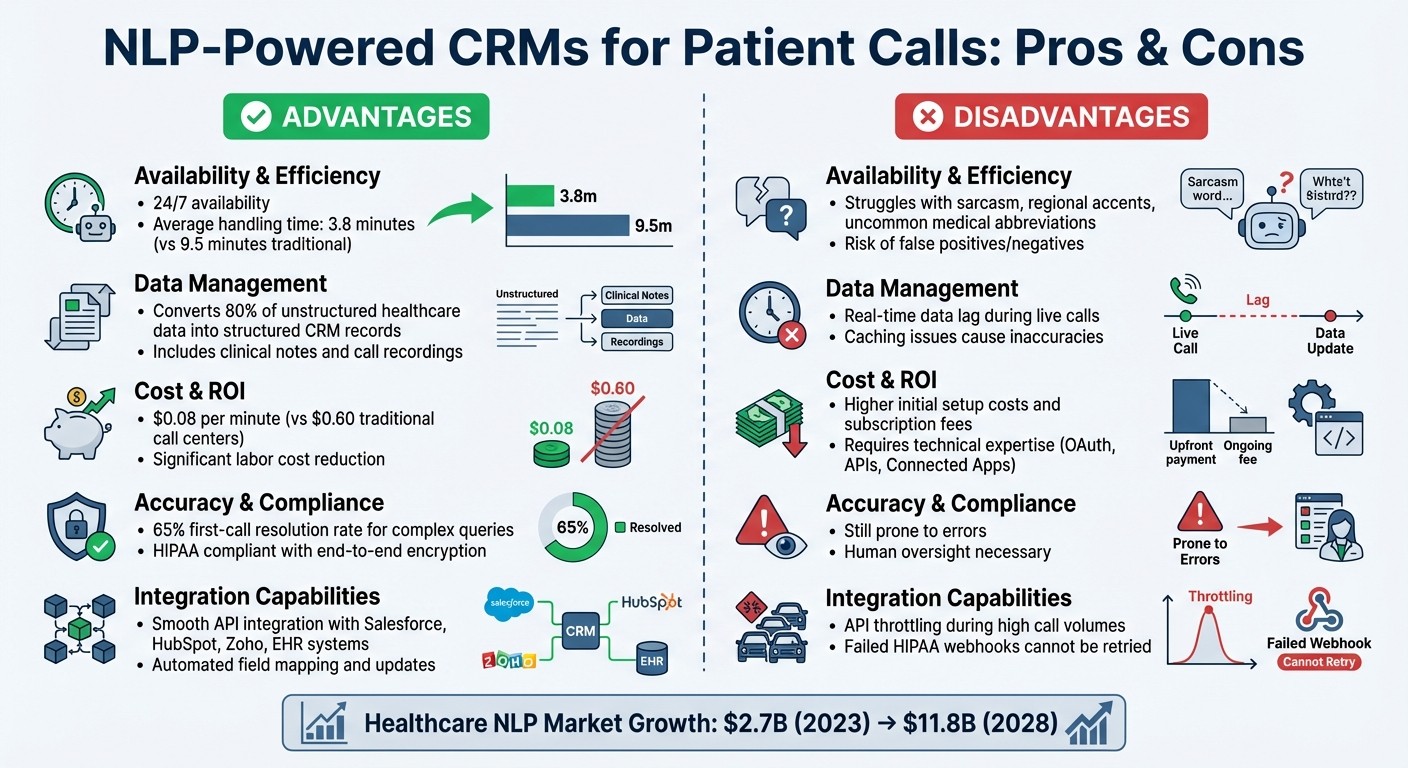
Advantages and Disadvantages of NLP-Powered CRMs for Patient Calls
Using NLP-powered tools in CRMs to manage patient calls brings a mix of benefits and challenges. Here's a breakdown of the key points:
Feature/Factor | Advantages | Disadvantages |
|---|---|---|
Availability & Efficiency | Provides 24/7 availability and cuts average handling time to 3.8 minutes compared to the traditional 9.5 minutes [18]. | Struggles with sarcasm, regional accents, and uncommon medical abbreviations, which can lead to errors like false positives or negatives [13][14]. |
Data Management | Transforms roughly 80% of unstructured healthcare data (like clinical notes and call recordings) into structured, searchable CRM records [14][8][17]. | Real-time data may lag during live calls due to caching issues, which can cause inaccuracies [2]. |
Cost & ROI | Costs average $0.08 per minute versus $0.60 per minute for traditional call centers, significantly reducing labor expenses over time [18]. | Initial setup costs and subscription fees are higher, and technical configurations like OAuth, APIs, and Connected Apps require expertise [2][4]. |
Accuracy & Compliance | Achieves a 65% first-call resolution rate for complex queries and ensures HIPAA compliance with end-to-end encryption [18][1][16]. | Still prone to errors, making human oversight necessary to maintain accuracy [15][16][17]. |
Integration Capabilities | Offers smooth API integration with platforms like Salesforce, HubSpot, Zoho, and EHR systems, along with automated field mapping and updates [5][8]. | High call volumes can lead to API throttling, disrupting data flow; failed HIPAA webhooks cannot be retried [11][2]. |
These points highlight the importance of strategic planning to fully unlock the potential of NLP in patient call management.
The growing healthcare NLP market further emphasizes its significance, with projections showing an increase from $2.7 billion in 2023 to $11.8 billion by 2028 [8].
As Martin Bauwens, Senior Data Scientist at MMS Holdings, puts it, "NLP examines written and spoken information for themes and categories by applying the integrated knowledge of linguistics, psychology, cognitive science, neuroscience and computer science" [13]. However, this complexity can lead to misinterpretation if training data isn’t carefully curated.
To get the most out of these tools, it’s crucial to train them on high-quality medical data, maintain human oversight, and implement strong cybersecurity measures like HMAC signature validation and IP whitelisting [8][16][11].
Conclusion
Selecting the right NLP-powered CRM solution hinges on aligning your organization's specific needs - like reducing long hold times, minimizing data entry errors, or addressing after-hours support gaps - with the platform's technical capabilities. For healthcare providers managing high call volumes, it's essential to prioritize features like quick response times and secure, HIPAA-compliant data handling. Practices serving diverse patient demographics should also ensure the solution offers multilingual support to meet communication needs effectively. These elements lay the groundwork for solutions that can enhance operational efficiency.
Start by focusing on high-impact areas such as scheduling, lead qualification, or handling routine inquiries. Once these are optimized, you can expand to more complex workflows, like clinical task management. By integrating NLP-driven CRM tools, healthcare practices can ease administrative workloads, improve patient care continuity, and reduce no-show rates thanks to 24/7 availability.
Specialized platforms can take these benefits even further. For instance, Lead Receipt offers AI receptionist services tailored for healthcare providers. It integrates seamlessly with existing CRM systems, providing round-the-clock call handling, automated scheduling, and workflow automation. Their Professional plan supports up to 100 AI calls daily across five languages, while the Enterprise plan is designed for high-volume practices, offering unlimited calls and fully customizable automation.
Another example is Eleven Labs, which provides advanced voice AI solutions with natural, multilingual speech capabilities. These tools enhance patient interactions and complement your CRM setup, ensuring smoother communication.
Before rolling out your chosen solution, take a close look at your CRM's data quality. Ensure secure OAuth 2.0 authentication, monitor API usage during peak times, and implement strong security measures to safeguard patient data. These steps will help you maximize the effectiveness of your CRM integration while maintaining compliance and security standards.
FAQs
How does natural language processing (NLP) enhance patient call handling in healthcare CRMs?
Natural language processing (NLP) is changing the way healthcare handles patient calls by allowing systems to understand and respond to inquiries in real time. Whether it’s scheduling an appointment, refilling a prescription, or resolving billing questions, NLP identifies the intent behind spoken or written queries. This not only reduces the need for manual data entry - by automatically updating CRM records - but also saves time, making workflows smoother, calls shorter, and first-call resolution rates higher.
Take platforms like Lead Receipt, for example. They use NLP to power AI receptionists that operate 24/7. These virtual assistants can route calls based on intent, automate scheduling, flag urgent issues, and sync patient data directly with CRMs. By handling these repetitive tasks, staff can dedicate more time to patient care.
Another standout is Eleven Labs, which integrates hyper-realistic voice AI to manage tasks like triage and appointment booking. And they do this while maintaining HIPAA compliance, ensuring every patient interaction is both secure and seamless. These tools make it easier for healthcare providers to focus on what truly matters - delivering quality care.
What challenges arise when integrating natural language processing (NLP) with healthcare CRMs?
Integrating natural language processing (NLP) into healthcare CRMs comes with its fair share of challenges. One major hurdle is that patient data is often stored in unstructured formats, such as free-form notes or PDFs, making it tough for NLP models to accurately extract useful information. Additionally, many older CRM platforms lack modern APIs, which means custom solutions are often needed to bridge the gap for proper integration.
Another layer of complexity comes from language-specific issues. Medical terminology, abbreviations, and even patient-specific phrases can be ambiguous and heavily context-dependent. This requires advanced NLP models trained specifically in healthcare vocabularies to ensure accuracy. And, of course, there’s the added pressure of complying with stringent privacy regulations like HIPAA, which enforce rigorous security and compliance standards.
One way to tackle these obstacles is by leveraging tools built for smooth integration. For instance, Lead Receipt offers AI-powered receptionists capable of processing call transcripts, extracting patient details, and updating CRMs - all without requiring a complete system overhaul. Similarly, Eleven Labs provides voice-enabled AI agents that work seamlessly with CRMs like Salesforce. These agents enable real-time patient data access, automate logging, and ensure secure communication - all while adhering to U.S. privacy standards. These tools not only simplify patient interactions but also boost operational efficiency in healthcare settings.
How do NLP-powered CRMs ensure HIPAA compliance and protect patient data?
NLP-powered CRMs take patient data security seriously by implementing stringent measures essential for managing Protected Health Information (PHI). For instance, Eleven Labs’ Conversational AI, designed to work seamlessly with popular CRMs like Salesforce, helps maintain HIPAA compliance. Key features include Zero Retention Mode, which automatically deletes raw audio, transcripts, and related data to avoid long-term PHI storage. Additionally, it ensures the use of HIPAA-compliant large language models (LLMs) and allows customers to use their own API keys under a signed Business Associate Agreement (BAA).
To protect real-time operations, these CRM integrations rely on enterprise-grade encryption and OAuth authentication. This ensures that sensitive patient data - like call notes or appointment scheduling - is transmitted securely, safeguarding it from unauthorized access. Enhancing these efforts, Lead Receipt offers AI-powered receptionists that handle calls, capture leads, and schedule appointments while meeting HIPAA standards. This provides healthcare providers with a secure and reliable way to automate workflows.