
AI Call Routing Trends in 2026
Healthcare Technology
Updated Jan 19, 2026
AI call routing cuts wait times and automates scheduling with predictive analytics, sentiment and multilingual support to boost healthcare efficiency by 2026.
AI is revolutionizing call routing in 2026 by eliminating outdated phone trees and enabling real-time connections based on caller needs. Industries like healthcare are leading the adoption of these systems, which use natural language processing, sentiment analysis, and predictive analytics to route calls more effectively. Key benefits include:
Faster Connections: Average call connection times are down by 35%.
Higher Efficiency: AI handles up to 45% of inbound calls autonomously in some organizations.
Improved Customer Experience: Sentiment-based routing ensures frustrated callers are prioritized for specialist attention.
Cost Savings: Healthcare providers report millions in annual savings through AI-driven systems.
AI call routing integrates seamlessly with CRMs and scheduling tools, supports over 32 languages, and meets strict compliance standards like HIPAA. By 2026, nearly 79% of healthcare organizations are expected to use AI to streamline patient interactions, reduce wait times, and improve operational efficiency. Advanced features like multilingual support, predictive analytics, and real-time emotion detection are setting a new standard for customer service across industries.
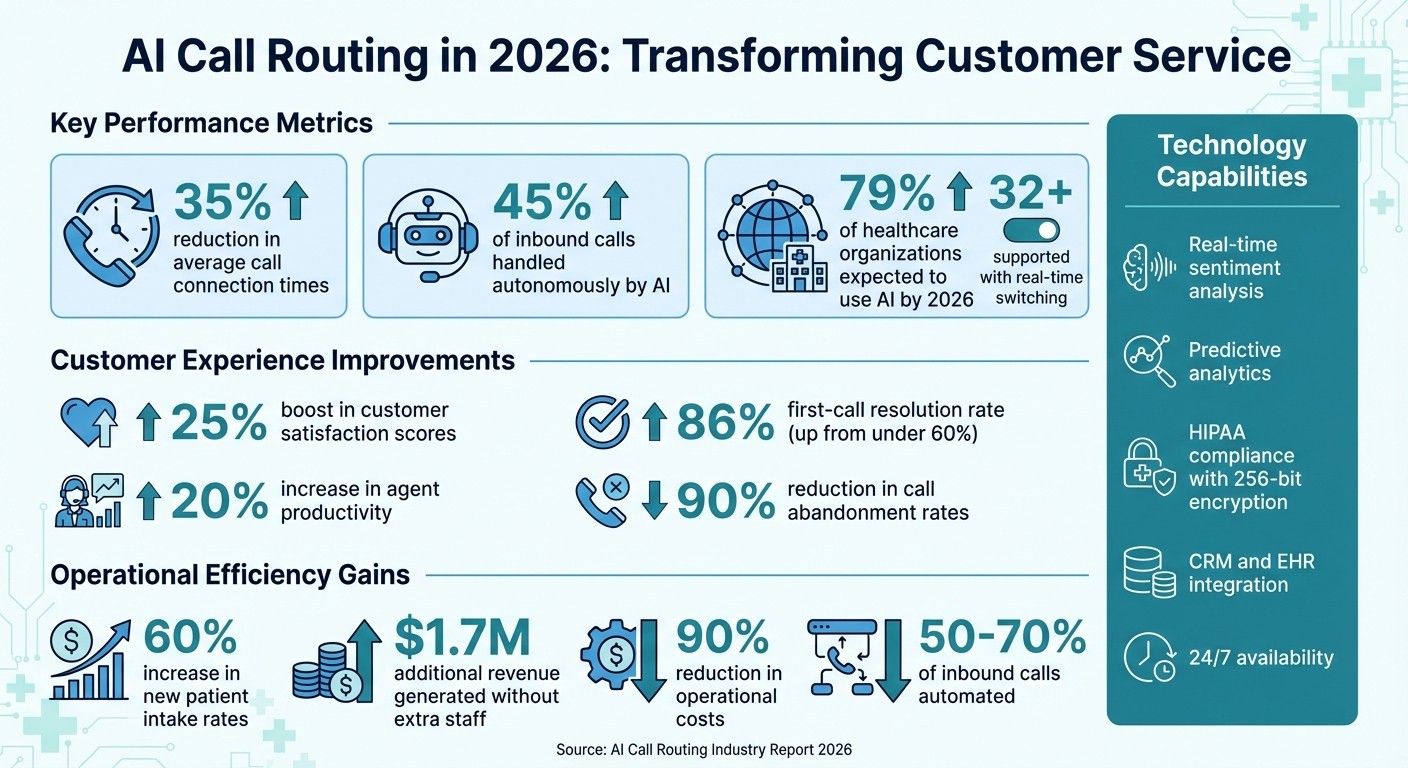
AI Call Routing Impact: Key Statistics and Benefits in 2026
AI Front Desk: How Doctors Save $100k With Automation (2025 Guide)
Predictive Routing and Personalized Call Handling
AI has already reshaped the basics of call handling, but predictive analytics takes it a step further by refining how calls are routed. By 2026, AI systems are no longer just reactive; they proactively anticipate caller needs by analyzing historical data and CRM records. This shift is redefining how healthcare providers and service businesses manage high call volumes.
How Predictive Analytics Enhances Call Routing
Predictive routing uses behavioral data to match callers with the most suitable agents. Instead of simply connecting the caller to the next available representative, the system identifies the agent best equipped to handle the specific issue - whether it’s a billing concern, a technical question, or a customer retention matter [10][13].
The impact is clear: customer satisfaction scores often see a 25% boost, while agent productivity increases by 20% when agents are matched to cases that align with their expertise [2].
Take Kaiser Permanente, for example. In 2025, they implemented natural language processing to sort through millions of patient messages, automatically routing about 33% of these to care teams before they even reached a physician's inbox [1]. Similarly, Siemens Healthineers connected 2,200 experts across 35 countries using Genesys Cloud, enabling case routing based on urgency and technical requirements - all achieved without any downtime during an eight-month rollout [1].
Real-time sentiment analysis adds another dimension. By analyzing voice tone and speaking patterns, the system can detect frustration or anxiety, triggering immediate escalations to senior specialists or de-escalation experts [2][1]. Additionally, dynamic workload balancing monitors agent stress levels in real time, ensuring calls are distributed fairly to prevent burnout [11][12].
Advanced tools like Eleven Labs enhance this process further by capturing subtle vocal cues, refining sentiment-based routing, and enabling highly personalized interactions.
Personalized Routing Through Caller History
Modern call systems are deeply integrated with CRMs and Electronic Health Records, pulling up account details, past interactions, and purchase history instantly [9][14]. This means a returning patient calling about a prescription refill doesn’t need to repeat their medical history - the system already has it on hand.
Behavioral scoring also plays a key role in routing decisions. High-value or high-risk callers are prioritized based on lifetime value, engagement trends, or subscription tiers [2][13]. VIP routing ensures these important customers are paired with experienced agents capable of handling complex issues.
Routing Type | Data Utilized | Primary Benefit |
|---|---|---|
Predictive | Historical patterns, intent | Anticipates needs; reduces wait times |
Sentiment-based | Real-time voice tone, stress | Matches emotional state to agent empathy |
Skills-based | Agent expertise, certifications | Improves first-call resolution |
VIP/Priority | Account value, subscription tier | Strengthens loyalty for key clients |
Platforms like Lead Receipt take this personalization to the next level. Their AI receptionist platform integrates seamlessly with CRMs and scheduling tools to provide context-aware call handling. Whether it’s scheduling an appointment, answering billing questions, or escalating a call to a live specialist, the system uses caller history and behavioral data to make smart routing decisions.
This technology isn’t limited to phone calls. Omnichannel orchestration connects data from various touchpoints - like website self-service attempts, chatbot interactions, and even social media conversations. When a customer transitions to a live call, this data travels with them, creating a seamless, well-informed experience [13].
Multilingual Support and Sentiment Analysis
After predictive and personalized routing, the integration of multilingual and sentiment analysis takes caller interactions to the next level. Language barriers and emotional stress can disrupt communication, but by 2026, AI has advanced to handle multiple languages and emotional cues simultaneously, creating smoother experiences for patients and customers alike.
AI-Powered Multilingual Call Routing
Modern AI systems can now detect a caller's language automatically and even switch languages mid-conversation without requiring manual input. These platforms currently support over 32 languages with real-time switching. For example, if a caller starts speaking in English and later switches to Spanish, the system adapts seamlessly, ensuring the interaction continues without interruption [15][16].
A 2025 study highlighted the impact of multilingual AI in outreach efforts, showing that Spanish speakers' opt-in rates increased significantly (18.2% compared to 7.1%). Additionally, Spanish-speaking patients spent more time engaging with the system - an average of 6.05 minutes versus 4.03 minutes for English-speaking patients [18].
AI systems also use skills-based matching to enhance these capabilities further. By leveraging CRM data and linguistic certifications, callers can be paired with bilingual agents best suited to their needs. These systems go beyond just identifying the spoken language - they also adapt to regional accents and dialects, reducing transcription errors. Tools like Eleven Labs are particularly effective in capturing these nuances.
For businesses handling high call volumes, solutions like Lead Receipt integrate AI receptionists with multilingual support, CRM systems, and scheduling tools. This ensures, for instance, that a Spanish-speaking patient seeking an appointment receives personalized service in their preferred language without needing to repeat their information.
These multilingual capabilities lay the groundwork for integrating real-time emotion analysis into call routing.
Detecting Caller Emotions with Sentiment Analysis
AI doesn’t stop at understanding language - it also analyzes voice tone, pitch, and speaking patterns to detect emotions like frustration, anxiety, or satisfaction. For example, if a caller's sentiment score falls between -0.8 and -1.0, the system immediately escalates the call to senior agents or supervisors trained in de-escalation techniques [2].
In 2024, CARS24 adopted Eleven Labs' AI voice technology to streamline customer interactions in India’s used-car market. This innovation, led by Jayesh Gupta, Head of AI and Innovation at CARS24, halved resolution times and reduced call costs by 66%, all while maintaining natural, emotionally responsive conversations [15][16].
"With ElevenLabs as our technology partner, we're creating a new standard where every interaction builds confidence. Our voice AI solution is cutting resolution times in half and boosting customer satisfaction." - Jayesh Gupta, Head of AI and Innovation, CARS24 [15]
In healthcare, sentiment-based routing has become a critical tool for improving patient care. AI trained on medical datasets can identify emotional cues signaling life-threatening emergencies, ensuring immediate escalation to human clinicians [18]. It also monitors other subtle indicators, like prolonged silence or overlapping speech, which may suggest confusion or distress. These calls are routed to agents with specialized training in handling high-stress situations [2][19]. On the other hand, when positive sentiment is detected (scores between 0.3 and 1.0), the system redirects these callers to sales or loyalty teams, enabling opportunities for upselling or customer retention. This dual approach not only protects vulnerable callers but also maximizes positive interactions [2].
AI Call Routing in Healthcare Settings
By 2026, nearly 79% of healthcare organizations are expected to utilize AI to enhance patient interactions. This shift aims to strike a balance between improving operational efficiency and meeting strict regulatory requirements [20]. With advanced predictive analytics and personalized call routing, AI is transforming essential administrative tasks in healthcare.
Automating Patient Intake and Scheduling
AI-powered voice agents are now handling appointment bookings, cancellations, and rescheduling - 24/7 - without requiring human assistance. By integrating with electronic health records (EHRs), these systems prevent scheduling conflicts and ensure patient records remain up-to-date [20].
The impact has been impressive. AI automation has increased new patient intake rates by 60%, generating an additional $1.7 million in revenue without the need for extra staff [22]. In one major hospital, the first-call resolution rate jumped from under 60% to over 86% after implementing AI call routing. Additionally, more than 20% of calls were redirected to voice self-service systems [20].
Natural Language Processing (NLP) plays a key role in assessing the urgency of calls. Emergencies are routed directly to clinical staff, while routine inquiries are handled autonomously [20]. For example, Kaiser Permanente uses NLP to triage millions of patient messages, ensuring 33% of those interactions are sent to care teams before reaching a physician’s inbox. This has significantly reduced clinical wait times [1].
AI receptionists further streamline operations by asking tailored intake questions, verifying insurance information, and automatically updating CRM systems - eliminating manual data entry [23]. This automation frees healthcare staff to focus on more complex patient care. As Erin Sandoval, Senior Director of Support Services at Complete Health, puts it:
"AI does not replace the human connection. It restores it by taking care of everything else." [7]
Solutions like Lead Receipt offer AI receptionists tailored for healthcare, seamlessly integrating with CRM and scheduling tools. Their 24/7 availability is critical, especially since nearly half of healthcare bookings happen outside regular office hours [23]. Providers like Eleven Labs ensure that automated interactions sound natural and reassuring, maintaining a comforting experience for patients.
While automation enhances efficiency, maintaining security and compliance remains essential.
Meeting HIPAA Compliance Requirements
In healthcare, security and compliance are non-negotiable. Any AI vendor managing patient calls must provide a written Business Associate Agreement (BAA) to protect Protected Health Information (PHI) [24].
Modern AI systems safeguard PHI with 256-bit AES encryption and meet rigorous security standards, holding certifications like SOC 2 Type II and ISO 27001. These systems also enforce strict data residency rules by operating on private global IP networks [20][24]. Features such as comprehensive audit trails and automatic call escalations ensure oversight and compliance [24].
Today’s voice AI achieves approximately 95% accuracy in recognizing medical terminology, while emotional recognition in healthcare communications is about 88% accurate [24]. This level of precision, paired with robust security, has increased public trust in AI. In fact, 8 out of 10 Americans believe AI can make healthcare more accessible and improve its quality [24]. For organizations adopting sophisticated call routing, customer satisfaction has risen by up to 30% [25].
Cloud-Based Systems and Workflow Integration
Cloud-based AI systems have become a cornerstone of modern call routing, providing healthcare providers with the ability to scale their operations without the hassle of traditional infrastructure. These platforms offer instant scalability, enabling practices to manage anything from a few calls to thousands simultaneously - without sacrificing performance or increasing wait times [8]. On top of that, they perform reliably even during peak call periods.
Scaling to Handle Growing Call Volumes
By October 2025, TSAOG Orthopaedics & Spine, which handles over 30,000 calls monthly, implemented cloud-based voice AI to manage 30% of their call volume, particularly for routine scheduling tasks [7]. Meanwhile, Women's Health Connecticut drastically reduced patient hold times from 10–25 minutes to under 20 seconds and cut call abandonment rates by over 90% [27].
Cloud-based AI also steps in after hours, handling about 11% of patient calls that occur outside of regular business hours. Tasks like scheduling and prescription refills are completed without requiring human staff [8]. This is particularly important when considering that the average hold time in U.S. medical call centers is 4.4 minutes, yet 60% of patients hang up if they wait longer than one minute [8]. With AI, those delays are virtually eliminated.
These systems also address staff burnout by automating 50% to 70% of inbound calls, allowing human staff to focus on more complex patient needs instead of repetitive administrative tasks [8]. This is a game-changer in an industry battling chronic understaffing. Hillary Diegelman from Western New York Dermatology puts it best:
"It is not about removing the human element. It is about helping patients help themselves" [7].
Integrating with CRMs and Scheduling Software
Beyond managing call volumes, cloud-based AI integrates seamlessly with existing systems to streamline workflows. These platforms connect directly with Electronic Health Records (EHR) and Practice Management (PM) software, enabling real-time calendar updates and automatic appointment scheduling directly into patient records [8]. This two-way data flow eliminates manual data entry and ensures information remains consistent across systems.
Healthcare providers using integrated AI solutions have reported impressive results: operational costs reduced by up to 90%, a 25% drop in no-show appointments, 35% faster call connection times, and a 40% improvement in first-call resolution rates [26][2]. Maxicare, a leading healthcare provider, implemented integrated AI routing in 2025 and achieved over $11 million in annual savings, with a threefold return on investment [1].
Platforms like Lead Receipt offer AI receptionists that sync with CRM and scheduling systems in real time, ensuring patient data flows seamlessly while maintaining HIPAA compliance. For organizations seeking natural-sounding voice interactions, providers like Eleven Labs deliver automated conversations that feel human. These integrated solutions not only improve operational efficiency but also enhance the patient experience, as next-generation medical language models now understand clinical terminology with 97% accuracy [8].
To see immediate results, begin by automating repetitive tasks like appointment confirmations, cancellations, and prescription refills [1][8]. Many healthcare organizations have reported a 52% reduction in staff-handled calls after implementing AI voice automation, freeing up teams to focus on delivering quality patient care [27].
Comparing AI Call Routing Features
Core Features and Capabilities
When it comes to AI call routing in 2026, a few standout features define the effectiveness and utility of these systems.
Predictive analytics uses historical data and behavioral insights to connect callers with the right resources even before the conversation begins. This feature plays a major role in improving efficiency [2][3].
Multilingual support enables real-time language detection and automatic switching across more than 32 languages [17][16]. This is especially important in industries like healthcare, where 96% of patient complaints stem from communication and customer service issues [8].
Sentiment analysis identifies caller emotions in real time, ensuring that calls can be escalated when necessary. This technology significantly reduces resolution times, making interactions smoother and faster [21][15].
Compliance is non-negotiable, particularly in healthcare. Systems must include HIPAA-compliant infrastructure, business associate agreements (BAAs), end-to-end encryption, and zero-retention modes [8][15][17]. For example, Lead Receipt offers enterprise-grade compliance in its Professional and Enterprise plans, ensuring secure handling of patient data while integrating seamlessly with electronic health record (EHR) systems. These capabilities highlight how AI call routing continues to evolve to meet the needs of modern industries.
Feature Comparison Table
Here's a breakdown of how the key features stack up across leading platforms:
Feature | Lead Receipt Professional | Lead Receipt Enterprise | Eleven Labs Voice Solutions |
|---|---|---|---|
Predictive Analytics | Matches intent using caller history | Advanced AI with behavioral insights | Real-time intent understanding [15] |
Multilingual Support | Covers 5 languages on a dedicated line | Fully customizable language options | |
Sentiment Analysis | - | - | Provides emotional nuance and lifelike pacing [17] |
HIPAA Compliance | ✓ Includes BAA | ✓ Enterprise-grade with zero-retention modes | |
Daily Call Volume | Up to 100 AI calls/day | Unlimited AI calls | Pricing based on usage per minute [16] |
Integration Depth | Syncs with CRM and scheduling tools | Unlimited integrations with expert support | Connects with Salesforce, Zendesk, Twilio, and 200+ providers [17][16] |
Choosing the right solution comes down to your specific needs. If you're managing moderate call volumes, Lead Receipt's Professional plan is a solid option. For larger operations requiring unlimited calls and tailored workflows, the Enterprise plan provides full-scale support. Meanwhile, for hyper-realistic voice interactions, Eleven Labs delivers a voice experience so natural it feels like talking to a real person [17][28].
Conclusion and Future Outlook
Key Takeaways
AI call routing has come a long way, progressing from basic menu options to intelligent systems capable of understanding intent, recognizing emotions, and refining routing logic on their own [1][5]. In healthcare, these advancements are making a tangible impact: reducing call resolution times by over 20%, achieving 97% accuracy with clinical terminology, and cutting 30-day hospital readmissions by around 31% through proactive follow-ups [5][8].
The numbers speak for themselves. AI routing has slashed hold times by 50% and improved first-contact resolution by 25%, even while handling thousands of calls simultaneously [4][8]. For healthcare providers navigating strict HIPAA regulations, modern platforms ensure enterprise-grade compliance and seamless integration with EHR systems. Companies like Eleven Labs are setting the bar with hyper-realistic voice solutions, creating natural, human-like conversations. With these proven benefits, the future of AI call routing is poised for even greater advancements.
What's Next for AI Call Routing
Looking ahead, the next frontier in AI call routing lies in signal-based routing. This approach will act on real-time clinical data - like sudden changes in vital signs or lab results - rather than waiting for incoming calls [1]. By 2029, predictions suggest agentic AI will autonomously handle 80% of routine service issues [29], potentially saving contact centers over $80 billion [6].
"The winners aren't the ones with the most or the best technology; they will be the ones that know how to use it really well" [5]
Jeff Gartland, CEO of Relatient
As healthcare organizations continue to embrace AI, they are not just adopting technology - they are becoming innovators. Many are now developing proprietary algorithms using their own clinical data [30]. This shift transforms traditional call centers into proactive access hubs that anticipate patient needs before issues arise [5]. With 75% of contact centers expected to adopt multiple GenAI applications by 2027 [31], the challenge is no longer about deciding whether to implement AI routing - it’s about how quickly organizations can integrate it to maintain a competitive edge.
FAQs
How does AI enhance call routing in the healthcare industry?
AI-powered call routing is transforming the healthcare industry by making communication more efficient and personalized. By leveraging natural language processing and voice recognition, these systems can assess a caller's intent, the urgency of their needs, and even their patient history in real time. This allows calls to be routed seamlessly to the right person - whether that’s a nurse, billing specialist, or a doctor’s office. What’s more, these systems integrate with electronic health records, offering a tailored experience for each patient. On top of that, predictive algorithms help manage staffing by forecasting call volumes, cutting down wait times, and improving how quickly issues are resolved on the first call.
Lead Receipt takes this innovation even further. With its 24/7 AI receptionists, it handles tasks like call routing, appointment scheduling, and lead management with ease. It also syncs smoothly with existing CRMs and scheduling tools, making it a perfect fit for busy healthcare environments. For a more natural interaction, Eleven Labs’ advanced speech technology can be added, providing human-like voice prompts that make patients feel genuinely understood and cared for. Together, these tools not only simplify operations but also boost patient satisfaction and allow staff to focus on more pressing responsibilities.
How does sentiment analysis enhance AI call routing?
Sentiment analysis leverages natural language processing and voice tone detection to evaluate a caller's emotional state - whether they’re frustrated, calm, or confused. In the context of AI call routing, this emotional insight works alongside caller data, such as their history and intent, to decide not only where the call should be directed but also how urgently it needs attention. For instance, calls from distressed or high-priority individuals can be escalated to experienced agents, while routine inquiries might be handled by virtual assistants or placed in standard queues.
For healthcare and service providers, Lead Receipt brings sentiment-aware AI into its 24/7 virtual receptionist system, ensuring calls are routed to the appropriate person based on the caller’s tone and specific needs. Partnering with Eleven Labs’ expressive voice AI, Lead Receipt delivers empathetic, tone-matched responses that reassure callers while efficiently managing tasks like scheduling and CRM updates. This combination of emotional awareness and intelligent routing allows for quicker, more compassionate service, ultimately boosting customer satisfaction.
How do AI call systems handle multilingual support?
AI call systems equipped with multilingual support use automatic language detection to instantly recognize the language a caller is speaking. Once identified, the system directs the call to a language-specific AI model. This model, powered by advanced natural language processing and text-to-speech technology, can understand the caller's needs and respond fluently, ensuring smooth communication across multiple languages - all without requiring human assistance.
For industries like healthcare and customer service, tools such as Lead Receipt bring these features to life. They offer round-the-clock multilingual call handling, lead management, and appointment scheduling. By automating these tasks and integrating directly with CRMs or scheduling software, businesses can cater to diverse audiences efficiently while keeping backend operations seamless and compliant.