
AWS vs Azure vs GCP: Best for Healthcare Automation
Healthcare Technology
Updated Jun 3, 2026
Choose the cloud that fits your priorities—scale and services, hybrid enterprise integration, or AI-first analytics for healthcare automation.
Choosing the right cloud platform for healthcare automation depends on your priorities. AWS, Azure, and GCP each bring unique strengths to the table for handling healthcare workloads, from compliance to AI tools.
AWS: Best for scalability and a wide range of healthcare-specific tools like HealthLake and HealthScribe. It supports over 130 HIPAA-eligible services, making it ideal for large-scale operations.
Azure: Perfect for organizations using Microsoft products like Teams or Dynamics 365. It excels in hybrid cloud setups and seamless integration with EHR systems like Epic.
GCP: Focused on AI and analytics, with tools like Vertex AI and the Healthcare API. It’s cost-effective and offers native support for FHIR, HL7v2, and DICOM standards.
Quick Comparison
Feature | AWS | Azure | GCP |
|---|---|---|---|
HIPAA-Eligible Services | 130+ | 80+ | 40+ |
Key Strength | Scalability, compliance | Microsoft integration, hybrid cloud | AI, analytics, cost efficiency |
Data Standards Support | FHIR, DICOM (separate tools) | FHIR, DICOM, IoT | FHIR, DICOM, HL7v2 (single API) |
Best For | Large-scale healthcare apps | Microsoft-centric setups | |
Cost Efficiency | Moderate | Moderate | High |
Each platform meets HIPAA compliance but differs in focus. AWS leads in service variety, Azure integrates well with Microsoft tools, and GCP offers strong AI capabilities at a lower cost. Your choice should align with your organization's existing tools, data needs, and budget.
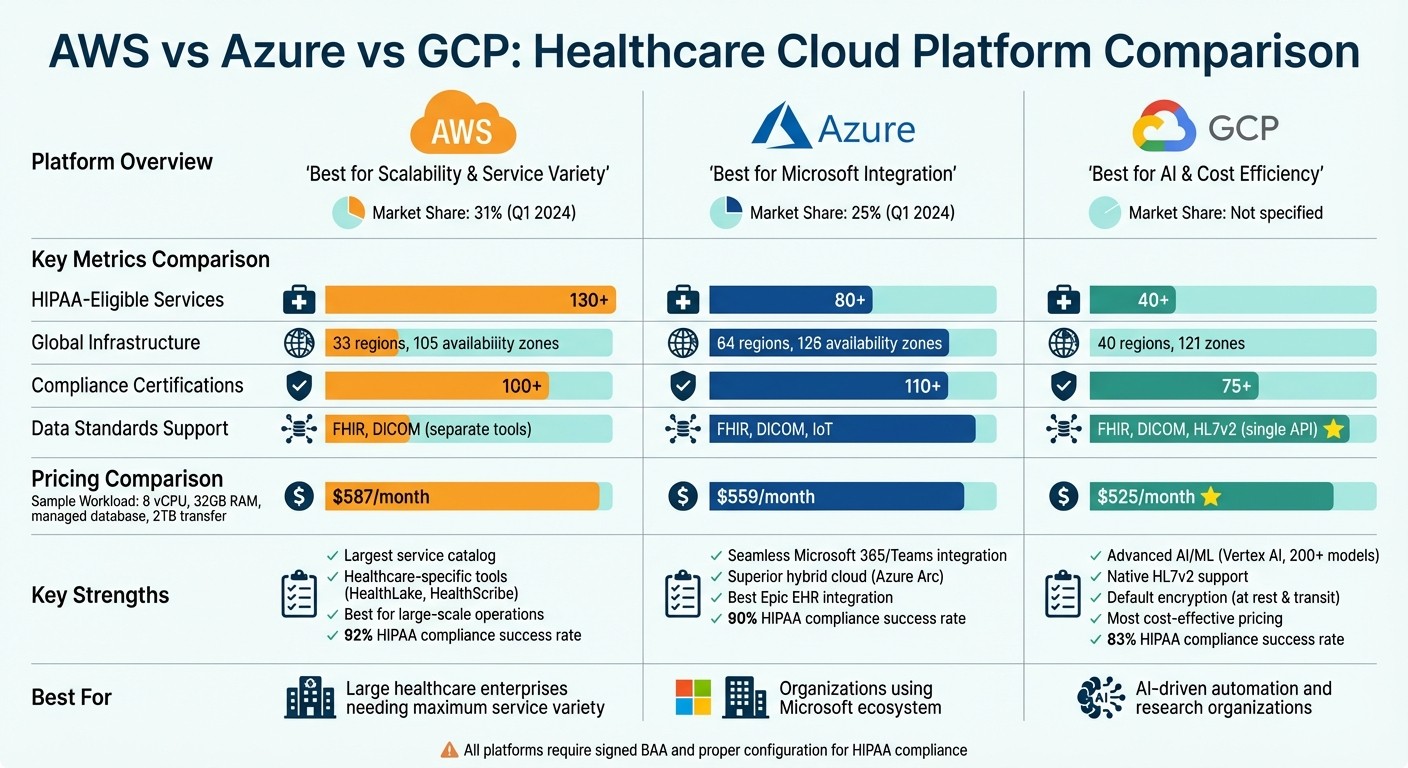
AWS vs Azure vs GCP Healthcare Cloud Platform Comparison
AWS: Wide Service Range and Healthcare Focus
Core Features for Healthcare Automation
When it comes to healthcare automation, efficient data management and rapid processing are essential - and AWS delivers with a suite of services tailored to these needs. AWS’s healthcare tools are built on six specialized services designed to handle the unique challenges of the industry [7]. For example, AWS HealthLake serves as a managed FHIR R4 data store, capable of managing petabyte-scale data with sub-second latency. Its "Zero-ETL" feature automatically converts FHIR data into analytics-ready formats like Apache Iceberg, simplifying workflows [5].
For clinical documentation, AWS HealthScribe uses generative AI to analyze patient-clinician interactions, creating preliminary clinical notes that reduce administrative burdens. Meanwhile, Amazon Comprehend Medical extracts critical medical details - like medications, conditions, and dosages - from unstructured text and maps them to standard ontologies such as ICD-10 and SNOMED CT. AWS HealthImaging provides instant access to large-scale DICOM medical imaging data, enabling faster diagnostics [7].
These tools are already making an impact. For instance, MHK sped up its payor interoperability efforts by nine months using AWS HealthLake [5]. Similarly, Greenway Health achieved transaction speeds exceeding 8,000 per second with the same service [5]. AWS also supports electronic health record (EHR) systems like Epic and Cerner through its "Epic on AWS" offering, which automates security and optimizes EHR workloads [7].
Compliance and Security Capabilities
AWS takes compliance and security seriously, offering 166+ HIPAA-eligible services as of March 2026, the largest catalog available [6]. The platform is HITRUST CSF Certified for version 9.3, which integrates HIPAA, HITECH, and other healthcare standards. AWS also uses advanced encryption protocols to protect PHI, ensuring data security both at rest and in transit - exceeding standard requirements [1].
Security tools like Amazon Macie automatically identify and classify PHI stored in S3 buckets. AWS CloudTrail provides immutable audit logs, while Amazon GuardDuty offers continuous threat detection [1][3]. These tools have proven effective in real-world scenarios. For example, Baptist Memorial Health Care migrated its clinical systems to AWS, resulting in a 20% boost in system performance across 22 hospitals and over 200 clinics [7].
AWS’s commitment to healthcare is also recognized by the industry. In 2025, it became the first recipient of the "Best in KLAS for Public Cloud" award, earning top marks for performance and reliability from healthcare providers [7].
"The real differentiator was the maturity of healthcare-specific services and how easily our engineering team could implement defense-in-depth without reinventing the wheel." – Daniel Ashcraft, Healthcare Software Architect [1]
With a strong security framework and extensive global infrastructure, AWS ensures healthcare systems remain scalable and reliable, even under demanding conditions.
Scalability and Ecosystem Size
AWS stands out with its massive global infrastructure, operating 126 data centers worldwide - more than any other provider. Each region includes at least three Availability Zones, ensuring strong availability and disaster recovery capabilities [8]. This infrastructure proved its worth when Singapore’s Integrated Health Information Systems (IHiS) scaled its vaccination IT systems from 8,000 to 80,000 daily vaccinations in just four weeks [6].
AWS HealthLake alone processes billions of transactions annually, supporting enormous repositories that enable real-time clinical insights [5]. Additionally, the AWS Partner Network and Marketplace offer pre-built connectors that simplify the transformation of legacy data into FHIR format, speeding up integration projects [5][7].
With a 31% share of the global cloud infrastructure market as of Q1 2024, AWS has established itself as a dominant force in healthcare cloud services, offering unmatched scalability and market presence [8].
Azure: Enterprise Integration and Hybrid Cloud Options
Microsoft Tool Integration
Azure stands out for its seamless integration with Microsoft's enterprise tools, which is a big deal considering that 90% of healthcare infrastructures already rely on Microsoft products [1].
The platform connects effortlessly with Microsoft Teams for virtual care automation, Dynamics 365 for managing patient engagement and care coordination, and Power BI for creating real-time clinical dashboards. Through Azure Health Data Services, healthcare providers can turn FHIR and DICOM data into actionable insights without needing custom-built integration layers [1].
Identity management is another area where Azure simplifies operations. Microsoft Entra ID (formerly Azure Active Directory) streamlines access across clinical apps, Microsoft 365, and administrative portals using single sign-on (SSO). It also supports multi-factor authentication (MFA), role-based access control (RBAC), and Privileged Identity Management (PIM), cutting down the hassle of juggling multiple authentication systems [1][3].
"The ability to use Azure AD for single sign-on across our clinical applications, admin portals, and Microsoft 365 eliminated a massive identity management headache." – Healthcare Technology Leader [1]
Azure also integrates with Nuance Dragon Medical SpeechKit and Dragon Copilot to enable AI-driven transcription within the Microsoft environment. Additionally, the Data Integration Toolkit keeps patient information in sync across Dynamics 365, creating a unified view for care management [1].
Azure's hybrid cloud capabilities add even more flexibility for healthcare organizations.
Hybrid Cloud and Edge Computing
Healthcare providers often face the challenge of balancing sensitive patient data between on-premises systems and the cloud. Azure addresses this with its hybrid solutions. Azure Arc allows IT teams to manage on-premises infrastructure like virtual machines, Kubernetes clusters, and SQL databases through a unified interface [9][10]. According to a Forrester study, organizations using Azure Arc saw a 304% ROI within three years [10].
For on-premises needs, Azure Local (formerly Stack HCI) delivers hyperconverged infrastructure, ensuring low latency and data sovereignty - critical for EHR systems that require real-time responses and secure patient data handling [9][10]. Meanwhile, Azure Stack Edge brings AI/ML capabilities directly to healthcare facilities, enabling quick processing of medical imaging or IoT data before transferring it to the cloud [9].
Azure's global reach is another advantage, operating 160 data centers across 60 regions and holding a 25% share of the global cloud infrastructure market as of Q1 2024 [8]. This extensive network supports disaster recovery and ensures compliance with data residency requirements in various regions.
Compliance and Security Tools
In addition to its integration capabilities, Azure offers robust tools to meet regulatory and security needs. For healthcare providers, Azure includes a HIPAA Business Associate Agreement (BAA) by default through its Product Terms and Data Protection Addendum. It also supports over 80 HIPAA-eligible services, such as Azure Health Data Services [1][3].
Azure Policy simplifies compliance with built-in initiatives for HIPAA and HITRUST. It maps regulatory controls to Azure configurations and provides a dashboard to monitor compliance at scale. Microsoft Defender for Cloud continuously evaluates environments against HIPAA standards, flagging violations and suggesting fixes [3].
For hybrid setups, Azure Local employs BitLocker XTS-AES 256-bit encryption for data at rest and TLS 1.2/1.3 for data in transit, meeting the 2026 HIPAA Security Rule's encryption requirements. Microsoft Sentinel enhances security by automating the detection of unusual access patterns to PHI across cloud and on-premises systems [1][3].
Azure also meets stringent federal standards, holding a FedRAMP High Provisional Authorization to Operate (P-ATO), which helps healthcare organizations align with HIPAA Security Rule requirements [11].
These capabilities make Azure a strong choice for healthcare organizations navigating complex data protection and privacy regulations.
GCP: AI Capabilities and Lower Costs
AI and Machine Learning Tools for Healthcare
Google Cloud Platform (GCP) places a strong emphasis on AI and machine learning, offering tools specifically designed to enhance healthcare operations. The Vertex AI Platform provides access to over 200 foundation models, including the Gemini 3 series. This multimodal system can process patient charts, medical images, and lab reports all at once, making it a powerful tool for healthcare providers [12][14].
For handling medical text, the Healthcare Natural Language API is a game-changer. It extracts key clinical insights from unstructured notes and maps them to standard terminologies such as ICD-10-CM, SNOMED CT, RxNorm, and LOINC. This reduces the manual effort involved in billing and documentation, streamlining workflows [18].
On the medical imaging front, GCP's Medical Imaging Suite enables AI-driven analysis of DICOM data, facilitating automated detection of diseases in X-rays and MRIs [16][17]. Additionally, Vertex AI Search for Healthcare allows clinicians to search across fragmented data sources like patient records, lab results, and even public healthcare databases, all through a search interface tailored for medical use [16][17].
Real-world applications demonstrate the impact of these tools. In April 2026, Seattle Children's Hospital used Gemini and Vertex AI to revolutionize pediatric care by leveraging AI-powered insights [17]. Similarly, HCA Healthcare adopted generative AI on GCP to cut down the 10 million hours nurses spend annually on administrative tasks like paperwork and patient handoffs [17].
For population health analytics, BigQuery ML stands out. It lets healthcare organizations build and run machine learning models directly within their data warehouse using SQL, offering a seamless integration with GCP's Healthcare API [15].
"GCP is renowned for its AI-first approach... Vertex AI provides a unified platform for managing ML workflows, from data preparation to model deployment." – Andrzej Bedychaj, Data Science Engineer, N-iX [15]
These tools not only enhance healthcare operations but also align with GCP's strong support for healthcare data standards.
Healthcare Data Standards Support
GCP's commitment to healthcare extends beyond AI. Its Cloud Healthcare API brings support for essential data standards like FHIR (DSTU2, STU3, R4), DICOM (DICOMweb standard), and HL7v2 into one managed service [22][23]. This single-service approach simplifies processes, unlike AWS and Azure, which often require multiple services or custom implementations for HL7v2 [1].
The API boasts impressive performance, offering 99.999999999% annual durability and the ability to handle thousands of requests per second [22]. It also supports bulk imports and exports to BigQuery for analytics and includes built-in de-identification tools, making it ideal for research and compliance workflows [22][1].
For example, Hackensack Meridian Health successfully migrated its Epic system to Google Cloud, using Looker and BigQuery to create a "single source of truth" for real-time clinical insights [17]. This level of integration makes GCP particularly appealing for research and diagnostics powered by AI.
"The Healthcare API uniquely supports FHIR, DICOM, and HL7v2 within a single managed service... Best choice for research organizations and AI-driven diagnostics." – Daniel Ashcraft [1]
Pricing Benefits for Healthcare Data Processing
GCP also offers competitive pricing options that are especially beneficial for healthcare organizations managing large data volumes. Unlike AWS and Azure, which require upfront commitments to unlock savings, GCP automatically applies Sustained Use Discounts (SUDs) based on monthly usage [21].
"GCP often provides the most cost efficient pricing for sustained compute workloads due to sustained usage discounts." – Veritis Group [21]
For the Healthcare API, GCP provides a free tier that includes 1 GB of storage and 25,000 requests per month [13]. Storage costs are approximately $0.020 per GB per month, which is lower than AWS and Azure's $0.023 per GB [21]. Outbound data transfer costs range from $0.08–$0.11 per GB, slightly undercutting AWS's $0.09–$0.12 rates [21]. Specifically, the Healthcare API allows the first 25,000 requests per month for free, with additional requests priced at $0.39 per 100,000 [13][19].
Vertex AI also offers flexible billing, charging in 30-second increments for training and prediction tasks [20]. Inbound data transfers to GCP are free, and there are no charges for data transfers between the Healthcare API and other Google Cloud services within the same region [13].
HIPAA in the Cloud: GCP vs AWS vs Azure - Who Leads in 2026?
Compliance, Security, and Data Protection Across Platforms
Before handling any Protected Health Information (PHI), healthcare organizations must secure a signed Business Associate Agreement (BAA) from AWS, Azure, or GCP [1][3]. Without this agreement, organizations risk facing significant legal challenges.
The updated 2026 HIPAA Security Rule now requires encryption for PHI both at rest and during transit [1]. Among the major platforms, GCP stands out by offering encryption at rest and in transit as a default setting, while AWS and Azure require users to enable these features manually [4].
"Google offers encryption at rest and in transit by default. With AWS and Azure, you've got to enable that feature." - Adam Zeineddine, host of the HIPAA Insider Show [4]
When it comes to HIPAA-eligible services, AWS leads with over 100 options, Azure follows with more than 80, and GCP offers around 40 [1]. However, the sheer number of services isn't the sole determinant of security. The real challenge lies in proper configuration. Missteps in setup can create vulnerabilities, regardless of the platform.
"HIPAA compliance in the cloud isn't just about picking AWS, Google, or Microsoft. All three have the certifications - the real risk is misconfiguration." - Adam Zeineddine [4]
This compliance framework lays the groundwork for the advanced security measures discussed below.
Compliance and Security Comparison Table
Here's a breakdown of key compliance and security features across AWS, Azure, and GCP:
Feature | AWS | Azure | GCP |
|---|---|---|---|
Total Certifications | 100+ | 110+ | 75+ |
HIPAA-Eligible Services | 100+ | 80+ | 40+ |
BAA Availability | Yes (Standard/Account-wide) | Yes (Enterprise terms) | Yes (Standard terms) |
Encryption Default | Manual setup required | Manual setup required | On by default |
Audit Logging Tool | CloudTrail | Azure Monitor / Sentinel | Cloud Audit Logs |
Compliance Automation | Security Hub / Config | Defender for Cloud / Policy | Security Command Center |
Threat Detection | GuardDuty / Inspector | Defender for Cloud / Sentinel | Security Command Center |
Distinct Feature | Macie (PHI Discovery) | Azure Policy (Continuous Compliance) | VPC Service Controls (Exfiltration Protection) |
AWS boasts a 92% success rate for HIPAA compliance implementations, slightly ahead of Azure at 90% and GCP at 83% [25]. Azure leads in overall compliance certifications with 110+, followed by AWS with 100+ and GCP with 75+ [25]. For organizations already using Microsoft tools, Azure integrates seamlessly with Entra ID (formerly Active Directory), which handles 30 billion daily authentication requests [24]. Meanwhile, GCP's VPC Service Controls offer a robust security perimeter to prevent data exfiltration - a feature that sets it apart from the competition [1].
These security measures not only address compliance requirements but also support scalable and integrated healthcare solutions, as highlighted in earlier discussions.
Scalability and Healthcare System Integration
Healthcare systems often face unexpected demand spikes, whether it’s flu season, a public health crisis, or an influx of telemedicine appointments. AWS Karpenter stands out for its speed, provisioning new Kubernetes nodes in less than 60 seconds [26]. This quick response is crucial for moments when emergency departments require immediate access to patient records or telehealth platforms need to handle a sudden surge in users.
Azure Virtual Machine Scale Sets (VMSS) allows for scheduled scaling, making it possible to prepare for predictable increases in patient portal traffic, such as during flu season [26][27]. Meanwhile, GCP's GKE Autopilot takes a hands-free approach by managing the entire node lifecycle automatically [26].
All three platforms now use machine learning to forecast demand and proactively adjust resources. A healthcare software architect shared:
"Karpenter on AWS offers the fastest scale-out and most flexible instance selection" [26]
For unpredictable traffic, GCP Cloud Run automatically adjusts based on concurrent requests, making it a strong option for patient portals.
Infrastructure footprint is another factor, especially for disaster recovery and data residency needs. AWS spans 33 geographic regions and 105 availability zones, Azure operates in 64 regions with 126 availability zones, and GCP covers 40 regions with 121 zones [28]. Beyond scaling, ensuring compliance with healthcare data standards remains a top priority.
FHIR, DICOM, and HL7v2 Standard Support
Efficient scaling is only half the battle; managing diverse healthcare data formats is equally important. Google Cloud Platform (GCP) is the only provider offering native, managed support for all three major healthcare data standards - FHIR, DICOM, and HL7v2 - within its Cloud Healthcare API [3][1]. This is a key advantage for organizations juggling modern FHIR-based applications, legacy HL7v2 messages, and DICOM-format medical imaging simultaneously.
AWS HealthLake specializes in FHIR R4, automatically indexing and structuring health data for analysis, while AWS HealthImaging focuses separately on medical imaging [5][1]. However, organizations needing HL7v2 support often have to rely on custom implementations or AWS partners. Azure Health Data Services, on the other hand, unifies FHIR, DICOM, and MedTech IoT services, though HL7v2 integration requires a distinct approach [3][1].
GCP's HL7v2 Store directly ingests legacy messages into BigQuery, enabling powerful population health analytics [1]. This unified capability makes GCP a strong choice for healthcare organizations handling varied data formats.
EHR/EMR System Integration
Bridging these data standards is crucial for synchronizing older EHR systems with modern clinical tools. Azure has a strong edge in Epic integration, thanks to its Microsoft connections. Healthcare organizations can run Epic directly on Azure infrastructure, integrating seamlessly with Office 365, Teams, and Active Directory [3][1]. One healthcare software architect noted:
"The Azure Health Data Services FHIR API gave us a standards-based integration layer that connected our legacy EHR to modern patient engagement apps in weeks, not months" [1]
AWS supports Epic and Cerner integrations through its Partner Network and HealthLake, while GCP connects legacy HL7v2 systems with modern FHIR-based applications via its Healthcare API [3][1]. Although GCP has a smaller market share, it handles a significant number of healthcare and finance workloads due to its advanced analytics and machine learning tools [2].
All three platforms require a signed Business Associate Agreement (BAA) before migrating any Protected Health Information (PHI). Customers are responsible for configuring key elements like identity access management, audit logging, and encryption [4][1]. Ultimately, the best platform often depends on existing infrastructure: Azure works well for Microsoft-centric environments, AWS offers the widest range of services, and GCP excels for organizations prioritizing AI-driven analytics and native HL7v2 support. These integration options empower healthcare providers to combine cutting-edge cloud solutions with their existing systems.
Pricing for Healthcare Automation Workloads
Healthcare organizations need to dig deeper than surface-level pricing when evaluating the cost of automation workloads in the cloud. While providers may advertise similar base prices, the actual monthly expenses depend heavily on factors like configuration, data transfer, and commitment levels.
Price Comparison for Similar Configurations
For a medium-sized workload - think 8 vCPU, 32GB RAM, managed database, and 2TB of data transfer - here’s how the numbers stack up:
AWS: Around $587
Azure: About $559
GCP: Roughly $525 [21]
The cost differences are largely due to GCP's lower storage rates (about $0.020/GB compared to AWS's $0.023/GB) and its automatic sustained use discounts, which apply without requiring a long-term commitment [21]. For smaller setups (2 vCPU, 8GB RAM), the gap narrows further, with AWS costing about $164, Azure $157, and GCP $146 [21].
But on-demand pricing only tells part of the story. Long-term contracts can slash costs by up to 72% on AWS and Azure, and 57% on GCP [21][30].
Data transfer fees also play a big role. For example, data egress costs average $0.09/GB on AWS, $0.087/GB on Azure, and $0.08/GB on GCP's standard tier [29]. For workloads like API-heavy patient portals or telemedicine platforms transferring 10TB monthly, this translates to about $920 on AWS versus $820 on GCP - a difference that grows with scale [29].
"The headline instance price is rarely what you actually pay - discounts, sustained use credits, committed use contracts, and egress fees dramatically change the effective price."
Alex Thompson, CEO & Cloud Architecture Expert, ZeonEdge [29]
Additional Costs for Managed Healthcare Services
Specialized healthcare services come with extra costs. GCP’s Healthcare API is the most budget-friendly option for FHIR, DICOM, and HL7v2 support, while AWS HealthLake charges more for its advanced clinical NLP features [1]. Organizations with existing Microsoft licenses can benefit from Azure Hybrid Benefit, cutting up to 76% off Windows Server and SQL Server workloads [30].
For GPU-heavy AI tasks, GCP leads with spot instances costing about $2,120/month for 8× A100 GPUs, compared to $2,310 on AWS and $2,605 on Azure [29].
These details highlight the importance of understanding pricing structures when balancing performance, compliance needs, and budget constraints in healthcare automation.
Conclusion: Selecting the Right Cloud Platform for Healthcare Automation
Main Points from the Comparison
AWS stands out with over 130 HIPAA-eligible services, making it a strong choice for large-scale, customized healthcare applications that require extensive third-party integrations[3].
Azure simplifies identity management for organizations already using Microsoft 365, Teams, or Active Directory. Its hybrid capabilities, powered by Azure Arc, make it easier to integrate with legacy EHR systems like Epic. Additionally, its more than 90 compliance certifications help reduce administrative hurdles[1].
GCP shines when it comes to AI-driven healthcare automation and data analytics. Its Healthcare API supports key standards like FHIR, DICOM, and HL7v2, while offering cost-effective solutions with default encryption for data at rest and in transit[4].
Decision-Making Framework
Choosing the right platform boils down to infrastructure needs, cost considerations, and compliance requirements. Start by evaluating your current setup. For organizations heavily reliant on Microsoft 365 and Active Directory, Azure offers streamlined identity management. Meanwhile, AI-driven projects, such as clinical natural language processing or predictive analytics, are better suited for GCP, thanks to its advanced AI tools and transparent pricing structure[31].
Cost is another essential factor. GCP often provides lower compute and storage costs, while AWS and Azure offer savings through programs like Savings Plans and the Azure Hybrid Benefit, which can cut Windows Server expenses by up to 40%[31].
"The right choice depends on your priority: a mature, do-it-all ecosystem, seamless hybrid cloud capabilities, or bleeding-edge AI."
– CloudToggle[2]
It’s important to note that none of these platforms are HIPAA compliant out of the box. Compliance requires a signed BAA, proper encryption, access controls, and audit logging to meet the 2026 HIPAA Security Rule[1].
For healthcare automation tools that integrate seamlessly with AWS, Azure, or GCP, Lead Receipt (https://leadreceipt.com) offers AI-powered receptionists and workflow automation. Their 24/7 AI receptionists handle tasks like call management, scheduling, and lead processing while syncing with existing CRMs and scheduling systems.
Ultimately, the best platform for healthcare automation will depend on your organization’s priorities - whether you need a comprehensive service ecosystem, smooth Microsoft integration, or advanced AI capabilities.
FAQs
How do I choose between AWS, Azure, and GCP for my healthcare automation goals?
Choosing between AWS, Azure, and GCP comes down to your specific needs around compliance, security, and integration.
AWS: Known for having the largest catalog of HIPAA-eligible services, AWS is a strong choice for handling complex workloads that require a wide range of tools and resources.
Azure: If your organization relies heavily on Microsoft-based enterprise systems, Azure's seamless integration with those tools makes it a natural fit.
GCP: Google Cloud stands out in healthcare for its advanced AI and analytics capabilities, making it a great option for organizations focusing on data-driven insights.
Whichever platform you choose, make sure to configure it correctly - this includes setting up encryption, access controls, and signing a Business Associate Agreement (BAA) for HIPAA compliance. Ultimately, your decision should reflect your infrastructure, the nature of your workloads, and your scalability goals.
What do I need to do to be HIPAA-compliant after moving PHI to the cloud?
To keep your PHI (Protected Health Information) secure and meet HIPAA requirements after migrating to the cloud, you need to take a few critical steps:
Sign a Business Associate Agreement (BAA): This is a must-have document between you and your cloud provider. It outlines each party's responsibilities for protecting PHI.
Use HIPAA-eligible services: Not all cloud services meet HIPAA standards. Make sure the ones you choose are explicitly designed for HIPAA compliance.
Implement key security measures: This includes enabling encryption, setting up audit logging, applying strict access controls, and using network segmentation to limit data exposure.
One important thing to note: compliance isn't automatic just because you're using a HIPAA-ready cloud platform. It’s your responsibility to configure and manage these features correctly to ensure full compliance.
Which cloud is best for integrating Epic and healthcare data standards (FHIR, HL7v2, DICOM)?
Google Cloud Platform (GCP) excels in supporting healthcare systems by integrating Epic and adhering to critical healthcare data standards like FHIR, HL7v2, and DICOM. Its fully managed Healthcare API simplifies data sharing and ensures compatibility across systems, enabling advanced analytics and streamlined workflows. While AWS and Azure also provide tools for data interoperability, GCP’s specialized focus on healthcare solutions positions it as a top option for scalable and reliable integrations in healthcare automation.