
AI Trends in Cloud Automation for Healthcare 2026
Healthcare Technology
Updated May 18, 2026
AI-driven cloud automation is essential for healthcare, cutting admin costs and improving care while demanding stricter HIPAA governance.
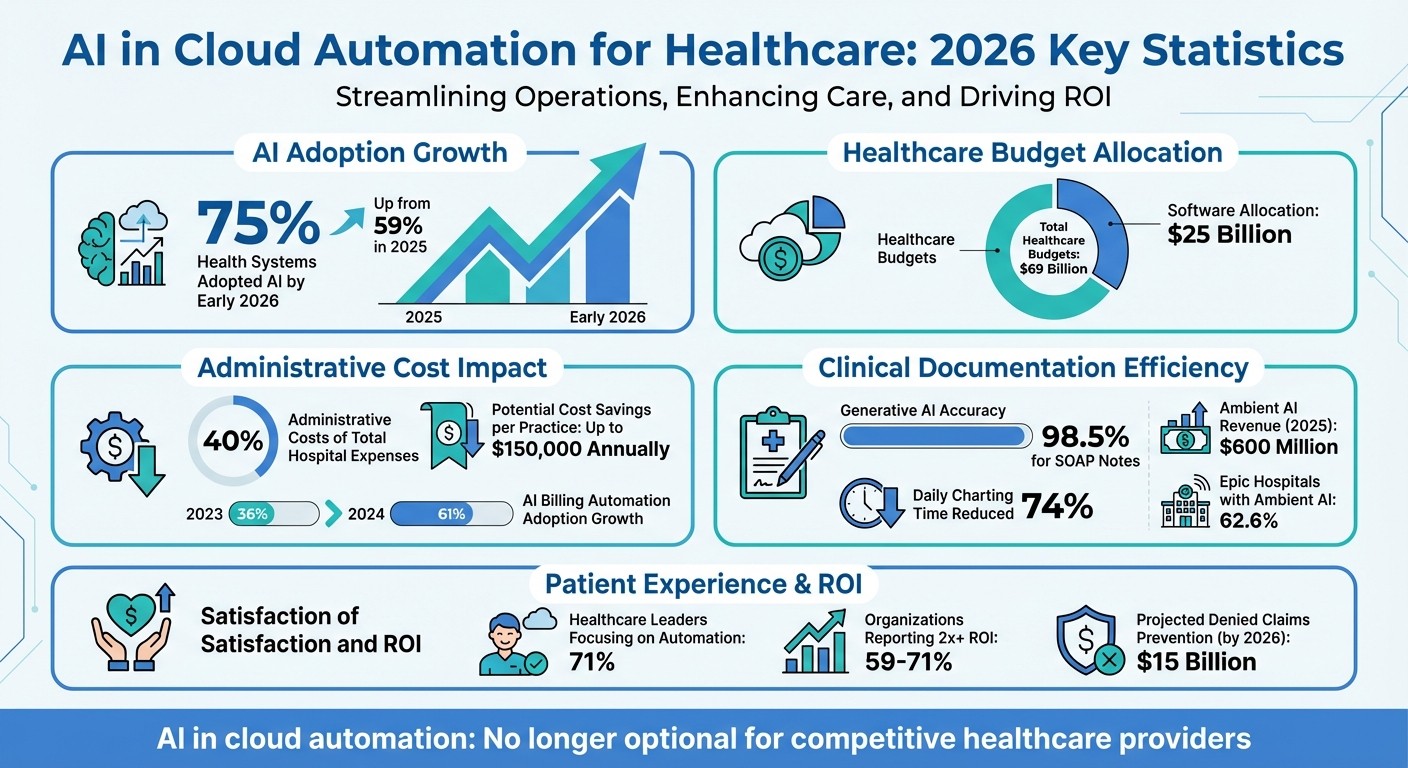
AI is transforming healthcare operations, with cloud automation leading the charge. By early 2026, 75% of health systems had adopted AI, up from 59% the previous year. With healthcare budgets hitting $69 billion, and $25 billion allocated to software, organizations are prioritizing tools that improve efficiency and reduce costs. Key trends include:
Generative AI for clinical documentation: Automates SOAP notes with 98.5% accuracy, saving time and reducing clinician workload.
24/7 workflow automation: Cuts administrative costs, which account for 40% of hospital expenses, by streamlining billing, scheduling, and patient intake.
Hybrid cloud platforms: Manage complex tasks like document processing while ensuring compliance with updated HIPAA regulations.
AI also enhances patient experience, with 71% of healthcare leaders focusing on automation investments. Tools like AI-powered receptionists handle calls, scheduling, and lead management, saving practices up to $150,000 annually. However, success depends on strong governance frameworks and scalable cloud solutions. Healthcare providers must align AI systems with HIPAA updates, including stricter security measures and mandatory audit logging.
The bottom line? AI in cloud automation is no longer optional - it's a necessity for cutting costs, improving care, and staying competitive.
AI Adoption and Cost Savings in Healthcare 2026: Key Statistics
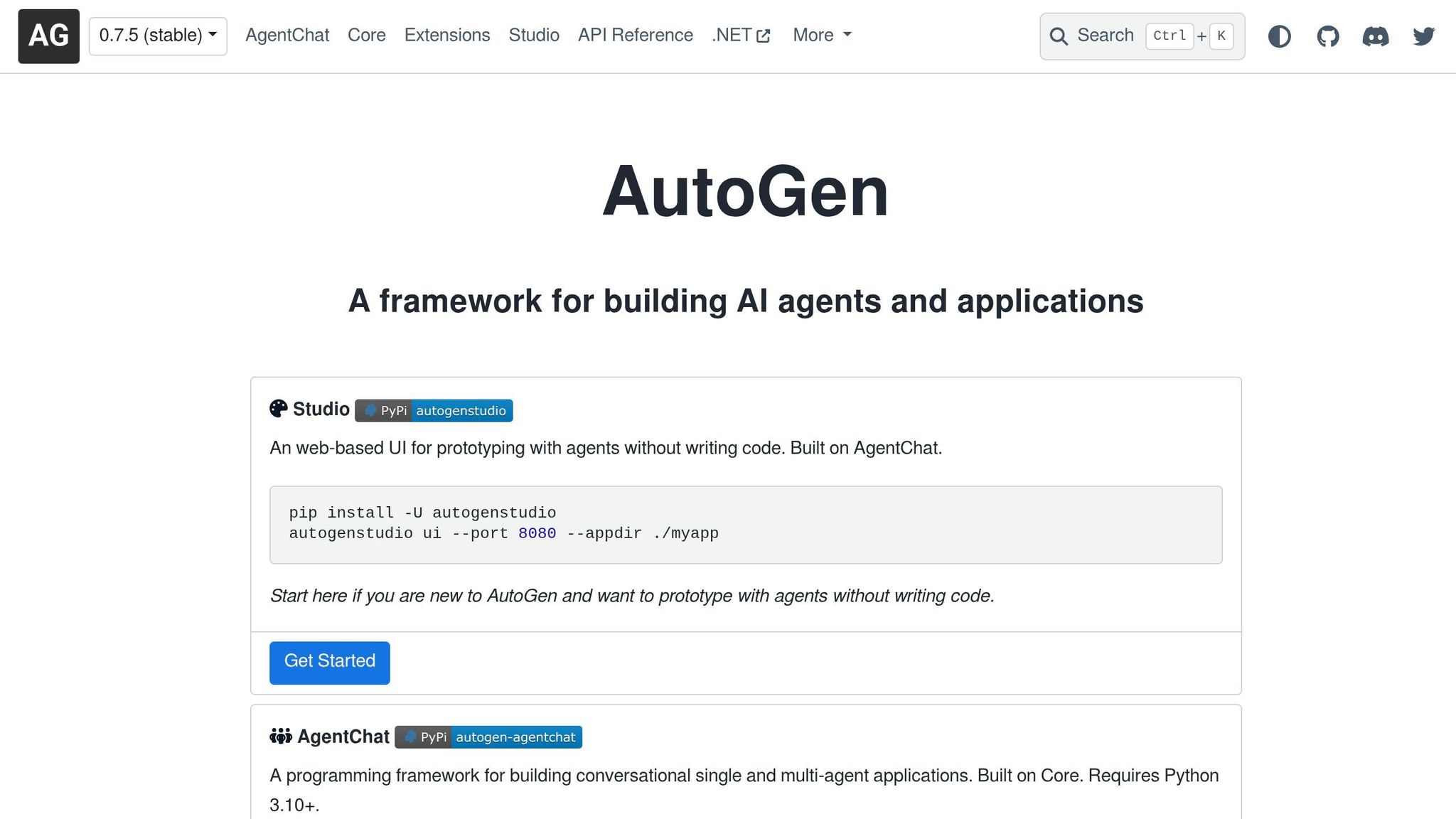
Building Cloud Native Agentic Workflows in Healthcare with AutoGen
Major AI Trends in Cloud Automation for Healthcare
Healthcare organizations are no longer just experimenting with AI - they’re deploying it on a large scale. Three key trends are reshaping cloud automation in the healthcare sector: generative AI for clinical documentation, 24/7 workflow automation, and hybrid cloud architectures designed for handling complex document processing.
Generative AI for Documentation and Care Optimization
Generative AI, particularly ambient AI, is transforming clinical documentation. These systems can transcribe provider-patient conversations into structured SOAP notes with 98.5% accuracy for common conditions [7]. By mid-2025, 62.6% of Epic hospitals had adopted ambient AI documentation tools [8].
The impact is clear: ambient AI documentation generated $600 million in revenue in 2025 and reduced daily charting time by 74% in some cases [7][8]. For example, Kaiser Permanente began implementing Abridge's ambient documentation solution across 40 hospitals and numerous outpatient facilities in 2025, aiming to ease the documentation workload for clinicians [8].
These tools integrate seamlessly with cloud-based EHR platforms like Epic, Oracle Health, and Cerner, automatically populating documentation fields without requiring manual input [6][8]. AI models are now trained with specialty-specific vocabularies for fields like behavioral health, oncology, and cardiology, ensuring they capture the right context [6][7]. Beyond transcription, these systems analyze clinical data to flag potential drug interactions, suggest diagnoses, and identify care gaps in real time [6][8].
"AI is no longer a theoretical conversation - it's a practical, revenue-impacting reality." - Jon Hilton, AI Practice Leader, LBMC [1]
Experts are calling this shift the "agentic AI era", where systems go beyond simple tasks to autonomously manage workflows like claims processing and scheduling [9][5]. For instance, in 2025, Highmark Health reported $27.9 million in AI-enabled value through its generative AI assistant, "Sidekick", which handled over 6 million prompts across 74 use cases - up from 1 million the previous year [9].
While documentation improvements are a major focus, AI is also driving efficiency in administrative workflows around the clock.
24/7 AI-Powered Workflow Automation
Administrative tasks consume a staggering 40% of total hospital expenses [10], with costs growing 87.2% between 2011 and 2023 - far outpacing spending on direct patient care [10]. Clinicians spend about 77% of their time on non-clinical tasks [11].
AI-powered workflow automation is helping to address this burden. Adoption of AI billing automation by U.S. hospitals jumped from 36% to 61% between 2023 and 2024 [11]. By 2026, Waystar's "AltitudeAI" is projected to help healthcare providers prevent more than $15 billion in denied claims while cutting appeal and documentation workflows by 90% [9].
Unified platforms now streamline processes like patient intake, insurance verification, and EHR documentation into a single workflow [11]. Building on AI's documentation capabilities, this automation improves operational efficiency across the board. For instance, Sentara Health introduced an agentic AI solution for virtual nursing in 2026, reclaiming thousands of nursing hours within months by automating care management and documentation [5]. This allows healthcare providers to handle more patients without increasing administrative staff [11].
Hybrid Cloud Architectures and Intelligent Document Processing
To complement advancements in documentation and workflow automation, healthcare organizations are adopting hybrid cloud architectures. These systems blend deterministic rules, large language models, and generative AI to manage both routine and complex tasks [13]. This layered approach enhances explainability and auditability, which are critical in regulated industries like healthcare [13].
Manual document handling continues to pose challenges, with 30% of medical tests reordered due to missing information and 25% of faxes arriving too late to be useful [13]. AI-powered ingestion layers now normalize documents from faxes, scans, emails, and portals, reducing errors caused by manual processing [13].
Real-time intelligent document processing has replaced batch workflows, enabling instant extraction of data critical for scheduling and care coordination [13]. With 85% of healthcare leaders prioritizing better data sharing and interoperability [14], and 52% of the market still using non-Epic EMRs [3], there’s a growing need for AI platforms that work across fragmented systems.
"The organizations seeing real returns are the ones doing the hard foundational work on data integration and process optimization first." - Justin Conant, Healthcare and AI Growth Expert, LBMC [1]
Rising analog phone line costs - up 300-400% in some areas - are also driving the shift to cloud-based communication, which supports intelligent document processing [13]. These advancements lay the foundation for scalable, enterprise-level automation in healthcare.
AI-Powered Receptionist and Lead Automation Solutions
Generative AI is reshaping clinical documentation and workflow automation, but front-office operations in healthcare still face big hurdles. Did you know that medical practices lose about $150,000 annually due to missed calls and scheduling issues? On top of that, 30% of patients hang up after waiting just one minute, and 89% switch providers because of delays in care navigation [17][15].
AI-powered receptionist solutions are stepping in to tackle these problems. These systems handle patient intake, appointment scheduling, and lead management 24/7. Using advanced audio-to-audio technology with multimodal models, they deliver lightning-fast response times of 100 milliseconds [15]. Some even include a clever backup: if voice recognition struggles during a call, the AI sends a real-time SMS so patients can provide information via text, which is then fed back into the ongoing conversation [17]. This innovation is helping medical practices streamline their front-office operations like never before.
24/7 Call Handling and Lead Management
Imagine saving thousands of hours in staff time while improving patient satisfaction. That’s exactly what Virtua Health achieved by deploying voice AI. Handling over 200,000 calls annually, they saved 4,395 agent hours in just one month, boosted their "Ease of Scheduling" metric by 29%, and saw a 3.5x ROI [15].
Similarly, Mississippi Sports Medicine & Orthopaedic Center automated appointment confirmation and rescheduling for 20% of their inbound call volume, cutting down 2,000 calls and 112 staff hours per month. This translated into savings equivalent to a full-time position - around $43,000 per year [15].
Companies like Lead Receipt are leading the charge with AI-powered receptionist solutions specifically designed for healthcare. Their tools provide around-the-clock call handling, manage leads, and automate scheduling. Plus, they integrate seamlessly with existing CRMs and scheduling software, ensuring patient inquiries are captured, appointments are booked, and urgent calls are routed to the right team members - all without missing a beat.
Integration with CRMs and Workflow Systems
AI receptionist platforms don’t just answer calls - they also integrate effortlessly with CRMs and scheduling tools. This streamlines patient intake and follow-up, reducing the administrative load on healthcare staff. Considering that 34% of healthcare costs are tied to administrative tasks [16], automating these front-office operations allows teams to focus more on patient care.
Lead Receipt’s solutions are designed with compliance in mind. They’re HIPAA compliant and include Business Associate Agreements (BAAs) to ensure data security and meet regulatory standards.
Pricing Plans for Healthcare Businesses
Lead Receipt offers flexible pricing plans to suit healthcare organizations of all sizes:
Starter Plan: For $300/month, you get a 24/7 web-chat receptionist to handle intake processes.
Professional Plan: At $750/month, this option adds a dedicated AI voice and chat receptionist, supports 5 languages, handles up to 100 AI calls per day, includes call recordings, and offers priority support.
Enterprise Plan: Custom pricing for unlimited AI calls, support for over 32 languages, fully customizable automation, dedicated AI consulting, and VIP support.
When compared to human receptionists, who typically cost between $35,000 and $45,000 annually per full-time position [18], AI receptionist solutions offer a 90%+ cost reduction [18]. Many practices report seeing a positive return on investment in just 3 to 6 months [18]. This makes AI-driven solutions an attractive option for healthcare providers looking to cut costs and improve efficiency.
Governance and Scalability in AI-Driven Healthcare Automation
As AI automation becomes a cornerstone in healthcare, governance and compliance have emerged as significant challenges. Nearly 90% of healthcare leaders see AI as a critical tool for improving patient access and easing clinician workloads [19]. Yet, many organizations face hurdles in advancing AI initiatives due to stringent regulations.
"HIPAA remains the single largest compliance hurdle preventing healthcare organizations from moving AI initiatives into production." - Heath Emerson, MBA, Founder & CEO, Apotheon.ai [19]
With HIPAA fines potentially reaching $2,134,831 per violation category by 2026, aligning AI systems with updated regulations is no longer optional [19][20]. The Department of Health and Human Services has finalized updates to the HIPAA Security Rule, with a compliance deadline of February 16, 2026 [20]. These updates demand a closer look at governance frameworks and scalable cloud solutions.
Formalized AI Governance Frameworks
The rapid introduction of AI tools in healthcare has led to fragmented systems, unclear responsibilities, and inconsistent security measures [23]. This has prompted organizations to adopt structured governance frameworks to mitigate risks, including "shadow AI" - the use of unauthorized tools like free ChatGPT for processing patient data [21][25].
One major change under the 2026 HIPAA updates is the elimination of the distinction between "required" and "addressable" safeguards. Now, all technical measures - such as encryption and multi-factor authentication - are mandatory [19]. Healthcare entities must also maintain a documented inventory of all AI software interacting with electronic Protected Health Information (ePHI) to prevent unauthorized access [19]. Additionally, business associates are required to notify covered entities of security incidents within 24 hours [19].
Governance frameworks often include advanced tools like Zero-Trust Governance Runtime systems, which validate every AI action against established policies before execution. Another critical component is Unified Agent Lifecycle Management (UALM). This framework operates across five layers: identity management, orchestration, PHI-bounded context, runtime policy enforcement with kill-switches, and credential-linked decommissioning [19][23].
Inference-level audit logging is also becoming a necessity. This involves capturing details like prompts, context windows, and AI outputs in tamper-proof storage for at least six years [21][22]. Unlike traditional IT logs, these records provide clear evidence of how PHI was processed by AI systems.
"Compliance documentation isn't proof. Evidence is." - Joe Braidwood, CEO, GLACIS [21]
To further enhance compliance, organizations are using de-identification pipelines based on the Safe Harbor method. These pipelines tokenize PHI before it enters AI systems, with re-identification occurring only within secure environments. This structural approach is quickly becoming a benchmark for compliance [19][22].
Scalable Cloud Platforms for Enterprise Adoption
In addition to governance, scalable cloud platforms are key to meeting compliance needs while supporting enterprise-level AI adoption. Major cloud providers like Microsoft Azure, AWS, and Google Cloud now offer HIPAA-compliant AI services bundled with Business Associate Agreements (BAAs). These services include Azure OpenAI, Amazon Bedrock, and Vertex AI [21][22].
Healthcare organizations are adopting three main architecture patterns:
Pattern A (Self-Hosted): Keeps PHI entirely within the organization’s infrastructure, ideal for sensitive data like genomic or behavioral health records.
Pattern B (Hybrid Proxy): De-identifies data before transmitting it to the cloud, suitable for clinical documentation and decision support.
Pattern C (Full Cloud): Transmits PHI directly to cloud services under a BAA, often used for administrative tasks like scheduling and billing [22].
Organizations that implement AI automation have reported a 35% reduction in administrative workload and a 40% improvement in scheduling efficiency [24]. However, these benefits rely on strong foundational work.
"AI doesn't fix broken data or broken processes. The organizations seeing real returns are the ones doing the hard foundational work first." - Justin Conant, Healthcare and AI Growth Expert, LBMC [1]
To ensure scalability, healthcare organizations are focusing on clean data, clearly defined governance rules, and automation that integrates seamlessly with existing workflows [2]. Standards like TEFCA (Trusted Exchange Framework and Common Agreement) are enabling secure and controlled data sharing across different environments [2].
Solutions such as Lead Receipt's Enterprise Plan are designed to support scalability. Their offerings include unlimited AI calls, support for over 32 languages, customizable automation, and dedicated AI consulting. Built on HIPAA-compliant infrastructure, these solutions include BAAs and technical safeguards that align with the 2026 regulatory updates, allowing healthcare organizations to expand AI automation without compromising security or compliance.
Conclusion
AI is reshaping healthcare, with trends like clinical documentation and automated workflows driving significant change. By 2026, 75% of health systems are expected to deploy at least one AI solution, up from 59% in 2025 [3]. This rapid adoption highlights the urgency for healthcare providers to embrace AI or risk falling behind, as automated workflows and cost savings push the industry forward.
Conversational AI, for instance, is projected to reduce global agent labor costs by $80 billion by 2026 [12]. For healthcare practices, AI agents have already demonstrated impressive results, cutting administrative burdens by 60% to 75% [11]. Additionally, 59% to 71% of organizations using AI report at least a 2x return on investment across various areas [3]. These numbers underscore how AI directly impacts both financial performance and patient satisfaction.
Agentic AI systems are now capable of automating complex, multi-step processes like patient intake, scheduling, claims review, and billing updates - all with minimal human involvement [4]. However, successful implementation requires more than just adopting new tools. Healthcare organizations must focus on clean data, establish governance frameworks, and ensure compliance with HIPAA regulations.
Platforms like Lead Receipt offer the infrastructure needed to scale AI automation while meeting compliance standards. With features such as 24/7 AI receptionists, seamless CRM integration, and enterprise-grade HIPAA compliance (including BAAs), these solutions allow practices to manage high call volumes without increasing staff. For organizations grappling with tight margins and growing patient demands, integrating well-governed, scalable AI systems is becoming essential for long-term financial stability. Combining robust governance with scalable technology is the key to navigating the evolving healthcare landscape.
FAQs
What’s the safest way to use AI with ePHI under the 2026 HIPAA Security Rule updates?
To use AI safely with ePHI under the 2026 HIPAA Security Rule updates, it's crucial to put strong security measures in place. This includes keeping detailed asset inventories, requiring multi-factor authentication, performing risk analyses tailored to AI, and ensuring thorough audit logging for every AI interaction involving PHI. These practices help safeguard sensitive information and ensure compliance with the updated regulations.
How do hospitals connect AI automation to Epic and other EHR/CRM systems without breaking workflows?
Hospitals are now combining AI automation with systems like Epic and other EHR/CRM platforms to streamline operations. Tools such as Epic's no-code Agent Factory make this process easier by offering a drag-and-drop interface. This setup allows AI agents to efficiently manage tasks like prior authorizations, medical coding, and patient engagement, all while ensuring workflows remain intact. Additionally, Epic’s AI platform incorporates predictive models to align automation with clinical workflows, improving processes without causing interruptions.
How can a 24/7 AI receptionist reduce missed calls and scheduling delays in a U.S. medical practice?
A 24/7 AI receptionist ensures that no calls go unanswered and scheduling stays on track by being available around the clock. It can handle multiple patient interactions simultaneously and take care of tasks like scheduling appointments and sending reminders. This setup reduces hold times, enhances communication, and simplifies workflows, helping medical practices deliver better service while staying attentive to patient needs.