Checklist: Assessing Scalability with AI in Healthcare
Healthcare Technology
Updated May 1, 2026
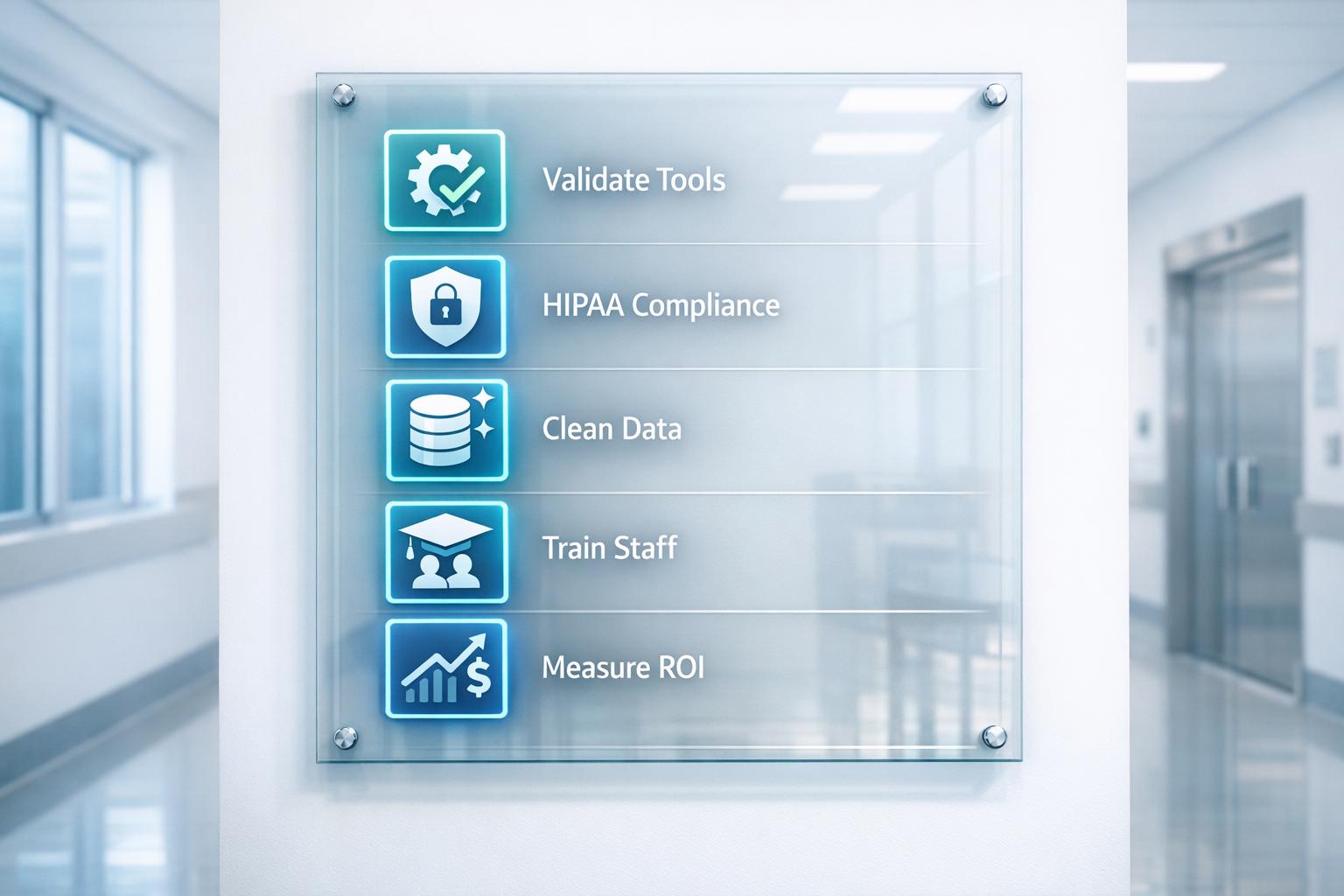
Practical checklist for scaling AI in healthcare: validate tools, ensure HIPAA compliance, fix data, train staff, and measure ROI.
When scaling AI in healthcare, scalability is the key to long-term success. AI can reduce administrative workloads, cut costs, and improve efficiency, but only if implemented carefully. Here’s a quick overview:
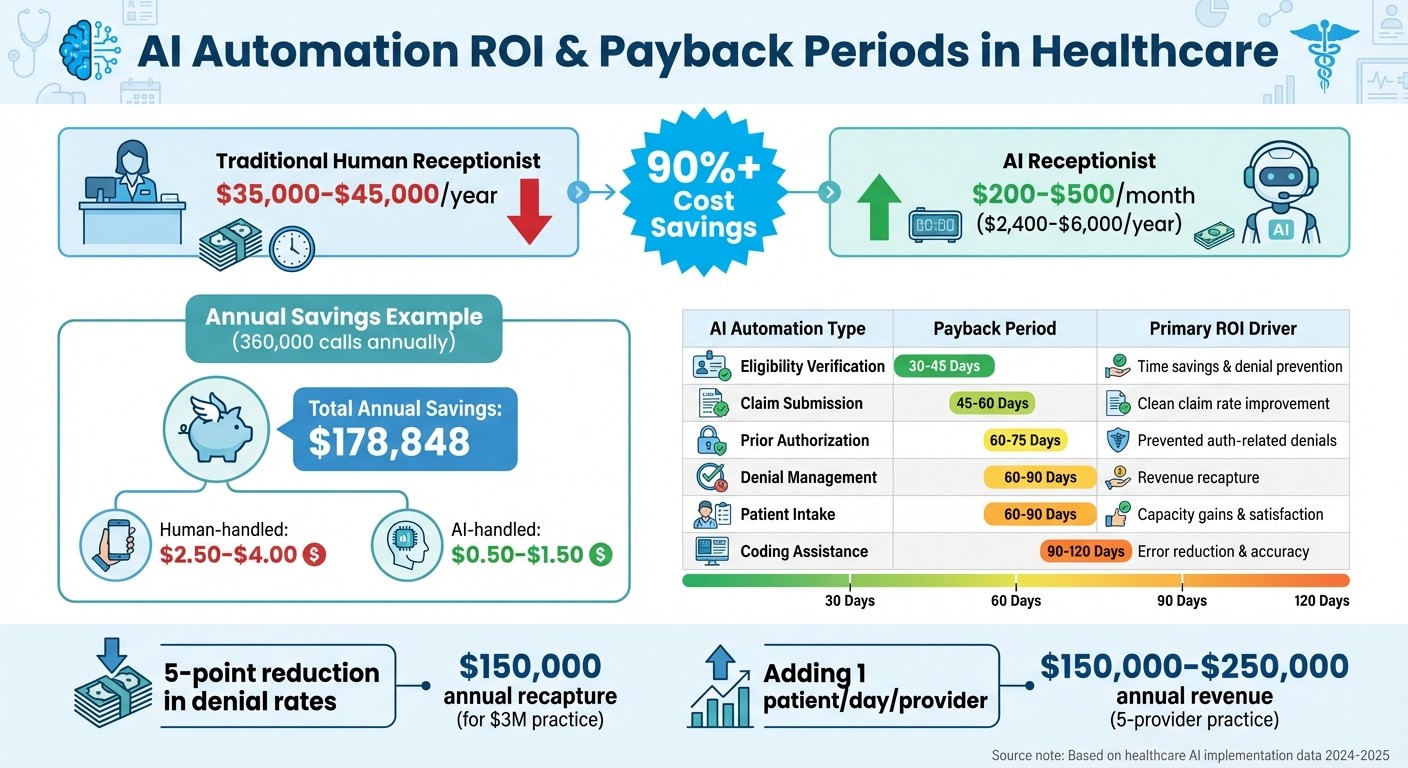
Why It Matters: AI reduces operational costs by up to 90% (e.g., $200–$500/month for AI receptionists vs. $35,000–$45,000 annual salary for human staff) while improving patient handling by 30–50%.
Challenges: 57% of organizations say their data isn’t ready for AI, and only 19% use AI for patient communication. Compliance (e.g., HIPAA) and integration with existing systems are common hurdles.
Steps to Success:
Validate Tools: Test AI in clinical settings to ensure reliability.
Meet Regulations: Use encryption, logging, and vendor agreements to stay compliant.
Prepare Teams: Train staff to interpret AI outputs and establish governance.
Fix Data Issues: Ensure data is accurate, diverse, and well-integrated.
Start Small: Begin with simple tasks (e.g., after-hours support) and expand gradually.
Track Metrics: Monitor performance, compliance, and ROI.
ROI Example: AI can save $178,848 annually for a practice managing 360,000 calls, with payback periods as short as 30–45 days for tasks like eligibility verification. Phased rollouts and regular monitoring ensure sustainable growth.
AI in healthcare isn’t about replacing humans - it’s about reallocating resources to improve patient care while reducing costs. Start small, measure results, and scale strategically.
AI Implementation ROI and Payback Periods in Healthcare
Scaling AI in Healthcare with a Focus on Trust, Compliance, and Operational Excellence
1. Building a Foundation for AI Scalability
Before scaling AI across your healthcare organization, it's crucial to ensure your systems, processes, and staff are well-prepared. A striking 57% of organizations believe their data isn't ready for AI [1]. This means the groundwork you lay today will determine if AI becomes a valuable asset or a costly misstep. Once the tools are in place, they need to be validated in actual clinical environments to confirm their reliability.
1.1 Validating AI Tools for Clinical Use
Clinical validation demands ongoing, real-world testing. Researchers Tej D. Azad, Harlan M. Krumholz, and Suchi Saria emphasize the need to move beyond static lab testing, advocating for an "evaluation-forward operating system" [6]. This approach involves assessing AI tools directly in clinical settings with real patient data.
"We propose straightforward principles to foster an evaluation-forward operating system that can transform the adoption of clinical artificial intelligence from a leap of faith into a stepwise, trust-building process." - Tej D. Azad, Harlan M. Krumholz, and Suchi Saria [6]
Begin by auditing your current workflows to pinpoint bottlenecks where AI could provide solutions, such as automating repetitive tasks or ensuring compliance [1]. Then, test AI tools against these specific scenarios. It's worth noting that organizations with higher AI maturity often keep projects operational for at least three years [1].
1.2 Meeting Regulatory and Compliance Requirements
Compliance with regulations like HIPAA isn't a one-time task - it requires ongoing attention to how AI systems are configured and monitored. Importantly, there is no such thing as "HIPAA-certified AI" [7]. Any vendor handling Protected Health Information (PHI) must sign a Business Associate Agreement (BAA) explicitly covering the AI services being used, not just the cloud infrastructure [5].
To meet compliance standards, implement technical safeguards such as AES-256 encryption for data at rest and TLS 1.2 or higher for data in transit [7][4]. Additionally, maintain inference-level logging to track what PHI is sent to the AI, its output, and who initiated the request [7][5]. Standard access logs won't suffice. The stakes are high - HIPAA violations can result in penalties of up to $2,067,813 annually [7]. Beyond HIPAA, upcoming regulations like the Colorado AI Act (effective June 2026) and the EU AI Act (effective August 2026) classify healthcare AI as "high-risk", adding further layers of compliance to consider [7].
1.3 Evaluating Organizational Readiness
Scaling AI isn't just about technology - it also depends on the readiness of your workforce and processes. AI "Pacesetters" report 75% proficiency among their staff, compared to just 16% for non-pacesetters [8]. This gap highlights why 50% of businesses cite a lack of skilled professionals as the main obstacle to AI adoption [1]. While your staff doesn't need to become programmers, they do need role-specific training to interpret AI outputs and spot potential biases [9].
Strong governance is another key factor. Establish a multidisciplinary AI Governance Board that includes clinicians, ethicists, and data scientists. This group should oversee validation efforts, address ethical concerns, and involve skeptics early to identify operational weaknesses [9][1]. The goal isn't to create unnecessary bureaucracy but to ensure accountability and avoid costly errors. Finally, fostering a positive attitude toward AI is essential to overcoming resistance - no technology can succeed if cultural barriers remain [8].
2. Evaluating Data Quality and Integration Capabilities
The success of AI hinges on high-quality, well-integrated data. With 57% of organizations reporting their data isn't AI-ready [1], tackling data issues is critical. Solid data management can mean the difference between AI that thrives and AI that falters. This foundation builds on the validation and compliance practices discussed earlier.
2.1 Maintaining High-Quality Data
For AI to function effectively, data must be complete, accurate, consistent, and timely. Missing data can prevent models from addressing edge cases, while outdated information can compromise tools like sepsis alerts, which depend on real-time accuracy.
Moreover, your data should mirror the populations your AI serves. Shockingly, only 38% of AI-based clinical risk stratification tools, such as those for sepsis, achieve full success [10]. This is often because training data fails to reflect the diversity of actual patient groups. Standardizing definitions across departments - terms like "patient" or "clinical outcome" - is another essential step. Additionally, maintaining clear data lineage ensures every data point can be traced back to its origin, which is vital for audits and regulatory compliance.
Ongoing monitoring is crucial to catch issues as they arise. For example, drift monitoring helps identify "data drift" (shifts in input patterns) and "concept drift" (changes in clinical guidelines), both of which can degrade model performance. Automated profiling systems can flag inconsistencies like missing values or coding errors before they impact AI outputs. Quarterly content audits, complete with auto-expiry tags for time-sensitive materials like certifications, can ensure models are always training on up-to-date information [1].
2.2 Integrating with Existing Systems
AI tools must integrate effortlessly with systems like Electronic Health Records (EHRs), CRMs, and scheduling platforms. Poor integration can lead to inefficiencies, creating extra work instead of streamlining processes. Interoperability standards such as HL7 FHIR, SNOMED CT, LOINC, and ICD codes are critical for enabling AI portability across multiple locations. Without these standards, deploying AI at scale becomes nearly impossible.
Centralizing clinical documents and databases in standardized hubs before introducing AI features helps prevent inaccuracies and reduces the need for manual fixes [1]. Instead of replicating every manual step, focus on mapping the essential parts of existing workflows into the AI platform. Using standardized templates, rather than creating custom rules for each interaction, also simplifies operations.
Selecting vendors familiar with major EHRs and healthcare data exchange protocols is key [11]. Role-based access controls and audit trails are non-negotiable when dealing with Protected Health Information. Considering that the average cost of a healthcare data breach reached $9.8 million in 2024 [12], robust access management not only protects sensitive data but also shields your organization from financial and reputational harm. For those working with older systems, edge computing can help by reducing latency and preventing bottlenecks during data transfers [12].
3. Scaling Operations and Automating Workflows
After establishing a solid data infrastructure, the next challenge is to weave AI into your daily operations. The goal? Make AI an integral part of your workflow - more than just an experimental tool. The trick lies in finding the right balance: let AI handle repetitive tasks while your team focuses on providing quality patient care. This integration sets the stage for more targeted automation strategies, as outlined below.
3.1 Using AI Receptionists and Automation Tools
AI-powered receptionists can take over time-consuming front-desk tasks like handling calls, managing schedules, and even lead management - around the clock. Without phone automation, small businesses miss about 27% of calls[14], which often leads to lost revenue and dissatisfied patients. Here's where AI shines: traditional front-desk operations cost roughly $87,000 annually, but AI receptionist solutions range from just $200 to $500 per month[2].
The financial benefits are clear. Each AI-handled call typically costs between $0.50 and $1.50, compared to $2.50 to $4.00 for calls handled by human staff when factoring in salaries and benefits[14]. Beyond saving money, AI receptionists can reduce the volume of calls staff need to handle by 60%[14]. This means your team has more time to focus on tasks that require empathy and specialized knowledge.
To make the most of AI receptionists, establish clear handoff protocols. For instance, the system should escalate calls to a human when it detects emergency phrases like "chest pain" or encounters complex medical inquiries. Tools like Lead Receipt offer 24/7 AI receptionist services that integrate smoothly with existing CRMs and scheduling software, ensuring data flows seamlessly between systems.
3.2 Planning Phased Rollouts
Once you've seen the benefits of AI receptionists, a phased rollout is the best way to scale operations sustainably. Currently, only 2% of healthcare organizations have implemented AI across their entire enterprise, while 30% use AI in specific areas of their operations[13].
Start simple: implement AI for after-hours support first. This delivers immediate benefits while allowing time to fine-tune the system. From there, expand to cover lunch hours and peak times[14]. Once the initial rollout proves successful, you can scale up to more locations or add new workflows. For example, you could move from just sending appointment reminders to also preparing patients for their visits. Experts recommend expanding in stages rather than attempting to deploy multiple solutions all at once[13].
As AI becomes a core part of your operations, invest in training your team to manage these platforms. This aligns with earlier discussions about governance and staff preparation[13]. Address resistance by positioning AI as a supportive tool that handles repetitive tasks, freeing up staff to focus on patient care[1][2]. Consider appointing "AI champions" within your team - these individuals can help adapt workflows and provide peer support during the transition. Keep in mind, 50% of businesses cite a lack of skilled professionals as the main barrier to AI adoption, so effective training and change management are critical[1].
4. Monitoring Performance and Managing Risks
Once your AI tools are live, keeping a close eye on their performance is crucial. Healthcare is an ever-changing field - patient demographics shift, clinical guidelines evolve, and regulations grow stricter. Without ongoing monitoring, even the most reliable AI systems can lose their edge, potentially jeopardizing patient safety and your organization's ability to grow effectively.
4.1 Tracking Performance Metrics
It's important to track key metrics that reflect the performance of your AI tools. For clinical AI systems, focus on indicators like sensitivity, specificity, and calibration metrics to ensure patient safety remains a priority [15]. If you're using AI for administrative tasks, monitor metrics like turnaround times, resource efficiency, and team productivity [1]. For clinical support tools, aim for a Faithfulness score of at least 0.95 and a Hallucination score no higher than 0.02 [17]. These metrics aren't just theoretical - studies show that 91.8% of clinicians have encountered "medical hallucinations" in AI tools, with 44% of those errors classified as "major", posing serious risks to patients [17].
Data quality is another critical area. Automated audits can help you identify declines in performance early, addressing what experts refer to as "model drift" - a gradual decline in an AI system's accuracy over time [15]. For AI systems that rely on knowledge databases, conducting quarterly content reviews ensures outdated information is removed, reducing the risk of drift [1].
Compliance metrics are equally important for avoiding legal and ethical pitfalls. Track error rates related to compliance, adherence to HIPAA and FDA standards, and the frequency of flagged ethical concerns [15]. Weak governance is a common problem - over 30% of companies cite it as their biggest challenge in scaling AI [16]. To counter this, assemble a multidisciplinary team that includes a clinical expert, a data scientist, and an administrative leader to oversee compliance and performance monitoring [15].
Once tracking systems are in place, focus on revalidation and risk management to ensure your AI tools stay reliable over time.
4.2 Revalidating AI Tools and Mitigating Risks
Monitoring alone isn’t enough - your AI tools need regular revalidation to remain effective and safe. AI systems evolve, and as one technical leader from the Health AI Partnership explains:
"In addition to making sure that it is keeping the lights on and still working, as with AI and ML, [the product] is going to change over time. So we're gonna have to keep revalidating that the model [to make sure it] is not drifting." [15]
Revalidation ensures your tools align with current standards. With over 1,250 FDA-authorized AI/ML-enabled medical devices as of July 2025 [17], staying compliant with evolving regulations is non-negotiable. Follow FDA Predetermined Change Control Plans (PCCP) to guide updates, covering areas like data management, retraining models, and evaluating performance [15]. However, reaching operational maturity is a challenge - only 45% of organizations maintain AI projects for at least three years [1].
Establishing rollback procedures is another safety measure. These protocols allow you to either update or retire AI tools if their performance drops below acceptable levels. For critical healthcare decisions, define clear points where human oversight is required and create workflows to escalate unexpected or harmful outcomes to qualified staff.
Finally, close the loop with feedback systems. Encourage clinicians and patients to report issues through formal channels, and use this input to fine-tune your monitoring strategies [15]. Automated tools can collect this feedback without adding to administrative workloads, helping you address problems before they lead to compliance breaches or compromise patient safety.
5. Aligning AI Scalability with Business Objectives
To maximize the impact of AI investments, it's crucial to ensure they align with your organization's strategic goals. Without this alignment, there's a risk of investing in tools that fail to deliver meaningful improvements in efficiency, revenue, or patient satisfaction.
5.1 Calculating ROI of AI Implementation
Start by establishing a 30-day baseline, tracking key metrics like denial rates, task durations, patient throughput, and overtime hours [18]. To measure ROI effectively, use the Four Buckets framework: labor savings, revenue recapture, error elimination, and capacity gains [18].
Labor savings: Multiply the weekly hours saved by the average loaded hourly cost (typically $22–$35 per hour).
Revenue recapture: Monitor improvements in claim clean rates. For example, reducing denial rates by 5 points could recapture $150,000 annually for a practice with $3 million in annual collections [18].
Capacity gains: Adding just one extra patient per day per provider in a 5-provider practice can generate an additional $150,000–$250,000 in annual revenue [18].
Capacity gains often deliver the highest long-term value. For example, revenue cycle management automation can yield 3–5x returns within a year, with breakeven typically achieved in 60–90 days [18]. Conduct a formal ROI review at the 90-day mark, once workflows stabilize and AI-prevented denials can be quantified. As Heph, AI COO at BAM, explains:
"The practices that get the best AI ROI aren't the ones with the fanciest technology. They're the ones that measure rigorously, implement completely, and give the system 90 days to prove itself." [18]
Here’s a quick breakdown of typical AI automation payback periods and their primary ROI drivers:
AI Automation Type | Typical Payback Period | Primary ROI Driver |
|---|---|---|
Eligibility Verification | 30–45 Days | Immediate time savings & denial prevention |
Claim Submission | 45–60 Days | Clean claim rate improvement |
Denial Management | 60–90 Days | Revenue recapture |
Prior Authorization | 60–75 Days | Prevented auth-related denials |
Patient Intake | 60–90 Days | Capacity gains & patient satisfaction |
Coding Assistance | 90–120 Days | Error reduction & accuracy |
5.2 Supporting Business Growth with AI
Once ROI metrics are clear, the next step is reinvesting AI-driven savings to fuel business growth. Instead of cutting headcount, consider reallocating staff from routine, repetitive tasks to higher-value responsibilities. This approach supports expansion without increasing overhead [18].
For example, Lead Receipt's 24/7 AI receptionists streamline administrative workflows, enabling your team to focus on patient care. These tools handle call management, lead tracking, and scheduling, eliminating administrative bottlenecks. The Professional plan supports up to 100 AI calls daily in five languages, while the Enterprise plan offers unlimited calls with fully customizable automation for high-volume practices.
To ensure success, begin with high-impact areas like eligibility verification, which has a 30–45 day payback period. Gradually expand to more complex tools like denial management as you validate AI's value and secure buy-in from stakeholders [18].
Conclusion: Key Takeaways for Scaling AI in Healthcare
Successfully scaling AI in healthcare demands a thoughtful strategy that blends cutting-edge technology with practical operations. It all begins with ensuring your data is ready - centralizing and cleaning up content libraries before introducing AI tools. This step is crucial, as 57% of organizations admit their data isn't prepared for AI integration yet [1]. Without this groundwork, even the most advanced AI systems can fall short of delivering reliable results.
A phased approach to implementation is equally important. Start small, focusing on tasks that are impactful but less complex, such as after-hours call handling. Gradually expand as you measure ROI and gain support from stakeholders. Regularly track key performance indicators (KPIs) like turnaround times and compliance error rates to make informed decisions about further investments and to pinpoint areas needing improvement [1].
The financial advantages of AI are hard to ignore. For example, AI receptionists cost only $200–$500 per month compared to the $35,000–$45,000 annual salary of a human receptionist [2]. This translates to more than 90% in cost savings while maintaining 24/7 availability. For practices with high call volumes, the savings add up fast. A group managing 360,000 calls annually could save approximately $178,848 each year by automating routine calls with AI [3].
Tools like Lead Receipt’s AI-powered solutions illustrate how scalable AI can transform healthcare operations. These tools integrate seamlessly with existing systems, offering features like 24/7 call handling, lead management, and scheduling automation. Their Professional plan supports up to 100 AI calls daily in five languages, while the Enterprise plan provides unlimited calls and fully customizable automation for larger practices. By eliminating time-consuming administrative tasks, these solutions free up healthcare teams to focus on patient care, all while staying compliant and efficient.
As Jesse M. Ehrenfeld, MD, MPH, President of the American Medical Association, wisely points out:
"Above all else, healthcare AI must be designed, developed and deployed in a manner which is ethical, equitable, responsible and transparent" [1].
FAQs
How do I know if our data is AI-ready?
To determine if your data is ready for AI, focus on three key aspects: cleanliness, connectivity, and completeness. High-quality data is the backbone of any successful AI project. Make sure your data architecture, workflows, and team expertise align with your AI objectives. Additionally, check that you have the right governance and infrastructure in place to deliver dependable results. Taking the time to evaluate these factors thoroughly can help uncover gaps and ensure smooth AI implementation.
What do we need for HIPAA compliance with AI tools?
Healthcare organizations aiming to align with HIPAA standards when using AI tools should adopt several key measures. Start with AES-256 encryption to secure sensitive data, alongside multi-factor authentication to add an extra layer of security. Implementing role-based access ensures that only authorized personnel can view specific information, while audit logging helps track and monitor data usage effectively.
Additionally, it’s crucial to establish Business Associate Agreements (BAAs) with vendors to clarify responsibilities regarding patient data protection. Don’t overlook the importance of staff training - educating employees on data security practices is essential to safeguarding sensitive patient information and staying compliant with regulations.
Which workflow should we automate first to scale safely?
Start with automating patient scheduling and appointment management - a smart move that delivers a strong return on investment and is straightforward to set up without running into regulatory obstacles. This approach helps cut down on no-shows, streamlines operations, and allows staff to focus on more urgent responsibilities. When implemented properly, it aligns with HIPAA regulations and improves patient engagement, particularly during off-hours, creating a solid base for future growth.