
AI Readiness Assessment Tools for Healthcare
Healthcare Technology
Updated Mar 16, 2026
Compare leading AI readiness assessments for healthcare, learn how to evaluate data, governance, and workforce gaps, and plan safe HIPAA-compliant pilots.
What is AI readiness? It measures how prepared an organization is to safely and effectively integrate AI into its operations, focusing on areas like data quality, governance, and workforce training.
Why does it matter? Errors in healthcare AI can have life-altering consequences. Proper preparation ensures patient safety and prevents wasted resources.
Key stats: Only 13% of organizations globally are fully prepared for AI adoption, and healthcare organizations score just 2.7 out of 5.0 on readiness metrics.
Tools to Evaluate AI Readiness:
DiMe Health AI Readiness Assessment: A free, 10-minute tool evaluating 7 domains like governance and clinical integration.
KMS Technology AI Maturity Assessment: Focuses on strategy, data, and governance with tailored roadmaps.
iTernal AI HIPAA Readiness Assessment: Specialized in identifying gaps in HIPAA compliance for AI use.
Samta.ai VEDA Platform: Emphasizes transparency, compliance, and decision traceability for AI models.
Pro Tip: Start with a self-assessment to identify gaps, then use professional consulting for detailed strategies. Focus on solving specific clinical issues like reducing sepsis mortality or improving scheduling efficiency.
Quick Comparison:
Tool | Focus Areas | Strength | Time | Cost |
|---|---|---|---|---|
DiMe Health AI Readiness | Governance, data, clinical integration | Quick baseline evaluation | ~10 minutes | Free |
KMS Technology AI Maturity | Strategy, data, governance | Detailed tailored roadmap | Varies | Fee-based |
iTernal AI HIPAA Readiness | HIPAA compliance | Compliance-focused evaluation | Varies | Free |
Samta.ai VEDA Platform | Transparency, compliance, traceability | Pre-deployment audits | Varies | Fee-based |
Next Steps:
Identify your organization's specific clinical or operational challenges.
Use an AI readiness tool to evaluate your current state.
Address gaps with targeted actions, focusing on areas like data quality, governance, and workforce training.
Pilot AI tools to measure their impact before scaling.
Proper preparation ensures AI improves patient care while maintaining safety and compliance.
How to Audit Your AI Readiness
Lead Receipt AI Readiness Consulting
Lead Receipt uses a four-phase consulting framework to help healthcare organizations improve patient intake, scheduling, and support operations with AI. Their process kicks off with the Smart Analyzing phase, where consultants map out current call flows, pinpoint workflow bottlenecks, and develop a strategic plan tailored to the organization's unique needs [10]. This groundwork ensures AI solutions can integrate smoothly into existing systems.
A key focus of their service is on blending AI tools with current platforms - like phone systems, CRMs, and scheduling software - creating workflows that work seamlessly without interrupting daily operations. This approach tackles common pain points, such as time-consuming tasks like logging interactions, routing urgent calls, and confirming appointments. Automated task bots handle these repetitive duties, freeing up time for staff to focus on patient care.
"Our expertise lies in seamlessly integrating AI solutions with your CRM and scheduling software, creating a unified and efficient workflow."
Lead Receipt [10]
For larger healthcare organizations, the Enterprise plan offers enhanced compliance features and includes a dedicated AI business consultant. This ensures the implementation aligns with HIPAA and other regulatory standards.
Once the AI systems are in place, Lead Receipt’s team continues to fine-tune their performance. Through ongoing data analysis and workflow adjustments, they help organizations scale their AI capabilities as patient volumes increase - all while maintaining a focus on delivering accurate and compassionate care.
Top AI Readiness Assessment Tools for Healthcare
Healthcare organizations are increasingly turning to specialized tools to evaluate their readiness for AI adoption, moving from conceptual ideas to practical clinical applications. In fact, over 5,000 organizations have already used standardized AI readiness tools to measure their maturity [7]. This shift reflects a broader industry trend, where fragmented pilot programs are being replaced by evidence-based strategies for implementation [8]. Below, we explore some of the leading tools designed to help organizations assess their AI readiness.
DiMe Health AI Readiness Assessment
The Digital Medicine Society (DiMe) offers a quick, interactive self-assessment that takes about 10 minutes to complete. It evaluates seven critical domains of AI maturity: Leadership/Governance, Data Infrastructure, Technology/Integration, Workforce Development, Clinical Integration, Financial Sustainability, and Stakeholder Engagement. Organizations are rated on a scale from Initial (Level 1) to Optimized (Level 5), with Level 4 representing "mature" readiness and Level 5 serving as an aspirational goal [9][3].
Participants receive a personalized report highlighting their strengths and identifying potential risks. DiMe advises healthcare leaders to prioritize solving specific clinical challenges rather than chasing after the latest technology trends.
"Selecting an AI tool without a clear strategy or a deep understanding of your system can lead to costly missteps and missed opportunities to improve patient care."
Digital Medicine Society [1]
The assessment also examines whether an organization’s technical infrastructure can securely support AI integration while identifying risks related to patient safety and trust [1][3].
KMS Technology AI Maturity Assessment
KMS Technology’s tool evaluates organizations across five key dimensions: Strategy, Data, Technology, People, and Governance [5]. It provides a detailed analysis of governance frameworks to ensure they meet AI's ethical and regulatory standards. The assessment also delivers a current-state analysis and a tailored roadmap for advancing AI maturity, aligned with specific clinical use cases.
A key focus of this tool is ensuring data quality and lineage tracking, which are essential for avoiding biased or incomplete training datasets. This helps organizations build models that are both effective and fair [9].
iTernal AI HIPAA Readiness Assessment
For organizations prioritizing compliance, the iTernal AI HIPAA Readiness Assessment offers a focused evaluation of HIPAA requirements in the context of AI adoption. This free tool identifies gaps in protecting Protected Health Information (PHI) and provides a compliance roadmap to address vulnerabilities before deploying AI systems. It emphasizes secure data handling and privacy measures, which are critical for meeting healthcare’s stringent regulatory standards.
Samta.ai VEDA AI Decision Audit Platform
Samta.ai's VEDA platform is designed to improve transparency and governance in healthcare AI. It focuses on decision traceability, model monitoring, and explainable AI frameworks. The platform enables pre-deployment audits to ensure models are transparent and compliant. VEDA also generates detailed compliance reports that document model behavior and data usage, which are invaluable for regulatory adherence and maintaining audit trails in clinical settings.
Feature Comparison
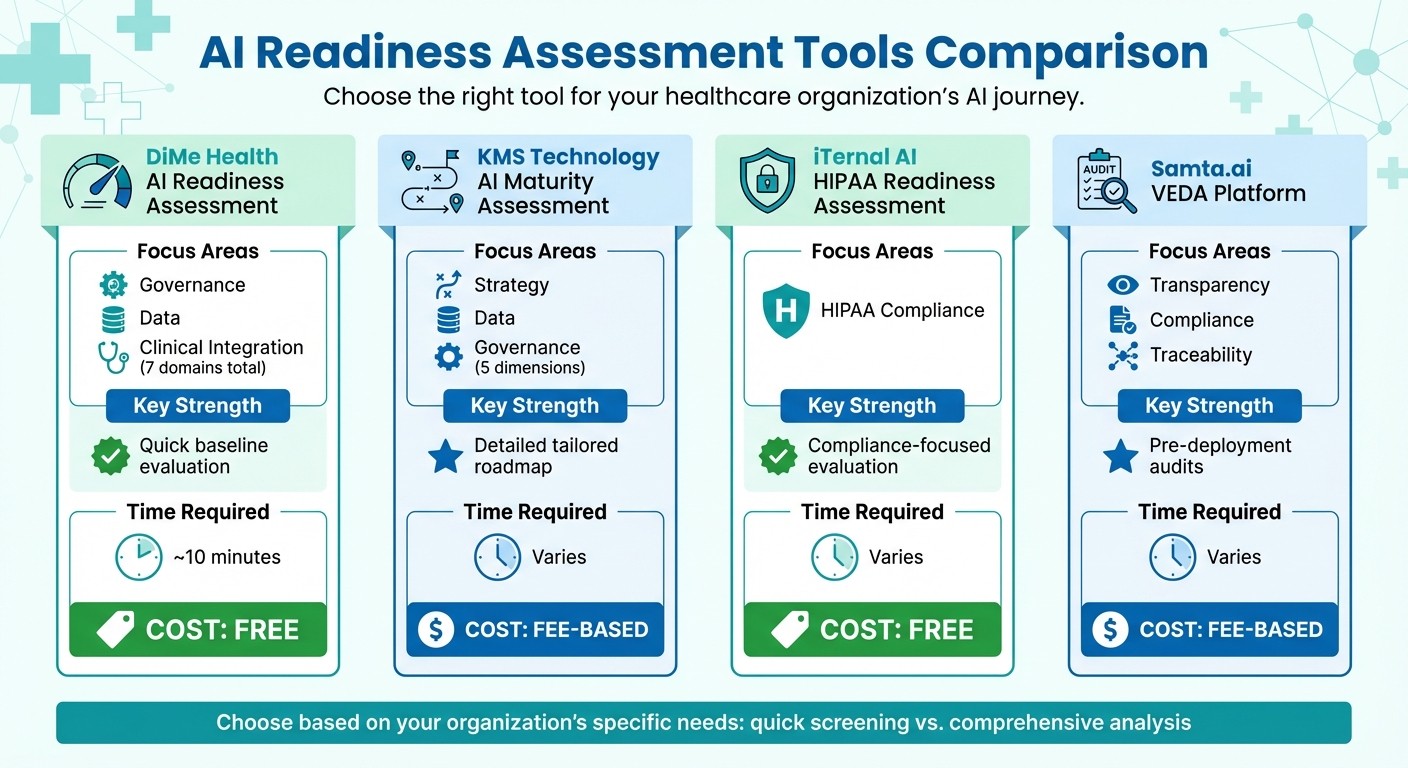
AI Readiness Assessment Tools for Healthcare: Feature Comparison
Choosing the right AI readiness tool is essential for aligning your digital strategy with your operational goals. Whether you need a quick overview or an in-depth evaluation, there are tools available to suit different needs.
Self-service assessments like the DiMe Health AI Readiness Assessment and the Vizient Mini AI Maturity Assessment provide fast, no-cost benchmarking options. DiMe Health's tool offers a quick evaluation of maturity across seven clinical and IT domains, giving users a broad understanding of their readiness. For organizations with more complex requirements, fee-based consulting services can provide a tailored, detailed analysis, albeit with a higher cost and time investment.
Here’s a side-by-side look at the two tools to help you decide which one aligns best with your goals:
Comparison Table
Tool | Assessment Dimensions | Healthcare-Specific Strength | Delivery Timeline | Pricing Model |
|---|---|---|---|---|
DiMe Health AI Readiness Assessment | Covers 7 domains, including clinical integration, data management, and IT leadership | Offers a quick baseline for readiness | ~10 minutes | Free self-service |
Vizient Mini AI Maturity Assessment | Focuses on operational areas (specific details not provided) | Provides immediate insights through rapid screening | A few minutes | Free self-service |
This comparison helps healthcare organizations identify the right tool based on their evaluation needs, timeline, and available resources.
How to Implement AI Readiness Tools
Before diving into AI tools, it's crucial to pinpoint the specific clinical or operational issue you aim to tackle. The Digital Medicine Society (DiMe) stresses the importance of defining clear challenges - like increasing sepsis mortality rates or frequent hospital readmissions - before selecting any technology [1]. This approach ensures that the tools you choose directly address your organization's needs.
Once you've identified the problem, begin with a self-assessment. Tools like the DiMe Health AI Readiness Assessment offer a quick, 10-minute evaluation to help gauge your organization's preparedness [3]. These assessments cover essential areas like Strategy, Infrastructure, Data, Governance, Talent, Culture, and Ethics [4][6]. They also provide a tailored roadmap that highlights risks and actionable steps to improve your AI maturity level [3]. Engage internal stakeholders - clinicians, IT teams, and leadership - to map current AI usage, uncover barriers, and align efforts strategically [1].
With a clear understanding of your gaps, focus on bridging them. Prioritize areas that could have the most impact, such as reducing clinician workloads or improving decision-making processes. According to the 2025 Global Readiness Index, only 13% of organizations are "Pacesetters", while nearly half are classified as "Followers" [4]. Pacesetters report a 75% staff proficiency rate in AI, compared to just 16% for other organizations [4]. Use these benchmarks to set realistic goals - Level 4 (Managed) maturity is often sufficient for most use cases, while Level 5 (Optimized) may be a longer-term aspiration [9].
For a more in-depth evaluation, consider professional consulting services. These services, typically completed in 2–3 weeks, transform stakeholder feedback and data reviews into actionable roadmaps [7][8]. Consultants can help establish governance frameworks, calculate Total Cost of Ownership (TCO) - including vendor fees and training costs - and identify quick-win opportunities that integrate AI into daily operations [8]. For instance, Lead Receipt specializes in strategic consulting and development, offering solutions like AI-powered receptionists for call management, scheduling, and lead processing to ensure a smooth transition from planning to execution.
Before scaling, pilot AI tools to measure their effectiveness against key performance indicators, such as accuracy or cost savings [11]. As Phil Rowell, Chief Analytics Officer at Health Catalyst, explains:
"Healthcare executives want to be assured that the technology they have selected for adoption will lead to continuous improvement and enable them to effectively translate data insights into actionable steps. AI is a tool that can help them make that next mission-critical business decision."
Finally, establish protocols for monitoring and retraining AI models. This ensures that your tools remain effective as clinical standards evolve or patient demographics change [2].
Conclusion
AI readiness assessment tools give healthcare organizations a clear roadmap for adopting AI effectively. Instead of diving headfirst into costly implementations, these tools help pinpoint gaps in areas like strategy, data infrastructure, governance, and workforce skills. As the Digital Medicine Society (DiMe) points out, "Selecting an AI tool without a clear strategy or a deep understanding of your system can lead to costly missteps and missed opportunities to improve patient care" [1].
The data highlights a noticeable readiness gap that these assessments are designed to address. Healthcare leaders should prioritize tackling specific clinical challenges - whether that's cutting readmission rates, improving sepsis outcomes, or streamlining administrative processes. Tools like the DiMe Health AI Readiness Assessment offer quick, 10-minute evaluations to establish a baseline, while more in-depth diagnostics provide detailed strategies for implementation [3].
For those ready to move from assessment to action, professional consulting services help bridge the gap between planning and execution. Lead Receipt's consulting services, for instance, turn insights into measurable improvements, ensuring alignment with existing systems and compliance standards. This step-by-step approach supports sustainable AI integration.
Instead of rushing toward full-scale implementation, organizations should focus on strengthening their foundation with targeted, incremental changes. By addressing core needs, involving cross-functional teams, and achieving small but meaningful wins, healthcare organizations can confidently advance their AI journey.
FAQs
Which AI readiness tool should we start with?
When it comes to evaluating how prepared your healthcare organization is for AI, tools like the AI Readiness Assessment from Netsmart are a solid choice. This tool generates a personalized report that highlights both your strengths and areas where you can improve. Another option worth considering is Cisco’s AI Readiness Index, which examines six critical areas, such as strategy, infrastructure, and talent. These resources can give you a clear picture of where your organization stands and what steps to take next.
What data and governance gaps block safe AI use?
Data and governance challenges in healthcare AI often revolve around issues like data access, quality, and oversight. Some of the main hurdles include the lack of solid frameworks to assess readiness, vague or incomplete data governance policies, and persistent biases that can lead to inequities. Beyond that, organizations face obstacles in infrastructure, skilled workforce, and organizational mindset, all of which are crucial for responsibly integrating AI. To make this work, they need to focus on privacy, security, and ethical practices, supported by well-structured evaluations.
How can we pilot AI without compromising patient safety?
To introduce AI safely in healthcare, it's crucial to follow a clear, step-by-step process. Start by defining what "safe pilot" means in your specific context. Prepare your team by building their readiness and understanding of AI. Establish strong data governance practices to protect sensitive information. Choose a focused, high-impact use case that allows for controlled testing.
Thoroughly test the AI system, document all findings, and use these insights to refine your approach. Finally, develop a plan for scaling responsibly. This method helps reduce risks like bias, errors, and data breaches, ensuring patient safety remains a priority throughout the pilot phase.