Scaling Home Care with AI Receptionists
Healthcare Technology
Updated Mar 24, 2026
AI receptionists let home care agencies answer every call, automate intake and scheduling, and scale while cutting admin costs and missed leads.
Home care is facing growing challenges as the demand for services rises. With over 71 million Americans aged 65 or older by 2030 and 90% of seniors preferring to stay at home, the industry is under pressure to handle increasing referrals, staffing shortages, and administrative inefficiencies. AI receptionists are stepping in to help agencies manage these issues by automating tasks like call handling, scheduling, and lead follow-ups.
Here’s how AI receptionists are transforming home care agencies:
24/7 Call Management: AI handles calls around the clock, reducing missed leads and abandoned calls by up to 60%.
Faster Scheduling: Automated systems integrate with calendars, ensuring real-time updates and reducing errors.
Lead Follow-Up: AI ensures rapid responses to inquiries, boosting client conversion rates by 15–30%.
Cost Savings: Agencies save on administrative costs with predictable subscription fees starting at $300/month.
Better Efficiency: AI reduces manual errors by syncing directly with CRMs and EHRs.
AI Receptionist ROI and Impact Statistics for Home Care Agencies
Common Challenges When Scaling Home Care Agencies
Managing High Call Volumes
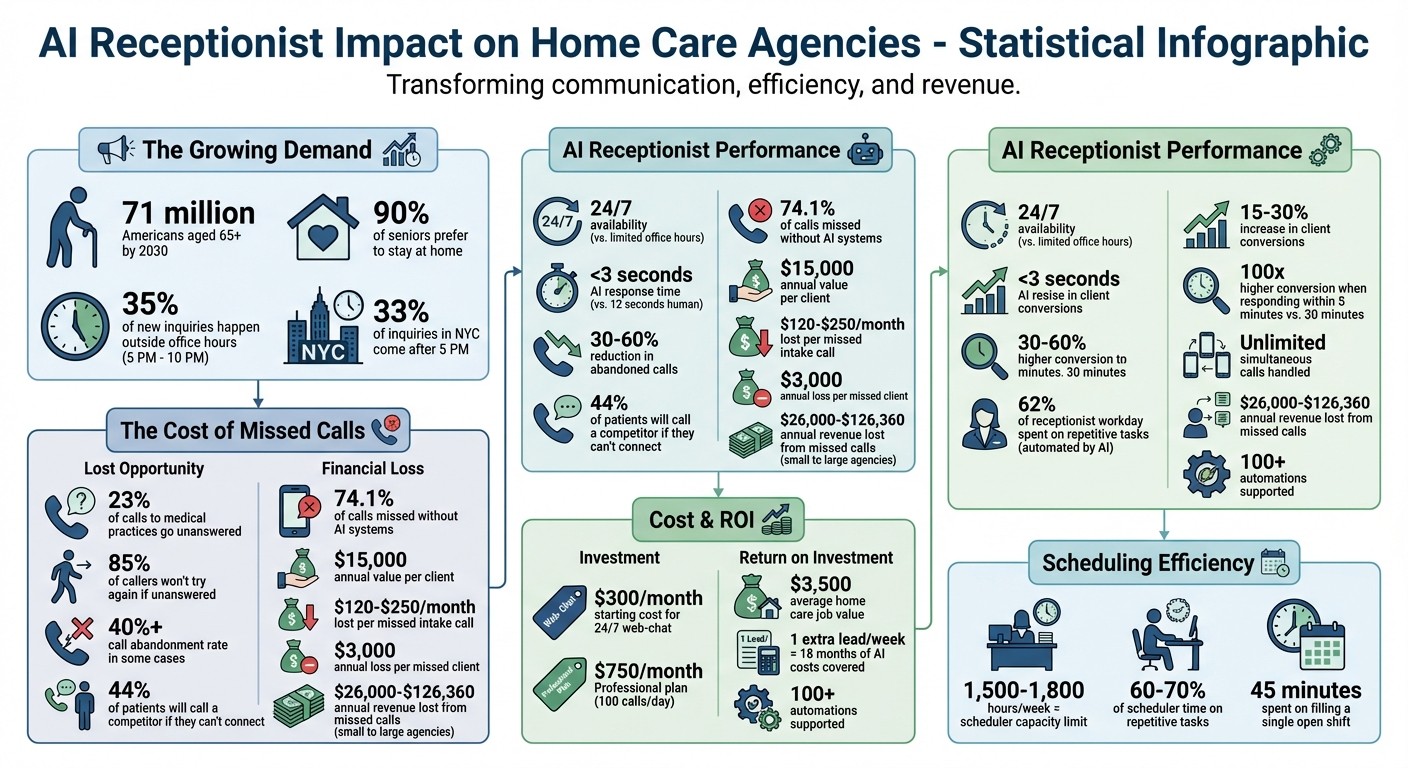
As home care agencies expand, their phone systems often struggle to keep up. Research shows that 23% of calls to medical practices go unanswered, and an overwhelming 85% of callers won’t try again if they don’t get through the first time [4]. Intake coordinators, who can only handle one call at a time, frequently leave simultaneous inquiries unanswered, creating a bottleneck.
The issue of call abandonment is especially costly, with rates exceeding 40% in some cases [2]. Each missed call represents a potential client, who could bring in $15,000 annually [1]. Furthermore, about 35% of new inquiries happen outside of standard office hours [2], typically between 5:00 PM and 10:00 PM, when adult children research care options after work [2]. This surge in after-hours calls not only overwhelms staff but also complicates scheduling, making it difficult to meet client needs efficiently.
Scheduling and Coordination Errors
Handling schedules becomes another major hurdle as agencies grow. Dave Dworschak, Head of Growth at Phoebe, highlights this challenge:
"Schedulers hit a wall around 1,500 to 1,800 hours per week. That's when quality suffers and people start looking for other jobs." [3]
Schedulers often spend 60–70% of their time on repetitive tasks, such as calling caregivers to fill shifts or managing last-minute call-outs [3]. A single open shift can trigger 45 minutes of frantic calls and texts [3]. This chaotic process not only frustrates staff but also increases the likelihood of errors. Mistakes like incomplete intake forms, manual data entry issues, and transcription errors become roadblocks, directly affecting client satisfaction.
Missed Leads During Off-Hours
After-hours calls are a leading source of lost opportunities for home care providers [2]. Families often reach out late at night, particularly after hospital discharges, urgently seeking nursing or personal care support [2]. In cities like New York, 33% of inquiries come in after 5:00 PM [2]. Missing just one intake call can cost an agency $120–$250 per month in private-pay revenue - adding up to $3,000 annually per client [2].
Traditional staffing approaches fall short here. Assigning on-call nurses to handle routine intake not only diverts them from clinical duties but also leads to burnout [2]. By the time offices reopen at 9:00 AM, many families - already under stress - have reached out to multiple other providers [1]. This delay often results in lost business, further compounding the problem.
How AI Receptionists Solve These Problems
24/7 Call Handling and Lead Management
AI receptionists tackle the issue of missed calls by being available around the clock - even during evenings, weekends, and holidays. Unlike human staff, who can only manage one call at a time, AI systems handle unlimited simultaneous calls [5]. This means no caller is left waiting.
With response times under 3 seconds - compared to 12 seconds for live staff - AI receptionists cut down abandoned calls by 30–60% and increase new-client conversions by 15–30% [2][5]. This speed is crucial because 85% of callers hang up if they reach voicemail [5], and 44% of patients unable to connect on their first try will call a competitor [5].
AI systems also use automated triage to prioritize calls effectively. For example:
Clinical emergencies trigger 911 instructions and staff alerts.
Urgent issues route to on-call nurses.
Routine tasks, like intake or administrative queries, are handled automatically [2][5].
Additionally, automated language detection allows bilingual support, removing the need for specialized staff to be on standby [2][5]. This constant availability ensures that patient intake is handled securely and efficiently, as discussed further in the HIPAA-Compliant Intake and Triage section.
HIPAA-Compliant Intake and Triage
For home care agencies, safeguarding sensitive health information during intake is essential. AI receptionists meet this need by following secure data collection protocols that align with HIPAA standards.
While AI doesn’t diagnose, it uses intent detection to recognize critical phrases like "fell" or "can't breathe" and escalates emergencies to clinical staff via SMS or push notifications [2][5]. Triage criteria, defined by the agency's clinical team, guide these processes. Meanwhile, all collected data syncs directly with CRM and EHR systems, reducing manual errors [5].
This integration boosts efficiency while allowing agencies to manage more patients without adding extra administrative work. Beyond triage, AI ensures every caller receives professional and consistent attention, enhancing the overall experience.
Consistent Customer Experience with Personalized Interactions
AI receptionists guarantee a professional and reliable experience for every caller. Matthew Hennessey from RestorationMaster Finder highlights this benefit:
"The AI communicates with clarity and precision, ensuring leads are informed and engaged before we even connect" [1].
This level of consistency is maintained regardless of call volume or time of day - something human staff juggling multiple tasks cannot achieve.
Routine queries are handled efficiently, freeing human employees to focus on more complex situations. Matthew McCleary, Owner of Assisting Hands Service Mansfield TX, shares:
"The ability to answer typical questions and solve basic calls such as screening inbound caregiver applications or provide our agency's fax number and mailing address" [1].
AI Front Desk: How Doctors Save $100k With Automation (2025 Guide)
Scheduling and Follow-Ups with Lead Receipt
AI receptionists are proving to be game-changers in addressing operational hurdles within the home care industry. Here's how automation is transforming scheduling and follow-up processes.
Automated Scheduling and Calendar Integration
With natural language processing (NLP), scheduling becomes effortless. Patients can book, reschedule, or cancel appointments at any time - whether it's the middle of the afternoon or the middle of the night. The AI handles these interactions smoothly, whether through voice or chat.
The system integrates with existing scheduling tools and EHR/EMR systems using HL7 or FHIR APIs. This ensures real-time updates, avoids double-bookings, and keeps calendars accurate. To further reduce no-shows, multi-channel notifications - via SMS, email, and voice - are sent out, and patients can reschedule with just one click based on their preferences.
This streamlined scheduling process feeds directly into an efficient lead nurturing strategy.
Automated Lead Nurturing and Follow-Ups
Once an appointment is confirmed, the system immediately shifts to nurturing the lead. Speed is critical here - responding to a lead within 5 minutes can increase conversion rates by up to 100 times compared to waiting just 30 minutes [7]. The AI ensures rapid follow-ups, sending personalized messages and secure links to collect any missing documentation, leaving no lead unattended.
These automated follow-ups integrate directly with CRMs, simplifying data capture and ensuring a smooth workflow.
CRM Integration and Workflow Automation
Lead Receipt connects seamlessly with existing CRMs and scheduling platforms, using native integrations, middleware, or custom HTTP webhooks [8]. Every interaction - whether it's a call recording or lead detail - is automatically logged into the CRM, eliminating the need for manual input.
The platform supports over 100 automations [6], such as routing urgent calls to on-call staff or notifying caregivers of schedule changes. Without such integration, businesses risk losing about 74.1% of calls, which translates to over $260,000 in missed revenue annually [8]. Additionally, 80% of callback requests go unanswered when there's no system in place to track them [8]. Automated workflows completely close these gaps, ensuring every lead and inquiry is handled efficiently.
ROI: Cost and Revenue Impact of AI Receptionists
When it comes to home care agencies, where margins can be tight and growth unpredictable, the financial benefits of AI receptionists go beyond operational improvements. They deliver measurable cost savings and revenue boosts that can make a real difference.
Lower Administrative Costs
Did you know that human receptionists spend 62% of their workday on repetitive tasks like answering FAQs, scheduling, and data entry? [9]. AI systems take over these tasks seamlessly, replacing fluctuating expenses like salaries, benefits, and training with a predictable subscription fee. For instance, Lead Receipt offers plans starting at $300/month for 24/7 web-chat coverage, while their Professional plan costs $750/month, handling up to 100 calls daily with unlimited voice and chat support [6]. Unlike human staff, AI doesn’t call in sick, take vacations, or require overtime pay during busy periods. This consistency translates directly into cost savings, giving agencies a financial edge while freeing up resources for other priorities.
Higher Revenue from Better Lead Capture
The revenue potential here is huge. Research shows that small businesses miss 74.1% of incoming calls, and 85% of those missed calls result in lost revenue [10]. For smaller operations, this could mean more than $26,000 in lost revenue annually, while larger agencies might see losses as high as $126,360 per year [9][10]. In the home care industry, where the average job value is approximately $3,500, just capturing one extra lead per week could cover nearly 18 months of AI receptionist costs [10]. Every call answered by AI represents a chance to connect with a potential client, turning missed opportunities into meaningful revenue.
Scaling from Small to Large Operations
AI receptionists aren’t just about saving money - they help agencies grow without the need for proportional increases in staffing. By managing tasks like intake, scheduling, and follow-ups, AI enables even small teams to handle a surge in leads. Lead Receipt’s Enterprise plan, which offers unlimited calls and full customization, ensures that multi-location agencies maintain high-quality service across all sites [6]. Whether it’s a seasonal spike in demand or a successful marketing campaign driving call volumes, the system adjusts instantly, letting your team focus on what they do best: providing outstanding care.
Wrapping It Up
Scaling a home care agency doesn't have to mean drowning in administrative headaches or losing potential clients. AI receptionists tackle challenges like high call volumes, scheduling issues, and missed after-hours leads - all while keeping costs in check.
With tools like Lead Receipt, agencies can handle 24/7 call management, automate intake and scheduling, and ensure every lead gets the attention it deserves. As Matthew McCleary, Owner of Assisting Hands Service Mansfield TX, shared:
"It quickly and accurately routes calls based on their need... many of our patients have no idea they are talking with an inanimate service!" [1]
The predictable subscription pricing offers agencies a solid return on investment by improving lead capture, reducing administrative expenses, and maintaining consistent service quality [6].
For home care agencies aiming to grow without unnecessary stress, AI receptionists are no longer optional - they're becoming a foundational tool. By automating repetitive tasks, your team can focus on delivering exceptional care, while your agency grows smoothly and confidently. Lead Receipt turns time-consuming processes into seamless systems, enabling agencies to prioritize what truly matters: quality care and sustainable success.
FAQs
Will an AI receptionist confuse seniors or families?
AI receptionists focus on delivering clear and compassionate communication, ensuring every interaction feels approachable and straightforward. They tailor their responses to meet the specific needs of seniors and their families, reducing potential misunderstandings. At the same time, they efficiently manage calls and address inquiries, providing reliable support.
How does it handle emergencies and after-hours calls safely?
AI receptionists handle emergencies and after-hours calls by providing round-the-clock support and ensuring urgent matters are addressed quickly and securely. These systems can automatically direct critical calls to the right team members or escalation channels, guaranteeing they receive immediate attention. With integrated safeguards, AI receptionists seamlessly work within existing workflows to notify staff when necessary, reducing the risk of missed emergencies while ensuring professional and secure call management at all times.
What does setup and integration with our CRM or EHR involve?
Setting up an AI receptionist to integrate with your CRM or EHR involves aligning it with the tools you already use. The process starts with evaluating your specific needs, followed by configuring and training the system to meet those requirements. Once set up, thorough testing ensures everything runs smoothly. This setup allows the AI to handle tasks like scheduling and follow-ups efficiently, all while adhering to compliance standards, maintaining security, and scaling to fit your agency's demands.