AI Receptionist vs. In-House Staff: Cost Comparison and ROI for Healthcare Clinics
Healthcare Technology
Updated Mar 16, 2026
AI receptionists cut front-desk costs 60–80% and recover missed revenue while delivering 24/7, unlimited-call support for healthcare clinics.
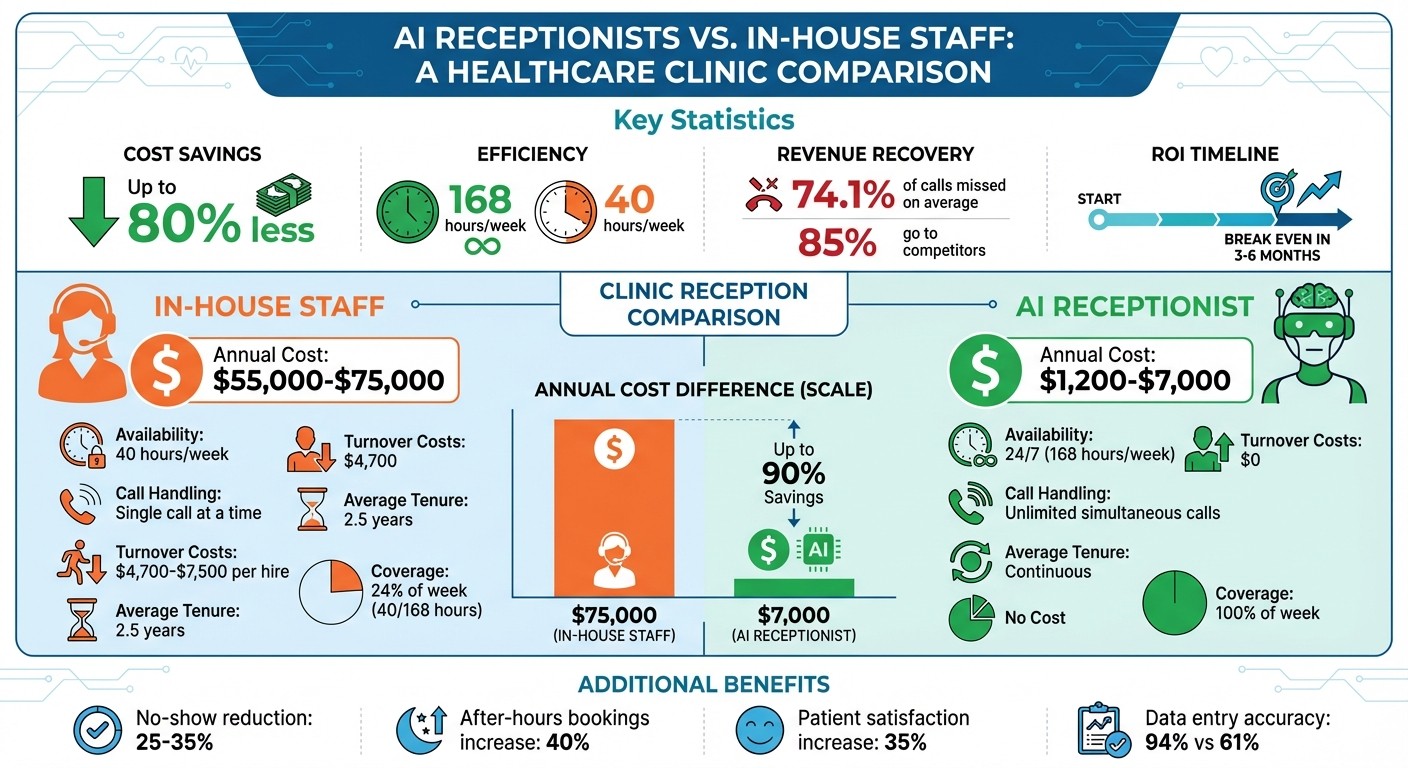
AI receptionists are transforming front-desk operations in healthcare clinics by slashing costs and improving efficiency. Here’s the bottom line: AI receptionists cost between $1,200 and $7,000 annually, while hiring a full-time receptionist can cost $55,000 to $75,000 per year when you factor in benefits, equipment, and turnover expenses. Plus, AI systems work 24/7 and handle unlimited calls, solving the problem of unanswered calls and missed opportunities.
Key Takeaways:
Cost Savings: AI receptionists cost up to 80% less than human staff.
Efficiency: AI works 168 hours/week, compared to a human’s 40 hours.
Revenue Recovery: Clinics lose 74.1% of calls on average, with 85% of those callers going to competitors. AI ensures these calls are answered.
ROI: Most clinics break even within 3–6 months, with significant savings in labor and no-show reductions.
Quick Comparison:
Category | In-House Staff | AI Receptionist |
|---|---|---|
Annual Cost | $55,000–$75,000 | $1,200–$7,000 |
Availability | 40 hours/week | 24/7 (168 hours/week) |
Call Handling | Single call at a time | Unlimited simultaneous calls |
Turnover Costs | $4,700–$7,500 per hire | $0 |
AI receptionists aren’t just cheaper - they also solve key operational challenges like high turnover, absenteeism, and missed calls. Whether you’re running a solo practice or managing multiple locations, the switch to AI can boost your clinic’s bottom line while improving patient access.
AI Receptionist vs In-House Staff Cost Comparison for Healthcare Clinics
AI Front Desk: How Doctors Save $100k With Automation (2025 Guide)
Cost Breakdown: AI Receptionist vs. In-House Staff
The cost difference between AI receptionists and in-house staff is striking when you break down the expenses.
In-House Staff Costs
Hiring an in-house medical receptionist comes with a base salary that typically falls between $35,830 and $38,240 annually. But that’s just the start. Employers also shoulder additional costs, such as benefits, which add about 29.4% to the total compensation, and payroll taxes (Social Security and Medicare), which tack on another 7.65% [1].
Beyond salaries, there are infrastructure expenses to consider. Desks, computers, phone systems, and office space can initially cost $1,500 to $3,000, with ongoing annual costs reaching up to $13,000. Training new hires adds another layer of expense, ranging from $800 to $4,000.
Turnover is another costly factor. With an average tenure of 2.5 years, replacing a receptionist can cost $4,700 to $7,500 in recruitment and lost productivity. Adding up salaries, benefits, taxes, equipment, training, and turnover, the first-year cost for a single in-house receptionist typically lands between $55,000 and $75,000 [5][1].
AI Receptionist Costs
AI receptionists, on the other hand, present a much leaner cost structure. These systems operate on subscription plans, avoiding expenses like benefits, payroll taxes, or office infrastructure. Basic plans typically cost $49 to $149 per month for limited call handling. More advanced plans, which include features like appointment scheduling and CRM integration, range from $197 to $299 monthly. Enterprise-level solutions, capable of handling unlimited calls and supporting multiple locations, can cost between $499 and $1,000+ per month [5][8].
Setup fees are usually waived, though some providers charge a one-time fee of $500 to $3,000 for EHR integration [5][10]. Even at the higher end, the annual cost for an AI receptionist falls between $1,200 and $7,000. Unlike a human receptionist, who works a 40-hour week and handles one call at a time, AI receptionists operate 24/7 (168 hours per week) and can manage unlimited simultaneous calls [5].
Cost Category | In-House Staff (Full-Time) | AI Receptionist (Professional) |
|---|---|---|
Annual Base Salary/Fee | $35,000–$45,000 | $1,200–$6,000 |
Benefits & Taxes | $10,000–$15,000 | $0 |
Equipment & Space | $2,000–$5,000 | $0 |
Training & Turnover | $3,000–$7,500 | $0 |
Availability | 40 hours/week | 168 hours/week (24/7) |
Call Capacity | Single call capacity | Unlimited simultaneous calls |
Total Year 1 Cost | $55,000–$75,000 | $1,200–$7,000 |
This breakdown highlights how AI receptionists not only reduce costs but also provide unmatched efficiency with their round-the-clock availability and unlimited call-handling capacity.
Hidden Costs of In-House Staff
The salary listed in a job posting doesn’t tell the whole story. For an in-house receptionist, the actual cost is typically 1.35 to 1.5 times their base salary when you account for all related expenses [2].
Recruitment costs are a big factor. On average, hiring a new employee costs $4,683, and the 41-day vacancy period during recruitment significantly impacts productivity [2]. Once hired, new employees require around 40 hours of training, costing anywhere from $1,000 to $7,000 due to lost productivity [1][2]. To make matters worse, 34% of new hires leave within the first 90 days, forcing clinics to repeat this costly cycle before the employee even becomes fully productive [2].
Turnover rates add another layer of expense. With healthcare administrative staff leaving at an annual rate of 22% and the average receptionist staying just 2.5 years, the costs of rehiring and retraining pile up quickly [6][1]. On top of that, managing in-house staff requires time. Tasks like scheduling, providing feedback, and managing time-off requests take about 2 hours per week, costing clinics approximately $5,200 annually [1].
Coverage gaps create additional challenges. A full-time receptionist only covers 40 hours out of a 168-hour week, leaving 76% of the week unattended. On average, receptionists also take 5 to 8 sick days and 10 to 15 vacation days annually [11][2]. To cover these absences, clinics often pay overtime ($150–$300 per day) or hire temporary staff ($200–$400 per day). And when no coverage is arranged, the consequences can be steep - studies show that 87% of callers who reach voicemail don’t bother calling back [9].
When you add up recruitment, turnover, management, and coverage costs, the gap between in-house staff and AI receptionists becomes even more apparent.
AI Receptionist Pricing and Features
After weighing the hidden costs of in-house staff, it’s worth considering how AI receptionists simplify pricing while offering powerful capabilities. On average, AI receptionists cost between $5,000 and $10,000 annually, which is roughly 25% of the cost of a full-time employee [9][12]. Pricing models generally fall into three categories: flat-rate subscriptions, tiered plans based on call volume, and usage-based billing [1][8][14].
Flat-rate plans are becoming increasingly popular because they eliminate unexpected costs during busy periods. For clinics managing more than 50 calls per month, this model ensures predictable expenses [1][8].
Here’s a closer look at pricing plans designed for different clinic sizes.
Pricing Plans by Clinic Size
AI receptionist pricing tiers are tailored to the size of the clinic and its call volume:
Starter Plans: Priced between $49 and $495 per month, these plans are ideal for small clinics with fewer than two providers. They typically include up to 500 minutes and basic call routing [8][13][14].
Professional Plans: Ranging from $750 to $995 per month, these plans cater to multi-provider practices. Features often include after-hours coverage, multilingual support, and integration with CRM or EHR systems [13].
Enterprise Plans: Starting at $1,495 and going up to $5,000+ per month, these plans are designed for large practices or multi-location groups. They offer over 2,000 minutes, custom workflows for patient intake and chart preparation, and dedicated account management [8][13][14].
For clinics exceeding their monthly minute limits, additional minutes typically cost between $0.95 and $1.25 each [13]. Setup fees vary widely - some providers waive them, while others charge between $1,000 and $5,000, particularly for custom workflows and advanced EHR integrations [9][13].
Advanced Features and Scalability
AI receptionists bring operational capabilities that go beyond what human staff can offer. For instance, their unlimited simultaneous call handling eliminates busy signals and long wait times, ensuring no missed opportunities. This feature is especially important, as 67% of customers won’t leave a voicemail and may seek another provider instead [1][7][8].
For healthcare clinics, HIPAA compliance is essential. Top providers ensure data security through end-to-end encryption, secure portals, and Business Associate Agreements (BAAs) [8][9][13]. Integration with systems like eClinicalWorks enhances efficiency by updating patient records in real time, verifying insurance eligibility, and automating chart preparation - all of which reduce manual tasks [9][13].
AI systems also streamline the entire appointment process, from scheduling and rescheduling to sending automated reminders via text or call. This can lower no-show rates by 25% to 35% [9]. Additionally, with 168 hours of weekly coverage compared to a human’s 40 hours, AI receptionists ensure no calls are missed. This matters because 87% of new patients who reach a voicemail won’t call back [1][9].
ROI Calculation and Break-Even Timeline
To figure out the ROI of an AI receptionist, use this formula: (Total Savings - AI Cost) / AI Cost. For healthcare clinics, these savings come from multiple sources: recovered revenue from missed calls, lower labor costs, fewer no-shows, and eliminating turnover expenses. This section breaks down how these savings turn into measurable ROI.
Let’s look at the numbers. If your clinic misses 74.1% of calls (the industry average) and 85% of those callers don’t try calling again [2], you’re losing potential patients daily. By reducing labor costs and capturing more patients, the financial impact becomes clear. For example, a family medicine practice with an average patient value of $1,200 only needs to secure 10 additional patients per year to cover the annual cost of an AI receptionist priced at $300 per month [2]. Specialized practices see even quicker returns - a clinic performing procedures averaging $3,500 per patient would only need 3.4 additional patients annually to break even [2].
How to Calculate ROI
Start by identifying your true in-house costs. A full-time receptionist typically costs between $52,000 and $68,000 annually. Compare this to AI receptionist costs, which generally range from $3,600 to $9,000 per year, depending on the plan and call volume.
Next, calculate how much revenue you could recover. Track unanswered calls during business hours and after-hours. AI receptionists can increase after-hours bookings by about 40% [4]. To estimate the additional revenue, multiply the number of recovered calls by your average patient value. Combine this with savings from fewer no-shows - AI systems can reduce no-shows by 25% to 35% [9]. Don’t forget the savings from avoiding turnover costs, which average around $7,500 per event [1].
These steps provide a clear picture of how quickly the investment can pay off.
Break-Even Timelines
Most healthcare clinics break even within 3 to 6 months of adopting an AI receptionist [9]. In high-volume or specialized practices, some clinics see a positive ROI as early as the first month [9]. For instance, a dental clinic reducing missed calls by 78% could immediately offset the AI subscription cost through additional booked appointments [9].
While setup fees - ranging from $1,000 to $5,000 - might slightly extend the initial break-even period, the long-term savings quickly outweigh this upfront cost. After the first year, clinics often achieve a 30% ROI, with savings accelerating in subsequent years once setup costs are fully recovered [4]. For solo practitioners, capturing just one additional mid-value patient every 3.5 months is enough to cover the annual AI subscription [1].
Case Studies: Cost Savings with AI Receptionists
These real-world examples highlight how clinics have achieved immediate and measurable savings by adopting AI receptionists. The numbers speak for themselves, showcasing both financial and operational improvements.
Small Clinic: Immediate Financial Relief
A solo family practice physician saw instant savings after transitioning from a traditional receptionist to an AI-powered solution. The clinic had previously spent $35,000 to $50,000 annually on a full-time receptionist, factoring in salary, benefits, and taxes [17]. By switching to an AI receptionist costing just $99 per month, the clinic reduced its yearly front-desk expenses to $1,188. This change resulted in first-year savings of over $26,000 [6].
But the benefits didn’t stop there. The AI system enabled the clinic to book 40% more after-hours appointments and cut no-show rates by 45% with automated reminders [4][15]. Data entry accuracy jumped from 61% to 94% [3], eliminating costly scheduling mistakes and double-bookings. Without the hassle of turnover and recruitment, total annual savings exceeded $30,000 [6].
Multi-Location Practice: Transformative ROI
A healthcare practice with multiple locations implemented AI receptionists across all sites, achieving impressive returns within the first year. The AI system managed routine calls, reducing total phone volume by 50% and allowing clinical staff to focus on patient care [4][16]. Physicians recovered 2 to 3 hours per week previously spent on administrative tasks [15].
With 24/7 availability, the AI responded to inquiries in just 2 seconds, compared to up to 60 seconds with human staff. This improvement boosted patient satisfaction by 35%, reduced wait times by 96%, and captured 40% more after-hours appointments [3][4][16]. Additionally, automated insurance verification saved the practice $40,000 to $60,000 annually. Over five years, these combined efficiencies delivered financial benefits exceeding $1.3 million [15][3].
Conclusion
The numbers speak for themselves: AI receptionists offer a cost-effective solution for healthcare clinics looking to streamline operations. By replacing in-house staff, clinics can cut labor costs by 60% to 80%[4]. Over five years, this translates to savings of over $228,000 - the difference between a human receptionist's total cost (approximately $265,000) and an AI service (around $37,000)[7].
But the savings don’t stop there. AI eliminates hidden expenses like staff turnover and the need to pay benefits and payroll taxes[2]. Plus, it tackles a major issue - about 85% of callers who hit voicemail never call back[1]. This ensures fewer missed opportunities and improved patient engagement.
The financial benefits grow even more compelling over time. Once the initial investment is recovered, the ROI accelerates. Unlike hiring additional staff - which can cost over $50,000 annually and require more space - AI systems scale effortlessly to handle increased demand[11].
To explore your clinic’s potential savings, start by calculating your in-house costs using a multiplier of 1.35 to 1.5 times the base salary[2]. Conducting a call audit can help determine how many inquiries are routine versus complex. If routine calls make up more than 60%, an AI receptionist can take over most front-desk tasks, allowing your team to focus on more specialized patient interactions.
With features like HIPAA compliance, seamless EHR integration, and proven cost-effectiveness, AI receptionists offer clinics a way to reduce expenses while improving patient access and satisfaction. The financial and operational advantages make adopting an AI receptionist a smart move for today’s healthcare providers.
FAQs
How do I calculate ROI for an AI receptionist in my clinic?
To figure out the ROI for an AI receptionist, start by comparing your current yearly staffing expenses - this includes salaries, benefits, and training costs - with the AI system’s price (e.g., $199 per month). Subtract the AI cost from your staffing expenses to calculate potential savings. Don’t forget to account for productivity improvements, such as fewer missed appointments. Then, use this formula to calculate ROI: ROI = (Savings - AI Cost) / AI Cost × 100%. This will give you a clear picture of your return on investment.
What integration work is needed for EHR and scheduling?
Integrating an AI receptionist with your EHR and scheduling systems starts with establishing an API connection. This allows the AI to access and update patient records and appointments in real time. The process involves configuring the AI to interact with your Practice Management System (PMS) or EHR using industry-standard protocols like HL7 or FHIR.
To ensure everything runs smoothly, collaboration with your IT team is essential. Running pilot tests helps confirm data compatibility and ensures the system functions as intended before rolling it out fully. This careful approach minimizes disruptions and guarantees a seamless integration.
Will an AI receptionist be HIPAA-compliant for patient calls?
Yes, an AI receptionist can meet HIPAA compliance for handling patient calls, but only if it follows stringent security and privacy protocols. These include using encryption to protect sensitive data, implementing access controls to limit who can view or interact with the information, and keeping detailed interaction logs as outlined in HIPAA guidelines. Before adopting such a system, always confirm that the provider guarantees adherence to these regulations.