
AI Monitoring Strategies for Home Care Agencies
Healthcare Technology
Updated Jul 2, 2026
Start AI in home care with communication and dashboards, then add workflow, data quality, and governance as your systems mature.
If I ran a home care agency, I would not start with the most complex AI setup. I’d start where missed calls, missed visits, and missing data cause problems first.
Here’s the short version: this article compares five AI monitoring methods for home care agencies, using four simple factors: care impact, setup effort, data needs, and compliance coverage. The main point is clear: start small, then add more control as your systems and data improve.
What I’d take away right away:
AI receptionist and communication monitoring is often the first step because it helps with after-hours calls, intake, and urgent message routing.
Dashboards and alerts help staff react faster to missed clock-ins, visit changes, and credential issues.
Workflow monitoring helps stop problems before they turn into missed care, but it needs more setup.
Data quality monitoring fixes missing, delayed, and mismatched records that weaken every other AI tool.
Governance and audit trail monitoring gives the strongest compliance control, but it asks the most from your systems and staff.
A few numbers stand out:
Less than 25% of home care agencies have made AI-specific investments as of 2026
60% of industry leaders think AI will change care delivery
Automated monitoring can catch about 95% of compliance issues in real time
Better AI-powered communication tools may cut hospital readmissions by up to 38%
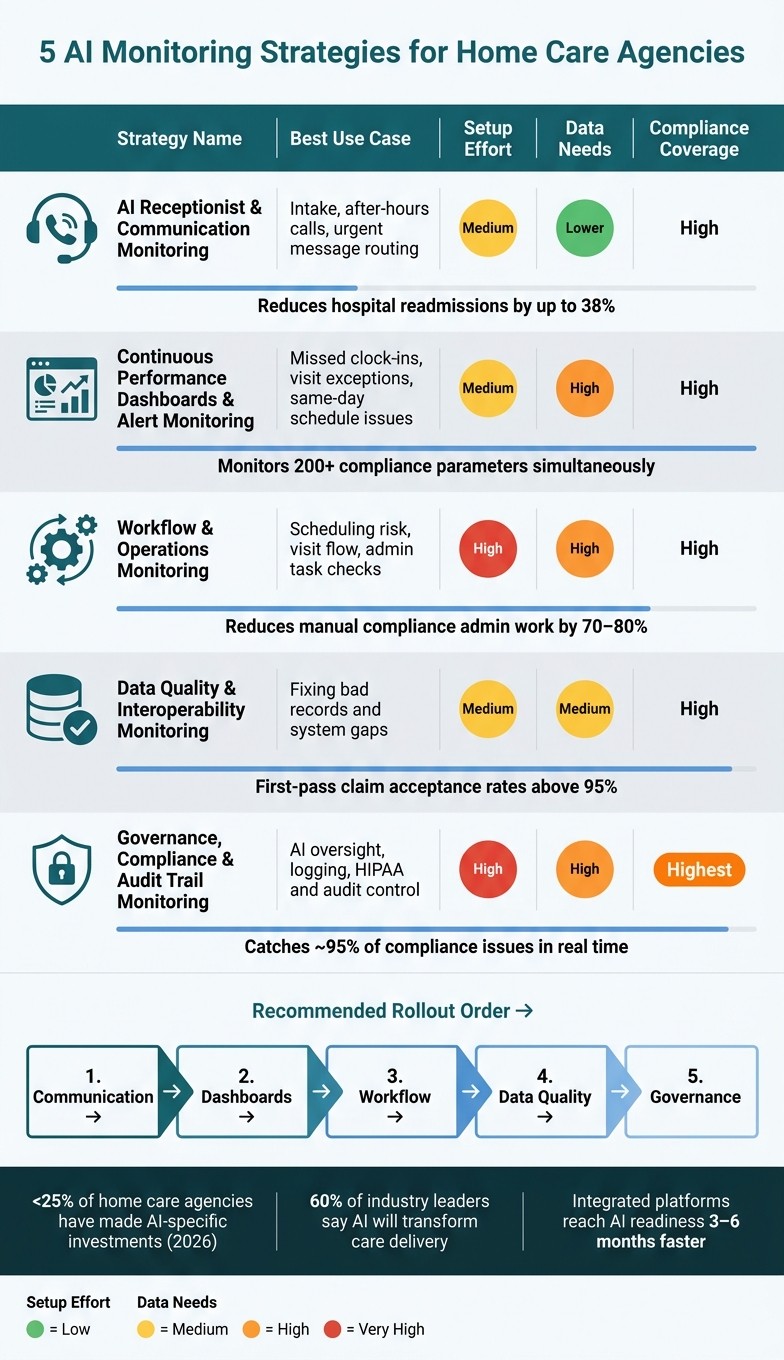
5 AI Monitoring Strategies for Home Care Agencies: Impact vs. Effort
Sensi.AI: How AI and In-Person Home Care Work Together
Quick Comparison
Strategy | Best Use | Setup Effort | Data Needs | Compliance Coverage |
|---|---|---|---|---|
AI receptionist & communication | Intake, after-hours calls, urgent message routing | Medium | Lower | High |
Dashboards & alerts | Missed clock-ins, visit exceptions, same-day issues | Medium | High | High |
Workflow monitoring | Scheduling risk, visit flow, admin task checks | High | High | High |
Data quality & interoperability | Fixing bad records and system gaps | Medium | Medium | High |
Governance & audit trails | AI oversight, logging, HIPAA and audit control | High | High | Highest |
If you want the simplest way to think about it, it’s this: start with communication, then alerts, then workflow, then data control and governance as your agency gets more AI-ready.
1. AI Receptionist and Communication Monitoring
Every call a home care agency gets tells you something. It might be a family member reporting a hospitalization, a caregiver calling out, or a new client reaching out after hours. If no system catches that info and routes it right away, it can slip through the cracks. That’s why this is often the easiest place to begin. AI receptionist and communication monitoring turns day-to-day calls into structured data your team can use.
Care Impact
The effect on care shows up fast. If an AI receptionist logs a call and marks it as a hospitalization, the scheduling team can pause that client’s visits the same day instead of waiting for someone to check voicemail. AI-powered communication tools can reduce hospital readmissions by up to 38% [5]. On top of that, tracking escalation rates and missed-call patterns helps leaders spot repeat staffing or scheduling problems before they start snowballing.
Implementation Effort
This is one of the easier starting points for most agencies. A phased rollout usually takes 3 to 6 months for the first setup and integration work [1]. Lead Receipt’s Professional plan includes a 24/7 AI voice and chat receptionist with call recordings and lead data output. That supports call logging and CRM sync for communication monitoring.
Data Prerequisites
For this to work well, agencies need call logs, recordings, intake forms, and scheduling API access connected in one place [8][1]. Teams should also set clear incident categories, such as:
"Hospitalization"
"Aide No-Show"
"Safety Concern"
That gives the AI a clear target and cuts down on noise [8]. Clean historical data from at least 6 to 12 months also helps the system set steady baselines [1].
Regulatory Coverage
AI communication monitoring creates an automatic audit trail by logging flagged calls, escalations, and CRM sync events for review. Automated systems can catch up to 95% of compliance issues in real time, compared with manual reviews that may miss 15% to 20% of problems [3]. To keep outputs HIPAA-defensible, limit prompts to facts stated in the transcript.
Criterion | AI Receptionist & Communication Monitoring |
|---|---|
Care Impact | High - flags hospitalizations and no-shows the same day [8] |
Implementation Effort | Moderate - 3 to 6 months for initial setup and EMR/CRM sync [1] |
Data Prerequisites | Call logs, recordings, intake forms, and scheduling API access [8][1] |
Regulatory Coverage | High - automated audit trails and HIPAA-compliant data capture [3][8] |
Once calls are visible, the next move is figuring out whether the response is fast enough.
2. Continuous Performance Dashboards and Alert Monitoring
A logged call only matters if someone can act on it fast. Continuous performance dashboards and alert monitoring help close that gap. They give coordinators and supervisors a live view across shifts, caregivers, and clients, so they can see what’s happening as it happens. Once calls are logged, the dashboard shows whether the response came in on time.
Care Impact
These alerts matter because speed shapes the outcome. A small issue can stay small if someone catches it right away. Real-time dashboards bring missed clock-ins, same-day visit changes, and authorization lapses to the surface before they turn into missed care. If a caregiver hasn’t clocked in within 15 minutes of a shift start, the system sends an alert right then instead of letting the issue sit in a next-day report.
Implementation Effort
This is a medium-lift move. The main work is connecting scheduling, EVV, billing, and clinical data in one dashboard so each alert reflects the full record. A phased rollout usually works best: start with the alerts that matter most, then add predictive risk scoring over time.
Data Prerequisites
Dashboards depend on clean, complete inputs. That means 95%+ field completion, standardized coding, and real-time data from EVV, caregiver credentials, care plans, visit notes, and billing authorizations. If the inputs are messy, the alerts will be noisy too, and false alarms can pile up fast.
Regulatory Coverage
Continuous dashboards can monitor more than 200 parameters simultaneously [3], including EVV exceptions, missing signatures, and credential lapses that manual reviewers often miss. Automated monitoring catches 95% of compliance issues in real time, while manual processes miss 15% to 20% of problems [3]. Even so, staff still need to review each flag and decide what action to take.
Criterion | Continuous Dashboards & Alert Monitoring |
|---|---|
Care Impact | High - surfaces missed clock-ins, visit exceptions, and same-day schedule changes in real time [9] |
Implementation Effort | Medium - integration-heavy; phased rollout recommended [1] |
Data Prerequisites | High - requires 95%+ field completion, real-time entry, unified data sources [1] |
Regulatory Coverage | High - monitors 200+ compliance parameters; catches 95% of issues in real time [3] |
The next question is whether those alerts change how work gets done.
3. Workflow and Operations Monitoring
Dashboards tell you what went wrong. Workflow monitoring helps stop the problem before it happens.
It does that by spotting scheduling gaps early, tracking visits as they happen, and automating the routine admin tasks that eat up coordinator time. So instead of finding out about a missed visit after the fact, AI can flag at-risk visits before a shift even begins. It looks at caregiver proximity, past punctuality, skill match, and travel time at the same time [2][4].
That’s what makes this the bridge between alerts and action.
There’s also a staffing angle here. Home care faces a caregiver turnover rate of about 79.2% [5]. Better scheduling and visit management can ease some of the daily friction that leads to burnout and pushes staff out the door.
Implementation Effort
This is the highest-lift option.
Bringing EMR, billing, and scheduling systems into one platform takes time and work. For larger agencies, rollout often takes 12–18 months. Smaller agencies are usually better off starting with one use case, like scheduling or documentation. The big shift is simple: monitoring moves from periodic review to continuous oversight.
Data Prerequisites
This only works when the source data is clean and connected.
Effective workflow monitoring pulls from EVV records, GPS data, caregiver credentials, care plans, and visit history. Agencies need 6–12 months of structured records with 95%+ field completion before putting predictive models to work [1].
Regulatory Coverage
Workflow AI can automate EVV validation, claim checking, and documentation audits in real time [10][3]. It also cuts manual administrative work tied to compliance by 70–80% [3], which helps agencies stay on top of active home care workflows without so much hand-checking.
Criterion | Workflow & Operations Monitoring |
|---|---|
Care Impact | High - prevents care gaps through predictive scheduling and real-time visit tracking [2][4][11] |
Implementation Effort | High - requires integrating EMR, billing, and scheduling systems; 12–18 month roadmap for larger agencies [1][3][12] |
Data Prerequisites | High - needs 6–12 months of clean, integrated data across EVV, GPS, and care plan records [1] |
Regulatory Coverage | High - automates EVV validation, claim checking, and documentation audits; reduces manual compliance-related administrative work by 70–80% [12][3] |
The catch is plain enough: workflow monitoring is only as good as the data feeding it. That leads straight to the next problem to fix.
4. Data Quality and Interoperability Monitoring
Every other AI monitoring method rests on one thing: clean, connected data. If records are incomplete, delayed, or stuck in separate systems, the output starts to wobble. That’s why data quality sits at the bottom of the stack for every other monitoring approach.
Data quality and interoperability monitoring steps in here. In many cases, it’s the first stage of AI rollout, checking visit notes, care plans, and physician orders before an agency moves into heavier automation [3].
Care Impact
Checking data at the point of entry helps cut missed authorizations, billing denials, and unused authorized hours. If authorized hours go unused just because no one tracked them against the schedule, agencies lose both care time and revenue [13][6].
When AI checks data as it comes in - flagging missing fields, authorization mismatches, or credential lapses before submission - first-pass claim acceptance rates can go past 95% [6]. Documentation accuracy can reach 98% [3].
Implementation Effort
A smart place to start is documentation monitoring, then branch into EHR, billing, scheduling, and EVV integration. Visit notes, physician orders, and care plans often show data gaps early, before those gaps spread into connected systems [3].
The tougher part is tying those systems together. EHR, billing, scheduling, and EVV platforms often store fields and timestamps in different ways. Getting them to sync the same way every time takes planning and steady setup work [3].
Data Prerequisites
Before AI can monitor with confidence, records need to follow the same format. Agencies should check existing records before adding AI monitoring [3]. Inconsistent timestamps, duplicate entries, and delayed visit notes all weaken what the AI can detect with confidence [3][13][14].
Regulatory Coverage
AI can be updated with new Medicare or Medicaid rules within days instead of months [3]. That matters when payer rules shift in the middle of the year.
Criterion | Data Quality & Interoperability Monitoring |
|---|---|
Care Impact | High - catches 95% of compliance issues in real time; prevents billing denials and lost authorized hours [3][6] |
Implementation Effort | Moderate - start with documentation monitoring, then expand to cross-system integration [3] |
Data Prerequisites | Moderate - requires standardized records and system connectivity before AI can perform reliably [3][13] |
Regulatory Coverage | High - automates claim scrubbing, EVV validation, and adapts to regulatory changes within days [3][6] |
Once the data layer is stable, the next step is figuring out which monitoring method gives you the best mix of impact and effort.
5. Governance, Compliance, and Audit Trail Monitoring
Once your data is clean, the next issue is control: who can use the AI, who signs off on its output, and what gets logged. That’s where governance and audit trail monitoring comes in. It gives you oversight over AI activity, flags unusual behavior, and keeps a record you can audit later.
Care Impact
The impact is indirect, but it matters a lot. This layer helps prevent compliance problems that can interrupt visits, billing, and documentation. Fewer survey deficiencies means less risk to both compliance and continuity of care.
Implementation Effort
This is the most control-heavy option of the five. It depends on unified clinical, billing, and scheduling data, along with role-based access, encryption, and automated audit logging. A structured rollout usually takes about 10 weeks and moves through four phases: Discovery, Pilot, Rollout, and Optimization [15].
Before any PHI moves through an enterprise platform, that platform should have:
A signed Business Associate Agreement (BAA)
SOC 2 Type II certification
Data encryption with TLS 1.2+ in transit and AES-256 at rest [15][16]
It also helps to put an AI Acceptable Use Policy (AUP) in place. That can block unsanctioned consumer AI tools and lower PHI exposure.
Data Prerequisites
This strategy asks the most from your data stack. You need high-quality, standardized records across connected systems like EMR, billing, and scheduling. And human review can’t be treated as optional. Any AI-generated note should go through licensed human review before submission to meet CMS expectations [15][16].
Regulatory Coverage
Governance monitoring gives you the strongest regulatory coverage in this group. It directly supports HIPAA, Medicare certification, and state survey readiness. It also lines up with newer frameworks such as the NIST AI Risk Management Framework (AI RMF) and ONC HTI-1 transparency requirements [3][17].
Automated audit logs can cross-check billed services against documented care delivery. That strengthens revenue integrity and cuts False Claims Act risk [3][15]. It can also reduce manual compliance work, shifting teams from weekly routine review to a smaller set of high-priority flags [3].
Criterion | Governance, Compliance & Audit Trail Monitoring |
|---|---|
Care Impact | High - prevents service disruptions; catches about 95% of compliance issues in real time [3] |
Implementation Effort | High - requires BAAs, SOC 2, encryption, AUP, and cross-system integration; roughly a 10-week rollout [15][16] |
Data Prerequisites | High - needs standardized cross-system records and mandatory human sign-off on AI outputs [15][16] |
Regulatory Coverage | Highest - covers HIPAA, Medicare, NIST AI RMF, and ONC HTI-1; continuous audit trail generation [3][17] |
Governance sets the top end of oversight. It also comes with the heaviest setup load, which is why it works well as the benchmark for the other four strategies.
Side-by-Side Comparison: Impact, Complexity, and Tradeoffs
Now that all five strategies are on the table, it helps to step back and compare them side by side. The main goal here is simple: match the depth of monitoring to the stage your agency is actually in.
Care Impact Across the Five Strategies
When you line these strategies up, the biggest difference is scope, not direction.
Performance dashboards and governance monitoring deliver the strongest oversight. They give agencies a broader view and tighter control. Workflow and operations monitoring lands in the middle, helping teams track how work moves across the agency. Data quality monitoring is the base layer because every other strategy leans on clean, consistent data. AI receptionist monitoring has the narrowest scope, but it can have the fastest day-to-day effect.
Implementation Effort: Low-Lift to High-Lift Options
The jump from the easiest setup to the hardest one is big.
AI receptionist monitoring is the simplest place to start because it uses data many agencies already have, like call logs and CRM records. Performance dashboards fall somewhere in the middle. Workflow monitoring and data quality work take more effort because they often mean reworking processes and standardizing data across teams. Governance monitoring is the heaviest lift since it depends on system-wide access and policy-based controls.
That helps explain why many agencies begin with intake and communication first, then move into cross-system automation later.
Data Prerequisites for Reliable Monitoring
All-in-one systems can shorten AI readiness because they pull scheduling, billing, EVV, clinical, and communication data into one place.
As strategies get more advanced, the data demands go up:
AI receptionist monitoring needs call logs and CRM entries.
Dashboards add call logs, scheduling history, EVV, and alert data. They also need at least 6–12 months of clean historical data for dependable alerting [1].
Workflow monitoring depends on EVV data, GPS patterns, and payer rules.
Data quality monitoring needs standardized inputs across every system.
Governance monitoring requires all of that, plus documentation, care plans, and audit logs.
In practice, data readiness usually decides which strategy an agency can use first.
Regulatory Coverage and Oversight Strength
Governance monitoring gives the strongest regulatory coverage. It supports HIPAA and survey readiness. Performance dashboards also offer strong real-time oversight, especially through audit trails tied to alerts and visit records. Workflow monitoring helps with fraud prevention through claim scrubbing.
AI receptionist monitoring supports HIPAA-compliant logging, but it doesn't reach into clinical audit territory. Data quality monitoring helps protect audit integrity, though it doesn't stand alone as a compliance strategy.
Matching Each Strategy to Agency Size and Complexity
Agency size and system complexity usually shape the best place to begin.
Agency Profile | Recommended Starting Strategy | Follow-On |
|---|---|---|
Small agencies (limited budget) | AI Receptionist (Strategy 1) | Basic alerting (Strategy 2) |
Mid-sized multi-location agencies | Workflow & claim scrubbing (Strategy 3) | Performance dashboards (Strategy 2) |
Advanced AI deployments | Governance & audit trails (Strategy 5) | Predictive analytics |
Small agencies often see the fastest payoff from AI receptionist monitoring because it's lower cost and quicker to put in place. Mid-sized agencies with several locations often get more from workflow monitoring paired with dashboards. Agencies with cleaner data and more connected systems are usually in a better spot to add governance monitoring as the final control layer.
Pros and Cons
Each strategy makes a different tradeoff between speed, reach, and day-to-day workload.
Main Advantages by Monitoring Strategy
The benefits below line up with the same four decision factors used earlier: impact, effort, data readiness, and oversight.
AI Receptionist and Communication Monitoring gives agencies 24/7 intake coverage and has the lowest setup barrier among the five strategies [1][5].
Continuous Performance Dashboards and Alert Monitoring has the strongest care-safety effect because it can flag missed clock-ins and visit exceptions before they affect care [7].
Workflow and Operations Monitoring improves efficiency through better caregiver-client matching and more optimized scheduling [1].
Data Quality and Interoperability Monitoring creates the base layer that helps every other strategy work better [1].
Governance, Compliance, and Audit Trail Monitoring catches 95% of compliance issues in real time and cuts manual audit work by 70–80% [3].
Main Drawbacks and Limits by Monitoring Strategy
Every upside comes with extra work somewhere else.
Strategy | Main Drawback | Staffing Impact |
|---|---|---|
AI Receptionist and Communication Monitoring | Risk of missed escalations or transcription errors when urgent needs are misread [1] | Requires human backup for urgent calls |
Continuous Performance Dashboards and Alert Monitoring | Alert fatigue from too many low-value alerts [7] | Requires clinical review within hours |
Workflow and Operations Monitoring | Requires clean historical data before outputs are reliable [1] | Needs staff-wide data discipline |
Data Quality and Interoperability Monitoring | Low immediate care impact; heavy upfront effort to standardize records [1] | Needs staff-wide data discipline |
Governance, Compliance, and Audit Trail Monitoring | High integration complexity; depends on connecting clinical, billing, and scheduling systems [3] | Needs ongoing audit maintenance |
Bad input data weakens every downstream AI output. That problem hits Data Quality and Interoperability Monitoring and Governance, Compliance, and Audit Trail Monitoring especially hard.
When the Tradeoffs Are Worth It
The best fit depends on the bottleneck doing the most damage: intake, alerts, workflow, data quality, or compliance.
Continuous Performance Dashboards and Alert Monitoring makes sense when an agency serves high-acuity clients or needs a faster response to missed visits [7]. Governance, Compliance, and Audit Trail Monitoring earns the extra integration work for agencies in heavily regulated markets or value-based care models [1]. Data Quality and Interoperability Monitoring has a lower immediate effect on care, but it is still the right first move for agencies that plan to scale [1]. If intake volume is the main problem, start with AI Receptionist and Communication Monitoring [1][5].
These strategies work best when each one is tied to a clear operating gap instead of rolled out all at once. The conclusion explains how to sequence that work.
Conclusion
There isn’t one AI monitoring plan that fits every home care agency. A small team using basic scheduling software should not roll things out in the same order as a multi-site agency running connected clinical and billing systems. That’s why rollout order matters more than a long feature list.
The smartest approach is phased, not all at once. Start with communication monitoring and simple dashboards. Then layer in workflow monitoring, data quality checks, and governance as your data gets cleaner and more consistent.
Integrated platforms usually reach AI readiness 3–6 months faster than siloed tools [1]. But AI can’t fix broken workflows or poor data entry. If records aren’t standardized first, adding more automation just adds more mess.
Across all five strategies, the same idea holds: match the depth of monitoring to where the agency is right now. The main tradeoff is impact versus effort. Communication monitoring and dashboards are easier to put in place and can bring early wins. Governance and predictive analytics take more work, but they can bring stronger compliance support and better clinical results. The agencies getting traction are the ones that roll out monitoring in step with their data, workflow, and compliance maturity.
FAQs
Which AI monitoring strategy should we start with first?
Start with data readiness. Check your data for errors, make sure staff enter information the same way, and switch to cloud-based management software.
Once that base is set, pick two or three high-impact use cases tied to major pain points, like scheduling optimization or automated documentation. Lead Receipt can help with AI-powered receptionist and workflow automation tools that plug into your existing systems.
How do we know if our agency is ready for workflow or governance monitoring?
Start by looking at your agency’s data and operational maturity. That means having digital systems you can rely on, data that’s clean and consistent, and documentation that follows the same standards across the team.
You’ll also need clear ownership for monitoring and managing the tech, plus a plan to train staff and build trust in how it’s used. Before you go past a pilot, pick a small set of high-impact use cases tied to your agency’s biggest pain points.
What data problems can weaken AI monitoring results?
Several data issues can weaken AI monitoring results:
Disconnected systems can leave clinical, billing, and scheduling data stuck in separate silos.
Manual entry errors - like transcription mistakes or incomplete intake forms - can skew the data from the start.
Duplicate entry or extra workflow steps can make staff less likely to use the system and can split inputs across places.
Weak data governance can lead to uneven data cleanup and inconsistent standards over time.