
What Is Automated Lead Scoring?
Healthcare Technology
Updated Mar 29, 2026
AI-powered lead scoring ranks prospects in real time, prioritizes high-intent leads, and shortens sales cycles for healthcare and service teams.
Automated lead scoring uses AI and machine learning to rank prospects based on their likelihood to convert. It analyzes behaviors like website activity, email engagement, and firmographic data in real-time, updating scores instantly as new information becomes available. This helps sales teams prioritize high-intent leads and respond faster, improving conversion rates by up to 25% and reducing sales cycles by 30%. Industries like healthcare, with complex sales processes and strict regulations, benefit significantly from this approach, as it simplifies lead prioritization and ensures compliance.
Key benefits include:
Real-time scoring: Instant updates based on new lead actions.
Higher efficiency: Sales teams focus on qualified leads, spending up to 80% of their time on high-value prospects.
Improved customer experience: Faster, more personalized responses to inquiries.
Automated lead scoring is particularly useful for businesses with long sales cycles or intricate buyer journeys, ensuring no opportunity is missed while maximizing team productivity.
Automated Lead Scoring System (beginner guide)
How Automated Lead Scoring Works
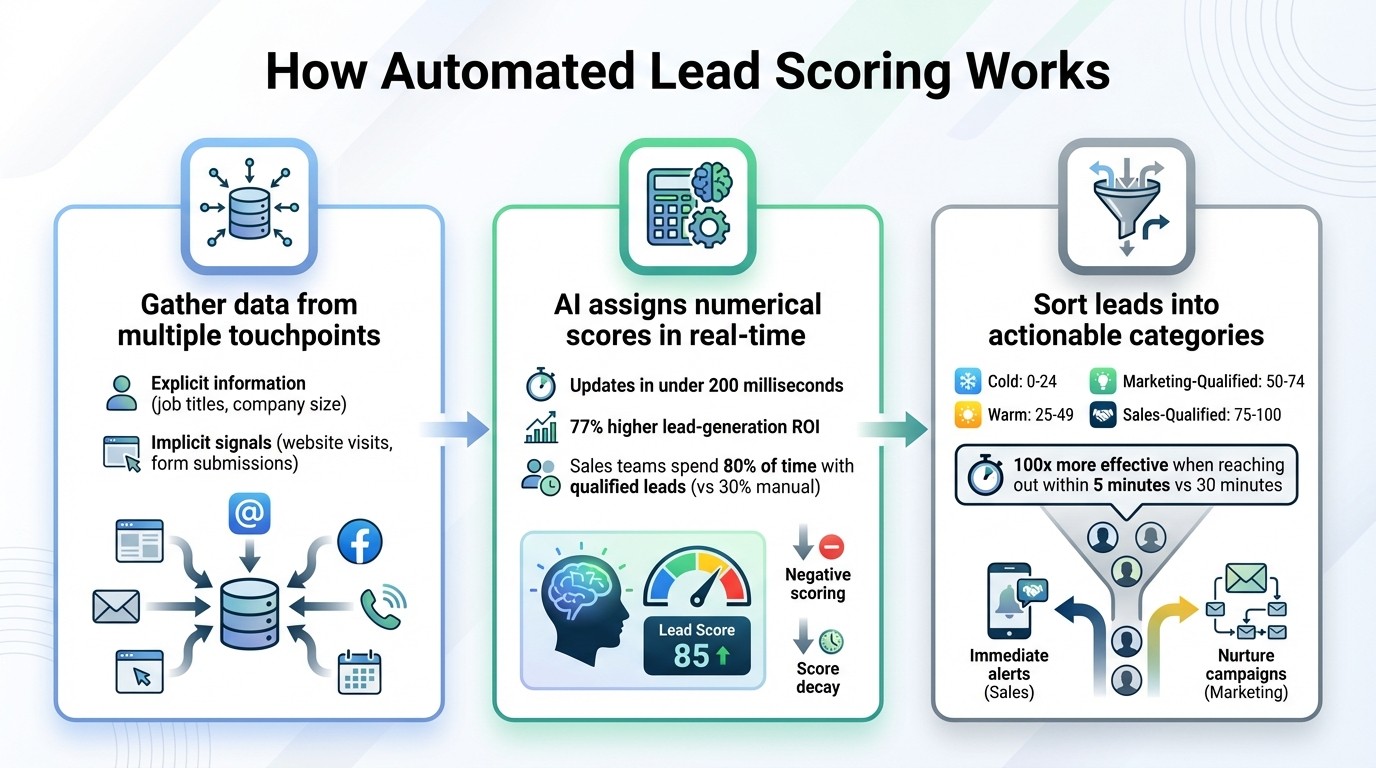
How Automated Lead Scoring Works: 3-Step Process
The automated lead scoring process involves three key stages, each building upon the last to paint a detailed picture of potential leads.
Step 1: Data Collection
It all begins with gathering data from various touchpoints to create detailed lead profiles. Businesses such as healthcare providers, dental practices, and service companies collect two types of data: explicit information (like job titles or company size) and implicit signals (like website visits or form submissions). Together, these data points help form a well-rounded view of each lead.
Step 2: Assigning Scores
Once the data is collected, the system assigns a numerical score to each lead. This can be done using traditional rule-based methods, where specific actions (like requesting a demo) are assigned fixed point values. Alternatively, predictive AI scoring uses machine learning algorithms - such as LightGBM - to analyze historical CRM data and uncover patterns. As Orbit Forms puts it, "Instead of starting with rules and hoping they predict outcomes, algorithms start with outcomes and discover the rules."
AI systems continuously update these scores in real time, often in under 200 milliseconds, based on new activities like page visits. To maintain accuracy, they also incorporate features like negative scoring (penalizing poor-fit leads) and score decay (adjusting for inactivity). This approach can deliver impressive results - companies using lead scoring report up to a 77% higher lead-generation ROI [8], and sales teams spend up to 80% of their time with qualified leads, compared to just 30% when using manual methods [2].
Step 3: Lead Segmentation and Routing
After scores are assigned, leads are sorted into actionable categories such as cold (0–24), warm (25–49), marketing-qualified (50–74), and sales-qualified (75–100). High-scoring leads trigger immediate alerts (via Slack or CRM tasks), prompting quick sales follow-up. Meanwhile, lower-scoring leads are automatically placed into nurture campaigns with tailored educational content.
For example, in healthcare, a lead requesting pricing for a specific procedure might be routed directly to an intake specialist. On the other hand, someone downloading a general wellness guide would enter an educational campaign. Similarly, service businesses can route leads based on product or service interest, ensuring they connect with the most knowledgeable consultant. Speed matters here - reaching out to a lead within five minutes can be up to 100 times more effective than waiting 30 minutes [8]. This precise segmentation ensures leads are handled efficiently, setting the stage for the productivity gains discussed next.
Key Components of Automated Lead Scoring Systems
Automated lead scoring systems are built around essential components that streamline the process of qualifying leads. These systems use three primary scoring methods, each tailored to identify prospects ready for sales engagement. By understanding how these elements work together, healthcare providers and service-based businesses can develop systems that more accurately identify and prioritize high-quality leads.
Activity-Based Scoring
Activity-based scoring tracks and evaluates a prospect's behavior to gauge their level of interest. Every action - from opening an email to downloading a whitepaper - earns a specific point value based on how closely it aligns with buying intent. For instance, in healthcare, requesting a demo might add +40 points, using an ROI calculator +25, and visiting an EHR integration page +20 [9]. Similarly, for service businesses, actions like multiple visits to pricing pages or downloading case studies signal serious interest.
This method also incorporates negative scoring to eliminate leads that aren't a good fit. Points can be deducted for factors like using competitor email domains, generic addresses (e.g., Gmail), or being inactive for extended periods. For example, scores may drop by 50% after 90 days of inactivity, ensuring the focus remains on recent, relevant signals. This is particularly important in healthcare, where buying cycles often span 12–24 months [9][5].
By balancing positive and negative scoring, businesses can maintain a pipeline filled with genuine opportunities while filtering out less promising leads.
Profile-Based Scoring
Profile-based scoring evaluates whether a lead aligns with your ideal customer profile by examining static attributes like job title, company size, and industry. This type of scoring helps determine if the prospect has the authority and resources to make purchasing decisions. For example, in February 2026, MedFlow Solutions - a healthcare SaaS company - assigned +20 points to Practice Managers and +15 points to multi-specialty clinics, as these roles matched their target audience [9]. For home care agencies, focusing on managers and owners - who typically handle operational decisions - makes practical sense.
Healthcare sales often involve multiple stakeholders, typically 6–10 people spanning various departments [5]. Identifying key decision-makers early is crucial to avoid wasting time on contacts who lack purchasing authority. Sean O'Connor from monday.com highlights this challenge:
"Healthcare decisions involve 6-10 people across departments, so identify all decision-makers upfront to avoid wasting months on the wrong contacts" [5]
Profile scoring ensures sales teams concentrate on the right individuals from the start, improving efficiency and reducing wasted effort.
Predictive Scoring Using AI
Predictive scoring takes things a step further by leveraging machine learning algorithms to analyze large volumes of data and uncover patterns that humans might miss. These algorithms review historical CRM data, engagement behaviors, and firmographic details to predict which leads have the highest likelihood of conversion. Unlike traditional rule-based systems that rely on fixed point values, AI identifies the combinations of factors that truly correlate with successful deals. For instance, it might discover that leads engaging with specific types of content during evening hours convert at three times the rate of those active during the day [3].
Orbit AI explains the advantage of this approach:
"The algorithm handles the pattern recognition that humans can't scale - processing engagement data from your website, email campaigns, and CRM in real-time" [3]
Tools like Lead Receipt enhance predictive scoring by analyzing data patterns to forecast conversion potential, which is especially valuable in industries like healthcare, where stakes and complexity are high. Together, these scoring methods provide a well-rounded, real-time view of lead quality, equipping businesses to navigate lengthy and intricate sales cycles with greater precision.
Benefits of Automated Lead Scoring for Healthcare and Service Businesses
For healthcare and service industries, where decision-making often involves multiple stakeholders, automated lead scoring addresses key pain points - like wasting time on unqualified leads, slow responses, and missed opportunities.
Better Lead Prioritization
Here’s a striking reality: only 25% of inbound leads are sales-ready [1]. Without automation, sales teams often spend hours chasing prospects who either lack the budget, authority, or genuine interest. Automated lead scoring changes the game. AI tracks real-time behavioral cues - like time spent on pricing pages, services reviewed, and even exit intent - to pinpoint high-intent prospects [1][2].
When a lead hits a specific score threshold, automated systems notify the right sales rep instantly through CRM tools like Salesforce or HubSpot, or communication platforms like Slack [1][10]. Speed matters, especially in healthcare, where responding to leads within an hour makes organizations 7x more likely to engage decision-makers meaningfully [2]. Advanced AI even uses Natural Language Processing (NLP) to gauge urgency and sentiment from form submissions or chat interactions, ensuring immediate attention for those who need it most [10].
By capturing 68% more sales-ready leads that manual methods might overlook [1], AI ensures your team focuses on genuine opportunities instead of wasting time on dead ends. This targeted approach leads to major productivity gains.
Higher Sales Productivity
Automation doesn’t just prioritize leads; it transforms how sales teams operate. Instead of spending only 30% of their time on qualified leads, teams using AI can dedicate 80% of their efforts to high-value prospects [2]. This shift happens because automation eliminates what experts call "negative work" - tasks like researching unqualified leads, scheduling demos with the wrong people, or following up with contacts who will never convert [11].
For a 10-person sales team, poor lead qualification can waste up to 1,000 hours every month, translating to about $75,000 in lost salary costs [3]. By cutting out manual research, individual reps can increase their monthly conversations from 20–25 to 30–40 [10]. Kyle Dorman, Department Manager - Operations at Ray White, sums it up:
"There's probably about a 70% increase in efficiency in regards to the admin tasks that were removed and automated, which is a huge win for us." [10]
According to McKinsey, AI-driven sales processes can boost leads and appointments by over 50% [2]. These productivity gains directly translate into revenue growth while also enhancing the customer experience.
Better Customer Experience
From the customer’s perspective, automated lead scoring delivers a smoother, faster, and more personalized experience. AI systems engage high-intent leads within seconds - not hours or days - offering timely assistance [2]. This is especially valuable for healthcare and service businesses that operate outside standard hours. AI tools ensure 24/7 availability, qualifying and engaging leads even on weekends or evenings when manual intervention isn’t feasible [2][10].
Personalization is another key advantage. Automated systems use behavioral data to craft tailored follow-ups - such as emails or content specific to what the user explored on your website, whether it’s detailed service information, case studies, or pricing [1][4]. When a high-scoring lead is handed off to a sales rep, they receive a complete intent profile, including pages visited and questions asked. This allows for more informed and meaningful conversations right from the start [1].
NLP further enhances the experience by identifying urgency and readiness from form submissions, ensuring the right specialist connects with the prospect quickly [10]. Tools like Lead Receipt go a step further, analyzing data patterns to guarantee personalized and prompt follow-ups. In healthcare settings, where timely responses can directly affect patient outcomes, this level of responsiveness is invaluable.
Steps to Implement Automated Lead Scoring with AI Tools
Automating lead scoring can simplify your sales process and boost efficiency. Businesses that use well-designed scoring systems often see conversion rates jump by 20% to 30% within the first six months, while also cutting sales cycle times by 15% to 25% [3]. Here’s how to get started.
Define Your Ideal Customer Profile
Start by analyzing your last 50 to 100 converted customers to identify patterns in their behaviors and characteristics [14]. Focus on the top 20% of customers from the past 12–24 months in terms of revenue and retention. Look for common traits such as job roles (e.g., Practice Manager, Medical Director), industry sub-sectors, company size, and geographic location.
Break down your criteria into two categories:
Explicit data: Information gathered directly, like form submissions.
Implicit data: Behavioral signals, like website interactions.
Collaborate with your sales team to ensure the traits you identify actually predict conversions. As Julian Alvarado, Content Lead at Coefficient, explains:
"The key is building your model around what actually drives conversions for your specific business" [12].
Also, create disqualification triggers - factors that immediately rule out leads. For instance, exclude competitors, students, or businesses outside your service area. For industries like healthcare, geographic location can be a critical factor due to licensing or service boundaries. To streamline lead routing, organize profiles into tiers, such as "Tier A" for the best matches and "Tier B" for good potential.
Set Scoring Criteria and Rules
Adopt a 100-point scale to keep your scoring system detailed and actionable [14]. Assign points to actions and attributes that have a proven track record of driving conversions. For example:
A VP or C-level title: +20 points
Requesting a demo: +50 points
Visiting a pricing page: +20 points
Matching your target industry: +15 points [7]
Incorporate negative scoring to flag potential issues. For instance:
Personal email domains (e.g., gmail.com): -10 points
Student status: -20 points
Use score decay to keep your pipeline fresh by automatically lowering scores for inactive leads. For example, subtract 5–10 points for every 30 days of no engagement [14][7].
Define clear thresholds for action:
0–30 points: Cold/Nurture
31–60 points: Warm/Email follow-up
61–80 points: Hot/MQL (Marketing Qualified Lead)
Coordinate these thresholds with your sales team’s workload. If sales is overwhelmed, raise the SQL threshold to ensure only the most promising leads are prioritized [14][2].
Use AI Tools for Predictive Scoring
Once you’ve established scoring criteria, integrate AI tools to take your system to the next level. AI-driven scoring analyzes hundreds of data points simultaneously, learning from historical "closed-won" deals to identify patterns that predict conversions [3][6]. Unlike static, rule-based systems, AI adjusts and updates scores in real time based on new lead behaviors [3][7].
For example, Lead Receipt’s AI platform not only scores leads but also ensures timely follow-ups. It syncs with your CRM and scheduling tools, updating scores instantly as leads interact with your business. This is especially helpful for healthcare or service industries where leads may engage outside regular business hours.
Start with a 30-day pilot program to test and refine your model [14]. Once the pilot is complete, move to continuous evaluation and optimization.
Monitor and Adjust Your Scoring Models
After launching your scoring system, review its performance monthly with your sales and marketing teams. Look for outlier leads - those with high scores that didn’t convert and low scores that did [14][2]. Track your Sales Acceptance Rate (SAR), which measures the percentage of leads sales agrees are qualified. A low SAR might indicate overly generous scoring or missing disqualifiers [14][13].
Regularly assess conversion rates for each score range to confirm that higher scores lead to better outcomes [14][7]. Healthy benchmarks include:
30%+ MQL to SQL conversion rate
50%+ SQL to Opportunity conversion rate[7]
To improve accuracy, make small, incremental changes. Adjust one or two criteria at a time, then monitor the results for a few weeks [14]. Use A/B testing to compare scoring models and fine-tune point values for specific actions [7]. Keep your data clean by removing duplicates, filling in missing information, and standardizing formats to avoid scoring errors or inaccuracies [2][13].
Conclusion
AI has reshaped how healthcare and service businesses handle their sales pipelines, making automated lead scoring a game-changer. With AI-powered systems, about 25% of inbound leads are instantly flagged as sales-ready[1], allowing sales teams to concentrate on leads with the highest potential. This approach doesn’t just streamline operations - it delivers results. Conversion rates increase by 25%, sales cycles are 30% shorter, and ROI jumps to 138%, compared to just 78% with manual methods[1][16]. Plus, sales teams are now responding 9x faster, with follow-ups within an hour boosting meaningful engagement by 7x[1][2].
"Lead scoring is no longer optional - it's the intelligence layer that determines whether your lead generation investments pay off." – Conversion System[16]
Platforms like Lead Receipt bring these benefits to life by scoring leads in real time and integrating seamlessly with CRM and scheduling tools. Whether a prospect reaches out during the day or late at night, the system captures their information, evaluates their profile and behavior, and routes them appropriately - all automatically. This 24/7 responsiveness is especially critical for healthcare and service businesses that can’t afford to miss opportunities outside of standard business hours.
As of 2026, 75% of businesses in the healthcare and service sectors are expected to adopt AI-powered lead scoring[16]. These systems allow companies to scale efficiently without adding staff, maintain consistent customer interactions, and make smarter, data-driven sales decisions. For growing businesses, automated lead scoring provides the strategic edge needed to seize every opportunity and fuel sustainable growth.
FAQs
What data do I need to start automated lead scoring?
To kick off automated lead scoring, start by gathering data that helps predict a lead's chances of converting. This typically includes demographic information like location, industry, and company size, as well as behavioral indicators such as website visits, email interactions, and form completions. Having accurate and complete CRM data is crucial because AI models depend on historical trends to deliver reliable scores. The more thorough your data, the better you'll be able to identify and prioritize leads with the highest potential.
How do I set the right MQL and SQL score thresholds?
To determine the best thresholds for your Marketing Qualified Leads (MQLs) and Sales Qualified Leads (SQLs), start by defining your ideal customer profile. This means identifying the key traits and behaviors of the customers most likely to convert. Then, dive into your historical lead data to uncover patterns that have led to successful conversions in the past.
Assign numerical values to different actions and characteristics - like email engagement, website visits, or job titles. Use these values to calculate scores that reflect a lead's potential. Over time, refine these thresholds to better pinpoint leads with the highest likelihood of converting.
The goal is to strike a balance: act quickly on hot leads while nurturing others who aren't quite ready. Make it a habit to review and adjust your scoring thresholds regularly to ensure they align with your performance metrics and business goals.
How can I keep lead scores accurate over time?
To keep lead scores accurate, it’s important to frequently update and fine-tune your scoring system. Using fresh data and real-time insights can make a big difference. Automated systems powered by machine learning can evaluate behavioral patterns, demographic details, and engagement levels to predict conversion likelihood. Make sure to retrain these models with the latest data and keep a close eye on their performance to maintain effectiveness. Adjust the criteria as needed to align with shifting trends, ensuring your scoring remains precise and helps prioritize leads for better engagement.