How AI Enhances CRM Lead Management Integration
Healthcare Technology
Updated Nov 19, 2025
Explore how AI transforms CRM lead management, enhancing efficiency, conversion rates, and customer experience, especially in healthcare.
AI-powered CRM systems are changing how businesses handle leads, especially in industries like healthcare and services. Here’s what you need to know:
Efficiency Gains: AI reduces manual tasks like data entry and lead qualification by up to 30%, helping teams focus on higher-value activities.
Improved Lead Conversion: Predictive analytics boost lead-to-deal conversion rates by 24%, while AI-driven workflows cut sales cycles by 40%.
Cost Savings: Companies report a 25% cut in operational costs and a 33% reduction in cost per lead.
Better Customer Experience: AI tools enable 24/7 availability, personalized outreach, and faster response times, leading to a 30% increase in customer satisfaction.
Healthcare-Specific Benefits: AI ensures HIPAA compliance, automates patient inquiries, and improves scheduling, resulting in a 20% increase in patient conversions.
AI integration with CRMs streamlines operations, reduces costs, and enhances customer interactions. Businesses that implement these systems see measurable improvements in sales, efficiency, and customer retention.
How to Integrate AI into Your CRM Strategy
Key Benefits of AI-Driven CRM Lead Management
AI-driven CRM systems are reshaping how businesses manage leads, delivering measurable results that directly boost profitability. According to Forrester research, companies adopting these solutions see an average 25% increase in sales revenue and a 30% reduction in operational costs [11]. Additionally, businesses report 27% higher sales win rates and enjoy up to 33% lower cost per lead when leveraging AI-powered workflows [8]. For industries like healthcare and service providers, which handle hundreds of inquiries daily, these benefits can transform operations from overwhelmed to efficient, scaling seamlessly with demand.
Automation of Manual Tasks
Repetitive tasks like data entry, lead qualification, and scheduling often consume valuable time that could be better spent on patient care or client engagement. AI eliminates these bottlenecks by automating such processes, allowing teams to focus on what truly matters. Research shows that AI-powered CRM systems can cut time spent on manual tasks by up to 30% [6][7].
AI tools also reduce non-selling activities by as much as 40%, enabling staff to prioritize core responsibilities [8]. Features like automated lead scoring and follow-up sequences ensure that outreach efforts are targeted, cutting unnecessary interactions by up to 30% [6][7].
Imagine the workflow improvements this brings: AI automatically logs new client details into the CRM, routes urgent inquiries to the right team member, and updates schedules - no human intervention required. In healthcare, this means patient information flows seamlessly from initial contact to appointment scheduling, eliminating errors and delays caused by manual handoffs.
This level of automation doesn’t just save time - it lays the foundation for smarter, more informed decision-making.
Better Data-Driven Decision Making
AI turns your CRM from a basic contact database into a strategic tool for decision-making. Predictive analytics process vast amounts of data - like website activity, email engagement, and social media behavior - to identify which leads are most likely to convert. This capability enhances lead qualification accuracy by an average of 40% [8].
AI also delivers actionable insights by predicting churn with up to 92% accuracy and spotting upsell opportunities 30–60 days earlier than manual methods [3]. For healthcare providers, this could mean identifying patients who might benefit from additional services or recognizing those at risk of leaving for another practice.
With real-time analytics, teams can allocate resources proactively rather than reacting to problems after they arise. Companies using predictive analytics in their CRM systems often see immediate improvements in operations and resource management. These insights also enhance customer interactions, creating a more personalized and effective experience.
Better Customer Experience
AI-powered tools redefine customer interactions by offering 24/7 availability. Virtual assistants handle inquiries, schedule appointments, and provide information around the clock, ensuring no opportunity slips through the cracks - even outside business hours. This constant accessibility is especially critical in healthcare, where urgent questions often arise beyond the typical workday.
Personalization is another game-changer. AI-powered communications, such as personalized emails, generate 29% higher open rates and 41% higher click-through rates [8]. For healthcare practices, this means appointment reminders, tailored follow-up care instructions, and targeted health tips that resonate with individual patients rather than generic messages.
Studies also reveal that AI-driven customer support boosts satisfaction by up to 30% [7][10]. Patients and clients receive timely, relevant responses, while more complex issues are escalated to human staff as needed. This hybrid approach ensures efficiency without losing the personal touch essential for healthcare and service industries.
The results speak for themselves: a SaaS provider reported a 20% increase in conversions after prioritizing high-potential leads identified by AI [5]. In healthcare and service sectors, this translates to more appointments booked, more inquiries converted, and greater revenue - all from the same marketing efforts.
Core AI Features Changing Lead Management
AI is reshaping lead management in healthcare, introducing capabilities that streamline operations and enhance patient engagement. Let’s dive into three standout features that are driving these changes.
Predictive Analytics and Insights
AI’s ability to analyze massive datasets is revolutionizing how healthcare providers forecast lead conversions. Through predictive lead scoring, it evaluates behavioral patterns, appointment histories, and seasonal trends to assign likelihood scores for conversions. This helps healthcare teams focus on the most promising leads, making their efforts far more strategic.
For instance, organizations using predictive analytics have seen up to a 24% boost in lead-to-deal conversion rates [2]. These tools can also predict when patients might need follow-up care or additional services, often identifying upsell opportunities 30–60 days earlier than manual methods [3].
By prioritizing high-probability leads, healthcare staff can focus their time where it matters most, while automated systems handle lower-priority prospects. This data-driven approach not only improves efficiency but also ensures a more seamless integration of workflows.
Real-Time Workflow Automation
AI’s true potential shines when systems work together without human intervention. Real-time workflow automation connects CRMs, electronic medical records (EMRs), billing systems, and scheduling platforms, eliminating manual processes that often lead to delays and mistakes.
For example, when a new patient inquiry comes in, AI instantly updates all relevant systems. Patient demographics are added to the EMR, appointment preferences sync with scheduling software, and insurance details are updated in the billing system - automatically. This reduces errors and ensures every department has access to the latest information.
Take Lead Receipt’s AI Receptionist as an example. This system logs client details into CRMs, routes urgent calls to on-call staff, and updates caregivers with scheduling changes - all while operating 24/7 [1]. Healthcare agencies using such automation report significant time savings, allowing staff to focus more on patient care while leaving administrative tasks to AI.
Smart Lead Qualification and Routing
AI-powered systems take lead qualification to the next level by analyzing multiple data points to assess fit and intent. Once qualified, leads are routed to the right team members, ensuring high-value opportunities are addressed immediately while routine inquiries are handled automatically.
Organizations that use AI-driven qualification systems report a 40% increase in qualified leads and a 25% reduction in sales cycle length [4]. For healthcare providers, this means more appointments booked and a faster onboarding process.
AI also optimizes follow-up communication. Whether through text reminders, emails, or phone calls, the system adapts to patient behavior and preferences, ensuring messages land at the right time and on the right platform to maximize engagement.
These three features - predictive analytics, workflow automation, and smart lead qualification - combine to create a highly efficient lead management system. Together, they enable healthcare organizations to scale their operations while continuing to deliver exceptional patient care.
How to Successfully Integrate AI with CRMs
Integrating AI into your CRM system can transform how your business operates, but it requires careful planning and execution. For industries like healthcare and service-based businesses, the process comes with unique hurdles, such as regulatory requirements and intricate workflows. Here’s a step-by-step guide to navigate this process effectively.
Preparing for AI Integration
The first step is to assess your data and align the goals of all stakeholders. Start by evaluating the quality of your data - this means identifying and resolving gaps, duplicates, or inconsistencies in your lead records. Clean, organized data is the foundation for successful AI integration.
Bringing stakeholders on board early is equally important. IT teams, compliance officers, sales staff, and customer service representatives all need to understand the objectives and their specific roles in the process. This collective alignment ensures smoother execution.
For healthcare businesses, compliance with HIPAA regulations is non-negotiable. You’ll need to implement strict access controls, encryption, and audit trails to safeguard patient information. Additionally, any AI vendor you partner with must provide business associate agreements (BAAs) and demonstrate their ability to handle sensitive healthcare data securely. Automated tools that redact personally identifiable information in CRM records can add an extra layer of security [5][3].
A great example of a well-prepared integration comes from Lead Receipt. Their process begins with an in-depth analysis of an agency’s specific needs, mapping out current workflows, and identifying challenges in lead management. This groundwork leads to a tailored strategy that ensures compliance while minimizing disruptions to daily operations [1].
To minimize risk, consider launching a pilot program. Test the integration with a specific department or lead source, measure the results, and refine the process based on your findings. This allows you to make adjustments before rolling the system out across the entire organization.
Once the initial integration is complete, the focus shifts to ongoing performance monitoring and refinement to ensure long-term success.
Improving AI Performance Over Time
AI integration isn’t a one-and-done task - it’s an evolving process. Your AI system should continuously learn and improve, refining tasks like lead scoring, routing, and follow-up timing based on real-world interactions.
Regular performance reviews are essential. Conduct quarterly evaluations to track trends and gather feedback from your sales and customer service teams. These team members interact with the system daily and can identify issues that may not be immediately obvious in the data. For instance, if the AI is misclassifying leads or overlooking certain qualification criteria, their input can guide model adjustments.
Lead Receipt exemplifies this approach with their commitment to ongoing optimization. Their systems analyze insights from AI interactions to refine processes, leading to efficiency gains of up to 20% for their clients [1].
Retraining your AI models with updated data is another critical step. Customer behaviors, market conditions, and seasonal trends are constantly changing. What worked for lead qualification six months ago might no longer be effective, especially in dynamic industries like healthcare.
Best Practices for Smooth Integration
To ensure a seamless AI-CRM integration, follow these best practices:
Use API-based connections: These enable real-time data exchange with CRM platforms like Salesforce, HubSpot, or Microsoft Dynamics, ensuring compatibility and efficiency [5].
Test in a sandbox environment: Before going live, use a controlled testing environment to identify and resolve technical issues, validate data flows, and train staff without interrupting ongoing operations.
Maintain thorough documentation: Keep detailed records of integration configurations, data mapping, and workflow rules. This makes troubleshooting easier and ensures consistency.
Prioritize staff training: Equip your team with the knowledge to understand AI decision-making, trust its recommendations, and provide feedback for improvement. Training programs are key to helping your staff adapt to new workflows and maintain high data quality standards.
A B2B software company in 2023 demonstrated how these best practices can deliver results. By integrating SuperAGI with Salesforce, they unified data from marketing, CRM, and social media platforms. The outcome? A 30% boost in conversion rates and a 25% reduction in sales cycle time [12].
Lead Receipt’s integration philosophy also highlights the importance of seamless connections with existing infrastructure. Their system automates repetitive tasks like logging client details into CRMs, routing urgent calls, and updating schedules - all while minimizing disruptions to daily operations [1].
The key to long-term success is gradual implementation. Start with simpler, high-impact tasks like lead capture and basic qualification. Once your team is comfortable, you can expand to more advanced capabilities like predictive analytics and complex workflow automation.
Case Study: AI-Powered Solutions for Healthcare Lead Management
Healthcare providers across the United States are finding that traditional lead management systems just don’t cut it anymore. Missed calls, data entry errors, and slow follow-ups are all too common, leaving patients frustrated and businesses falling short. Enter Lead Receipt, whose AI-powered tools are reshaping how healthcare and service providers manage leads.
What Lead Receipt Brings to the Table
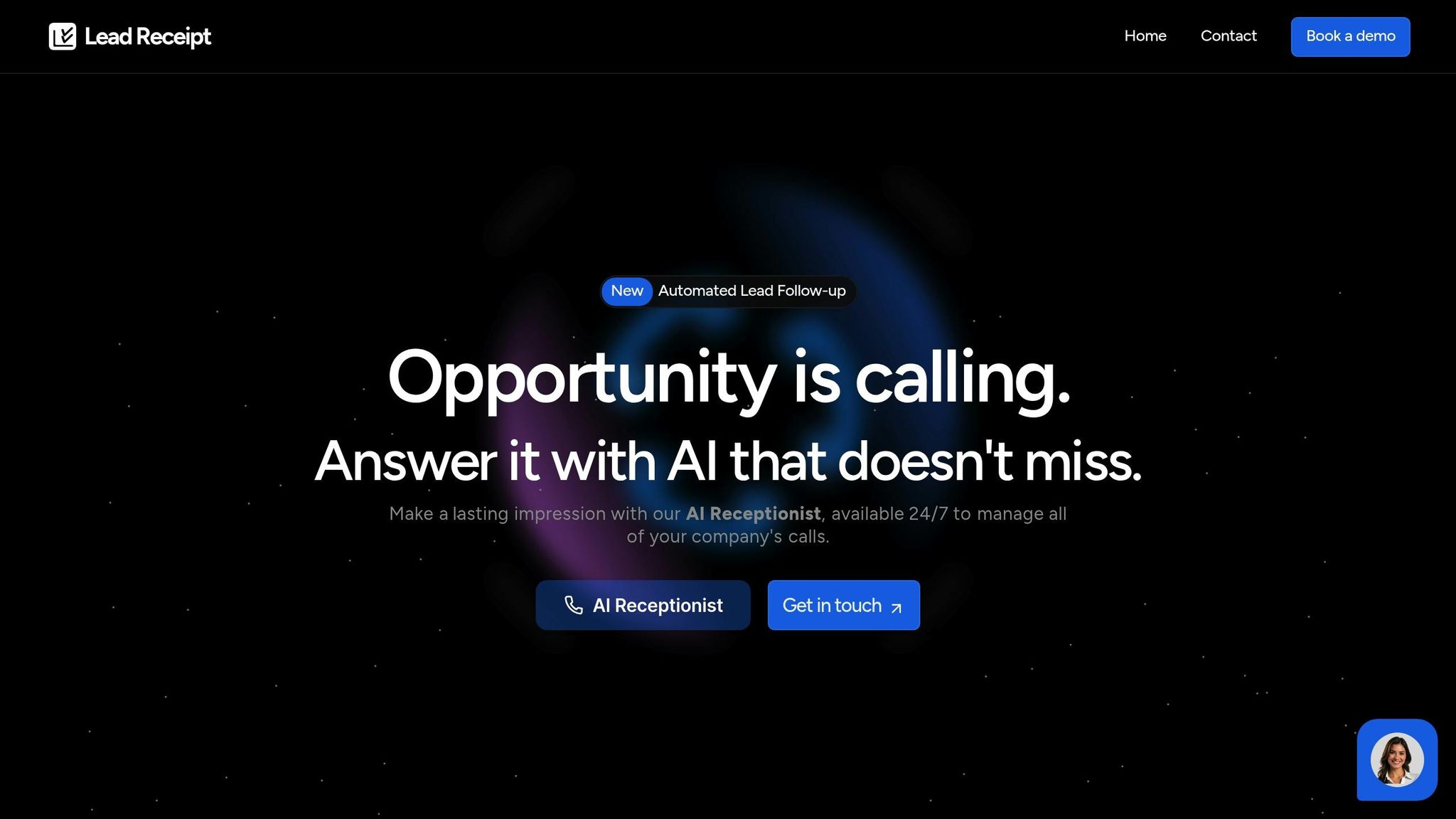
Lead Receipt offers a suite of AI-driven tools built specifically to tackle the challenges of healthcare lead management. Their 24/7 AI receptionists are at the heart of the solution, taking calls day and night. These receptionists handle new patient intakes, answer support questions, and schedule appointments with remarkable accuracy - all tailored to each organization’s needs.
But it doesn’t stop there. The platform’s workflow automation takes efficiency up a notch. With over 100 automations available, the system can log patient details directly into existing CRM platforms, route urgent calls to on-call staff, and send real-time updates to caregivers. This eliminates manual tasks and keeps things running smoothly.
Integration is seamless, thanks to RESTful APIs and plug-and-play connectors that work with leading CRM and scheduling software. And because healthcare data security is non-negotiable, Lead Receipt’s systems are designed with HIPAA compliance in mind. Data is encrypted, and every interaction is tracked, ensuring both security and accountability.
Real Results That Speak Volumes
The impact of these tools has been nothing short of transformative. Take, for instance, a mid-sized urgent care network that adopted Lead Receipt’s AI receptionist and workflow automation. Within six months, they saw a 40% jump in qualified patient leads and a 25% drop in average wait times for scheduling appointments. This not only boosted operational efficiency but also improved patient satisfaction.
Administrative workloads have also seen a dramatic reduction. By automating routine tasks like patient intake, appointment confirmations, and follow-ups, healthcare providers have cut administrative time by 25%. This means staff can focus on what really matters - delivering quality care.
Lead-to-patient conversion rates have also climbed. Clinics using Lead Receipt’s AI-driven lead qualification and follow-up systems report improvements of 20-24%. The key? Instant responses to patient inquiries, even outside regular business hours, ensuring no lead goes cold.
Patient engagement has improved too. Automated appointment reminders and timely communications make the process smoother and more familiar for patients. The system even handles insurance verification, using standard US date and time formats (MM/DD/YYYY, 12-hour clock) to ensure everything feels intuitive.
One standout example is a multi-specialty clinic that had been losing 30% of its after-hours calls. After implementing Lead Receipt’s 24/7 AI receptionist, they captured every single inquiry, resulting in an additional $180,000 in annual revenue from what were previously missed opportunities.
Built to Scale with Your Business
Scalability is a cornerstone of Lead Receipt’s approach, making it a perfect fit for growing healthcare providers. Their tiered subscription plans cater to practices of all sizes, from small offices to expansive networks:
Starter Plan ($300/month): Offers 24/7 web-chat coverage, ideal for smaller practices.
Professional Plan ($750/month): Adds voice and chat capabilities, supports up to 100 AI calls daily, and includes dedicated phone lines and multi-language support.
Enterprise Plan: Designed for large-scale operations with unlimited calls, fully customizable automation, and dedicated AI consultants.
The urgent care network mentioned earlier is a prime example of this scalability. Starting with just five locations, they used Lead Receipt’s AI tools to streamline operations. This allowed them to expand to 15 locations without needing to hire more administrative staff - the AI handled the increased workload effortlessly.
Lead Receipt also provides strategic consulting and development services to help businesses adapt as they grow. Their team works closely with healthcare providers to refine workflows, update lead qualification criteria, and integrate new software as needed.
What’s more, the platform’s self-learning algorithms continuously improve performance. By analyzing lead interactions, appointment outcomes, and patient feedback, the AI evolves alongside the business. This ensures high conversion rates and patient satisfaction, even as operations scale or patient demographics shift.
For healthcare providers planning to expand, Lead Receipt’s integration capabilities are a game-changer. New locations can quickly adopt existing AI configurations while still allowing for local adjustments based on community needs. This not only reduces training time but also guarantees a consistent patient experience across all sites.
Conclusion: The Future of AI in CRM Lead Management
Integrating AI into CRM lead management is no longer optional for businesses aiming to stay competitive. Companies that adopt AI-powered CRM tools are experiencing noticeable growth in revenue and better customer retention, particularly in sectors like healthcare and services.
AI's role goes far beyond simple automation. With AI-driven lead scoring, businesses are seeing sharper accuracy in qualifying leads, higher conversion rates for sales-ready prospects, and reduced acquisition costs[8]. For healthcare and service providers, these benefits translate into smoother operations, better patient experiences, and the ability to grow without needing to proportionally expand staff. For instance, healthcare providers have reported a 24% improvement in turning leads into patients[4][5][2], thanks to instant responses and smart follow-up systems.
Lead Receipt’s scalable pricing options - from the $300/month Starter Plan to tailored Enterprise solutions - highlight how AI can cater to businesses of all sizes while maintaining top-tier service.
Looking ahead, the possibilities for AI in CRM are becoming more advanced. Unified data ecosystems are on the rise, where AI seamlessly integrates with CRMs, marketing platforms, and analytics tools to provide real-time lead scoring and personalized content delivery[9]. By 2027, it’s expected that 75% of companies will incorporate autonomous AI agents into their sales strategies, making it essential for businesses to adopt early to remain competitive.
For healthcare and service industries, the way forward is clear: establish clear goals, ensure your data infrastructure supports AI, and select solutions that provide both immediate results and the ability to scale over time. These advancements pave the way for a future where AI continues to evolve, helping businesses focus on what truly matters - delivering exceptional care and building stronger relationships with patients.
The future of CRM lead management is already here, driven by AI that learns, adapts, and grows alongside your business.
FAQs
How does AI help improve lead conversion rates in CRM systems?
AI is transforming how businesses handle lead conversion within CRM systems by simplifying and automating essential tasks. With the help of predictive analytics, AI pinpoints the most promising leads, allowing companies to channel their energy toward prospects with the highest potential to convert. This targeted approach not only saves time but also increases the likelihood of success.
On top of that, AI takes customer interactions to the next level by using data to create personalized communication. This means businesses can deliver messages that resonate more deeply with their audience, making each interaction more meaningful and effective.
AI-powered tools also take over routine tasks like data entry, scheduling, and follow-ups. By automating these time-consuming chores, sales teams can shift their focus to building stronger relationships with clients. And because AI integrates smoothly with CRM platforms, the entire lead management process becomes more streamlined and productive, helping businesses achieve better results with less effort.
How does AI improve lead management in healthcare CRMs?
AI is transforming lead management in healthcare CRMs by taking over tasks that typically consume a lot of time, like handling calls, tracking leads, and managing schedules. With the help of 24/7 AI receptionists, healthcare providers can ensure every lead is captured while maintaining clear and professional communication around the clock.
Beyond that, AI-powered tools simplify repetitive tasks and easily connect with existing platforms like CRMs and scheduling software. This boosts productivity and frees up teams to concentrate on what matters most - providing quality care to patients.
How can businesses successfully integrate AI with their CRM systems?
To make AI work seamlessly with your CRM system, it's important to approach the process with a clear plan. Start by pinpointing the specific issues or inefficiencies in your current lead management process that AI can help solve. This step ensures the integration has a clear purpose and aligns with your business objectives.
From there, select AI tools that fit your industry and workflow. For instance, tools like AI-powered receptionists or workflow automation platforms can simplify tasks such as call management, lead tracking, and scheduling. Make sure these tools are compatible with your existing CRM to avoid unnecessary hiccups during the transition.
Lastly, prioritize training your team to use the AI features effectively, and regularly track their performance. This way, you’ll not only maximize the value of the integration but also ensure it adapts as your business grows and changes.